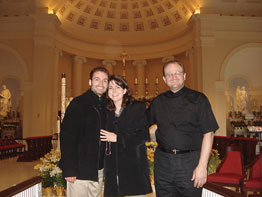

Almost every groom at the start of a Baltimore Basilica wedding chokes up and tears up as his bride walks down the aisle in the striking setting on Cathedral Street.

Almost every groom at the start of a Baltimore Basilica wedding chokes up and tears up as his bride walks down the aisle in the striking setting on Cathedral Street.

One of Deacon Charles Hiebler’s greatest joys as a permanent deacon is witnessing weddings. Working with young couples preparing to commit their lives to one another helps strengthen his own faith and life commitments, he said.

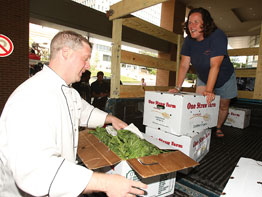
As “Farmer Joan” slid boxes of produce to the edge of her pickup truck, executive chef Anthony Cover opened one to peel back a head of romaine lettuce fresh from the farm to ensure it had a tight head and a bright green color.

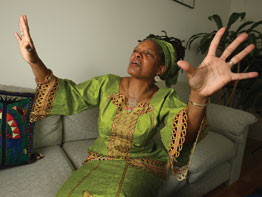
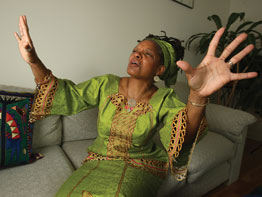
The art of storytelling goes back to the beginning of human history. And though just about anyone can tell a story, few can bring them to life like Janice Curtis Greene.

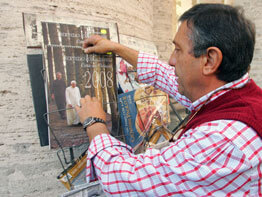
VATICAN CITY – Catching a glimpse of Pope Benedict XVI at the Vatican this summer will be more difficult than ever.
George Weigel reminds us in his latest column (CR, June 19) that there was indeed a time, not so long ago, when the bishops of America were willing to seriously discuss important issues of peace and justice. I agree with him that “Today, it is virtually impossible to imagine the bishops’ conference taking on a project of the magnitude of ‘The Challenge of Peace.’”
Mr. Weigel explains to his readers (CR/June 26) that “improving U.S. diplomacy in the world of competing ideas of a just society must be the priority of the next Administration.”

The art of storytelling goes back to the beginning of human history. And though just about anyone can tell a story, few can bring them to life like Janice Curtis Greene.

If there’s one thing the Podhorniak family knows, it is how to get things done.

One of Deacon Charles Hiebler’s greatest joys as a permanent deacon is witnessing weddings. Working with young couples preparing to commit their lives to one another helps strengthen his own faith and life commitments, he said.
Although I have lived in the Washington, D.C., area since 1984, I am an orthodox Baltimorean by birth, nurture, education, baseball loyalties, and a settled disdain for offering tartar sauce with crab cakes. So I should be the last person to think the unthinkable about my native city’s principal contribution to American public culture (after, of course, the Colts’ sudden-death victory over the New York Giants in the 1958 NFL championship game). Nonetheless, I shall risk the charges of heresy and treason by proposing the following thought experiment: as America celebrates Independence Day, let’s ponder a switch in national anthems, substituting “America the Beautiful” for the poem Francis Scott Key wrote during the British bombardment of Fort McHenry in Baltimore harbor during the War of 1812.
The proud observance of July 4 is enriched by our growing awareness of the extent to our dependence on one another, as individuals and as a group. The other big current jawbreaker, globalization, reinforces our mutual need for one another. This is not a new phenomenon, but the news of the day drives it home forcefully in ways not quite so urgent for prior generations. It has come as almost a shock, to many, that we as a nation are not self-sufficient in the matter of fuel. Two huge competing customers, China and India are suddenly in the picture, for example. Besides, the link between fuel and food has grown more crucial as populations grow along with expectations of more and better nutrition around the world, but most particularly now that the same substance, corn, serves as both fuel and food. The added incentive to cut down on air pollution only exacerbates this note of competition, with no easy solution in sight. (Our tendency to see billionaires cleaning up on all this gives us that familiar helpless feeling…) We pretty clearly, as a nation, cannot quite go it alone in the style to which we have grown accustomed.