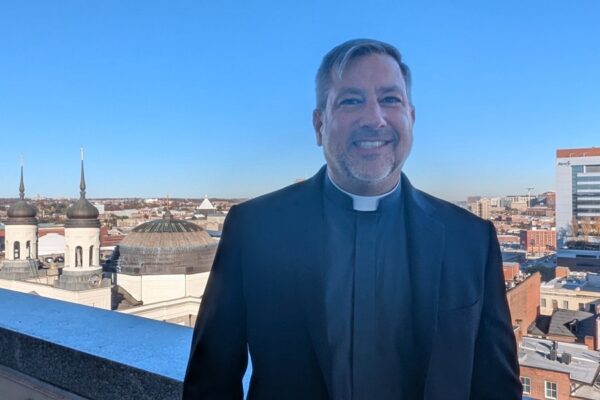

The Church’s mission is sustained every day by people who share their gifts through prayer, generosity, and service. Deacon Andrew Lacovara has witnessed that reality throughout his ministry and believes everyone has a role to play.
“Everybody has a gift,” he says. “Figure out what yours is, and use it in service to God and his Church. Don’t convince yourself you don’t have time or talent. Recognize what you’ve been given, and give it back.”
Whether serving patients at Mercy Medical Center, accompanying people through prison ministry, or helping build new ministries in Baltimore City, he has seen how lives are changed when people choose to share what God has given them.
For him, the gift that defines his own ministry is presence.
In ministry, each door Deacon Andrew Lacovara walks through leads into the unknown: a hospital room, a prison cell, a place where pain and hope often meet. He never knows what he will find. Without a script or certainty, he carries only a simple prayer: “Holy Spirit, keep me from doing anything stupid. Keep me from making something worse.”
It is in those moments, when words fail and presence must speak for itself, that he understands what it means to serve.
Deacon Lacovara grew up in Washington, D.C., the youngest of seven children in what he calls an “old-school Italian Catholic family.” Faith was woven into daily life. He attended Catholic school, served at the altar, and was influenced by priests who showed him that a vocation could be joyful and deeply connected to the needs of others.
His path to ministry was anything but conventional. After studying art history and classics at New York University, he worked in archaeology and later led an underwater inspection division that evaluated bridges and dams across the country. Yet even as his career developed, the call to serve remained quietly present.
That call became clearer through parish life in Baltimore. Teaching confirmation classes challenged him to deepen his own understanding of the faith.
“When students asked, ‘Why do we believe this?’ I had to go find out,” he said. “It made me take the faith seriously, both intellectually and personally.”
Encouraged to consider the diaconate, he discovered that what attracted him most was service to the poor, the imprisoned, and the sick.
A Ministry of Presence
Early in formation, Lacovara volunteered in prison ministry at one of Baltimore’s maximum-security correctional facilities.
“You never know who’s on the other side of the door,” he said.
Later, he began serving in hospital chaplaincy at Mercy Medical Center, a ministry he continues today.
“There are questions you can’t answer,” he said. “When someone asks, ‘Why would God let this happen?’ all you can do is be present. Each encounter reminds me of the dignity of every person, made in the image of God.”
Service in the City
Today, Lacovara serves at the Basilica of the Assumption and St. Ignatius Church while also supporting ministry efforts throughout Baltimore City. “There’s no lack of opportunities for service in the city,” he said. “Everywhere you look, there are people in need, physically and spiritually. The call is to show up, to listen, to treat them with dignity.”
That conviction shapes the way he approaches every encounter.
“Sometimes people just need to know they’re not an afterthought,” he said. “They need to feel like they’re the most important person in the world in that moment.”
For Lacovara, hope is found in those one-on-one encounters.
“You can’t fix everyone,” he said. “Sometimes you can’t fix anyone. But you can treat them with respect. You can be present. And that’s where grace shows up.”
The Gift of Presence
For Deacon Andrew Lacovara, hope is found in people who answer God’s call, accompany others in their struggles, and offer their gifts in service to others.
Through his ministry, he has come to see that some of the most important gifts are not measured by budgets, programs, or accomplishments. They are found in the willingness to listen, to accompany, and to remain present when someone is hurting.
Whether in a hospital room, a prison ministry visit, a parish community, or a conversation on a city street, he has seen how God works through those simple acts of faithfulness.
In the end, the gift he speaks about is not simply what we give. It is the gift of presence.
