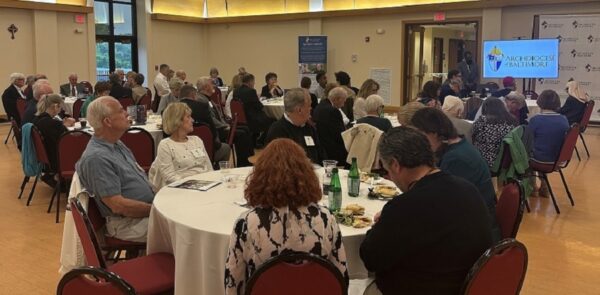

 On two spring evenings this May, two parishes, St. Joseph in Fullerton and Holy Family in Davidsonville, opened their doors for gratitude.
These weren’t typical receptions. There were no head tables, no awards, no program booklets. Instead, there were simple conversations over light fare, familiar faces from across parish lines, and a warm spirit of shared mission. These were “thank you” gatherings. Quiet celebrations of generosity for those who have sustained the Archdiocese of Baltimore’s ministries.
But beneath the surface of these receptions were stories. Deep, sometimes hidden stories, that revealed the real impact of giving. From family formation to prison chaplaincy, campus ministry to confessionals turned classrooms, each speaker painted a portrait of faith alive and changing lives in Maryland.
At St. Joseph Church in Fullerton, Father Jesse Bolger stepped to the podium, not just as pastor, but as witness.
“I just want to share a quick testimony,” he began, glancing around the familiar church hall. A month earlier, the parish had hosted the Catholic Men’s Fellowship Conference. “Over 700 men attended,” he said, “and we turned our classrooms into confessionals. I mean, dozens of men going to confession at the same time. It was stunning.”
Then he paused. “Archbishop Lori arrived mid-morning, and before he said a word to the crowd, he put on his stole and started hearing confessions. For an hour.
Moments later, the crowd sang “Happy Birthday” to the Archbishop, who smiled as candles flickered on a modest sheet cake. It was, by coincidence, his birthday.
Then came Stacy Golden.
Grounded with a warmth that disarmed the room, Stacey stood at the podium not as a bureaucrat, but as a convert. “I was welcomed into the Catholic Church as a young adult through RCIA—what we now call OCIA,” she said. “It wasn’t a transformative experience. It was in the basement of the rectory. I left with knowledge but not fire.”
She looked around the room. “But I’m still here, 32 years later. And I want more for those coming into the Church today.”
Now Director of Family, Youth, and Young Adult Ministry for the Archdiocese, Stacy has shaped a vision rooted in the Eucharist and family-based formation. “We can’t just teach kids and expect their families to catch on,” she said. “We have to form the entire family.”
Thanks to the Annual Appeal, her small team is doing just that. She spoke of investing in campus ministries at UMBC, supporting marriage preparation, and ensuring scouting and sports are authentically Catholic. “We are not here to simply deliver content,” she said. “We are here to help people experience God.”
Then she offered a line that lingered with many in the room. “This is a time of great hope,” she said. “Not wishful thinking, but radical trust in God.”
Later, Archbishop Lori took the mic, his voice familiar and steady. “An annual appeal doesn’t make a lot of sense unless you believe in the Church’s mission,” he told the room. “And it’s clear you do.”
He cited numbers, 2.2 million meals served, $1.7 million returned to parishes, 60 seminarians, five Blue Ribbon schools, but his closing remarks were deeply personal.
“I’ve been here 13 years,” he said. “And sometimes people tell me I’ve changed things. But the truth is—you’ve changed me. For the better.”
If Fullerton gave voice to family and formation, Davidsonville revealed the quiet miracle of prison ministry.
Deacon Seigfried Presberry stepped to the mic, his cadence slow but strong, every word weighted by decades of experience. “I worked 25 years as a correctional officer,” he said. “And I saw how little spiritual care the incarcerated receive.”
He told a story about Christmas behind bars. “Most people don’t think about Christmas in prison,” he said. “But I watched grown men cry. They missed their kids. They missed their mothers. And I thought, What could we do to show them they’re not forgotten?”
He started collecting cards, just simple Christmas cards.
“People told me, ‘Deacon, nobody wants to write to prisoners.’ But we asked anyway. And then something amazing happened.”
He pulled a letter from his pocket. It was dated December 22, 2024. Archbishop Lori had written it to be read aloud at Christmas Masses in correctional facilities.
“Even though we are separated by physical walls,” the Archbishop wrote, “know that you are not separated from God’s love.”
Deacon Seigfried looked up. “One inmate heard that letter and said, for the first time in years it felt like God hadn’t forgotten him”
Since that day, the inmate joined Bible studies and begun helping other inmates explore the Catholic faith.
“This,” he said, “is the work your generosity makes possible.”
When Archbishop Lori rose to speak that night, his message was laced with global reflections—fresh from attending the funeral of Pope Francis and the inaugural Mass of Pope Leo. But he brought it home, too.
“Sometimes, people talk about the Church in decline,” he said. “But I see young people coming to faith. I see renewal. I see hope.”
And he reminded the room of its role: “This isn’t about a headquarters in Baltimore City. You are the Archdiocese. You, and the people you serve.”
From Fullerton to Davidsonville, the message was clear: ministry is happening everywhere. It’s happening in families, in schools, in confessionals. It’s happening behind prison walls. It’s happening because of the quiet faith and generosity of people who give not only their money, but their hearts.
At the end of the Davidsonville event, Archbishop Lori offered a final blessing. “May the Lord keep us in His love,” he prayed, “and may His Spirit lead us forward with joy.”
And so, across the Archdiocese of Baltimore, the Church moves forward, quietly, faithfully, visibly.
Thanks to you.
