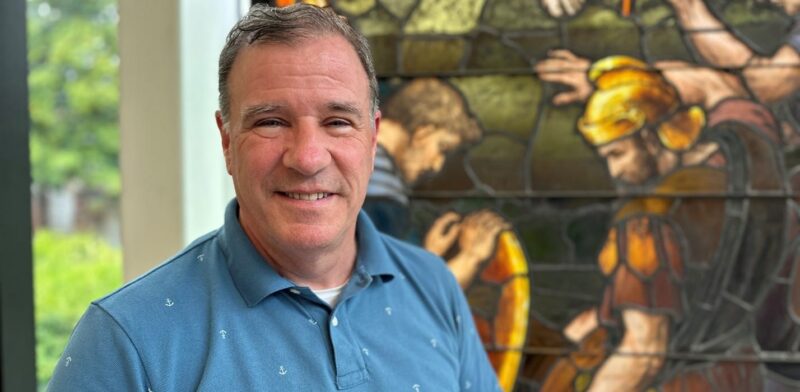

It was a gray afternoon in late September when I met Deacon Mark Cohagan in the narthex of Our Lady of Victory. The sky outside was overcast, but inside the space glowed with color from stained-glass windows, their reds and blues spilling across the floor. We sat at a round table in the warm light. He showed me around the church, moving easily through the familiar space. This is home base, where his ministry in Southwest Baltimore is lived, day in and day out.
Mark’s path to the diaconate was anything but straightforward. He was baptized Lutheran and spent his early childhood attending Sunday school before his family drifted away from church. By age nine, religion had all but disappeared from his daily life. Restless and independent, he found his footing in theater rather than sports, eventually meeting his wife in a community college acting class. She came from a Catholic family where faith was woven into ordinary life, Sunday dinners, conversation with grandparents, the quiet rhythm of Mass.
At first, he simply followed her to church, sitting in the pew as she went forward for Communion. Their children were baptized and enrolled in Catholic school. Faith seeped in gradually, not by argument but by example. It took a long time for him to claim it for himself. That moment came at the Easter Vigil in 2001, when he was confirmed and received his First Communion alongside his daughter. “She and I had our First Communion together,” he recalls. “It was a moment I’ll never forget.”
Life tested that new faith quickly. After 9/11, his business in communications and design collapsed as government contracts shifted, and his mother was diagnosed with cancer again. For a time, he wondered whether he had made the right choice in becoming Catholic. But he kept showing up at Mass, asking questions, listening. A Dominican sister once explained to him that the difference between Catholicism and every other denomination could be seen in a single flame: the sanctuary lamp beside the tabernacle. “If the light is lit, that’s the difference,” she told him. That image of the light became central to his faith.
WATCH DEACON COHAGAN SPEAK ON WHAT GIVES HIM HOPE
The idea of becoming a deacon did not come easily. He was reluctant, even resistant. On the very last day applications were due, he drove downtown to the Catholic Center in Baltimore to hand his in personally. He parked on Cathedral Street, hurried inside, and slid the packet across the reception desk, watching as it was laid on top of a tall stack of unopened mail. “I remember thinking, well, maybe mine will just get lost in there, and that would be fine,” he recalls. When he stepped back outside, the meter had run out and a ticket flapped against his windshield. “I thought it was a sign this wasn’t meant to be,” he laughs.
Later on in the process, he nearly gave up again when told he had to hand-write a formal letter in cursive. Every candidate, he learned, had to write their own promise of obedience to the archbishop, not typed, not dictated, but in ink, twice over, with signatures in proper script. For someone who had long since left handwriting behind in favor of keyboards, the requirement felt almost impossible. Still, he sat down with sheets of lined paper, tracing letters, scratching out mistakes, crumpling page after page. “It was like being back in grade school,” he remembers. At last, the letter was finished, imperfect but authentic, another step in a journey he never imagined would bring him this far, and ultimately he somehow understood the importance of this simple but profound task.
When ordination came, his assignment placed him in South Baltimore with Father Patrick Carrion. The city parish setting turned out to be a gift, a place where Mark discovered the richness and challenge of ministry. It was in the city that he grew most deeply as a deacon, learning that the call was not only to serve at the altar but also to carry the light of Christ into the everyday struggles and hopes of the community.
So what does a deacon do? As Deacon Mark explains, deacons embody service and charity in visible, practical ways. They proclaim the Gospel at Mass, preach homilies, baptize, witness marriages, and bring Christ into hospitals, prisons, schools, and neighborhoods. “Every priest is first a deacon,” he says. “Every bishop, every cardinal, they were all deacons first. We are the charitable arm of the bishop, the representatives of the community at the altar.”
Unlike priests, permanent deacons are not paid for their ministry. They volunteer their time while holding jobs and raising families. “Our first vocation is always our family,” he says. Expenses like retreats, vestments, or continuing education can be reimbursed, but the service itself is an offering of love.
For Deacon Mark, the work has meant everything from teaching students in a theater he helped design at Mount de Sales Academy, to preaching homilies that help parishioners see Scripture in new ways, to sitting beside those in hospital rooms or family struggles. “Every time you stand with someone in difficulty, it’s like hitting a wall in a marathon,” he explains. “But you keep going. You go through it with them.”
His conversion, he insists, is not a completed event but an ongoing journey. “It’s about reapplying everything I have been, what I am, and what I believe I’ll always be. To me, that is my continual conversion story.”
Sitting in the narthex, surrounded by the stained-glass windows, his words seemed to echo the space itself: colored light refracted and passed on. Deacons, he believes, are called to carry that light into the world, not as polished professionals, but as ordinary men whose lives testify to Christ’s presence in family, work, and community.
Day in and day out, deacons like Mark remind us what it means to live as Catholics: to serve, to proclaim, to accompany, to stand in the gap between despair and hope. They are among the Church’s greatest volunteers, leading us toward the light of Christ without asking for recognition or pay.
Deacon Mark often frames this call in the simplest of images. At home, he has his own chair by the window, just as his father and father-in-law did before him. From that chair he can look out, but until the window is opened he cannot truly hear or feel what is happening outside. “It’s okay to sit in your own chair,” he says. “But without opening the window, you won’t hear, you won’t smell, you won’t feel everything else. What is your window? What is it that you need to open?”
For him, that window is the community, the lives of people beyond the glass, where faith becomes action. His challenge to us is to open our windows too, to step out of comfort and into the world, carrying the light of Christ to those who need to see it most.
Perhaps the best response is simple. Thank your deacon. Pray for him. Consider whether you, or someone you know, might be called to this ministry. And support the formation that allows men like Deacon Mark to serve.
The sanctuary lamp burns steadily in every Catholic church. It is more than a light above the tabernacle. It is a flame carried by those who step forward in faith, reminding us that Christ’s presence endures, and that there is always the true light of hope.
