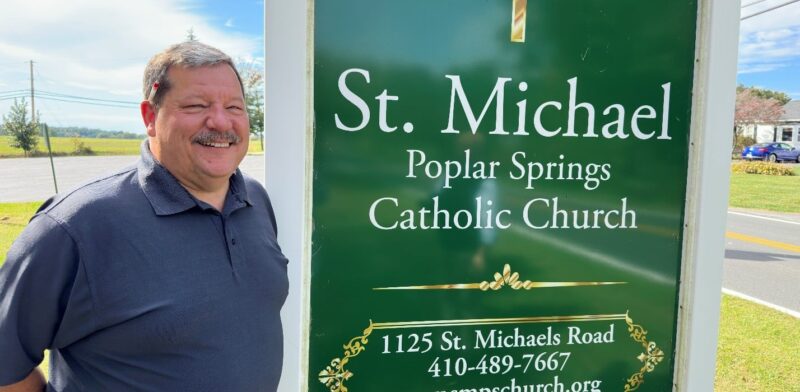

On weekday mornings at St. Michael, Poplar Springs, before the phones ring and meetings begin, Brian Crompwell can often be found with a cup of coffee in hand, walking the grounds. He checks in with the facilities manager, making sure the preschool classrooms are safe, the lights are working, and the small but vital details of parish life are in order. Seventy children gather in those classrooms each week, and for Brian, their safety and well-being are part of the mission. It is an ordinary ritual, but one that reveals the larger story of a man who has spent his life weaving together faith, work, and service.
Brian grew up in Kirkville, a small town on the Erie Canal near Syracuse, New York. The second of nine children and the oldest son, his early years were shaped by a household full of siblings, faith, and the unexpected burden of responsibility. His father, a Catholic, died when Brian was only thirteen. His mother, forced into the workforce, leaned on her eldest children to hold the family together. Brian and his sister became parents overnight, making meals, supervising homework, tucking in younger siblings. “Life can throw you a curve at any moment,” he says. “That was a big one for me. But I look back and wouldn’t have changed anything. It shaped who I am.”
The church, and the people in it, helped carry them through. Friends’ families, neighbors, and parishioners provided guidance and support. One friend’s father, a Catholic, became an anchor and mentor. Brian began attending Mass with him, drawn to the rhythm and structure of Catholic worship. Though baptized both Protestant and Catholic, he began to fully embrace the Catholic faith as his own.
VIEW WHAT GIVES BRIAN HOPE
At Le Moyne College, a Jesuit school in Syracuse, faith deepened into habit. When life was difficult, he found solace in the chapel or conversation with a priest. “That structure helped form who I am today,” he says.
After college, Brian’s path wound through accounting, teaching, and eventually the media world. He managed business operations at a Fox affiliate in Syracuse and later joined a radio group during the boom years of deregulation. Radio taught him something lasting: the discipline of creative problem-solving. When a client struggled, the question was never what would not work, but rather, “In what ways can we…?” It was a framework that shaped his outlook on work and life. “I’ve always used that,” he explains. “In what ways can I make this work? That’s made me successful.”
The media industry, however, was volatile. Mergers and acquisitions dissolved positions as quickly as they created them. Brian moved through television, radio, financial services, and even newspaper distribution, navigating layoffs and closures with persistence and faith. At one nonprofit radio station, he found a sense of belonging again, staying nearly twelve years. The experience confirmed what he already suspected: he thrived when his work served a mission larger than profit.
When another transition arrived, Brian began to ask himself a deeper question: how do I want to finish? He prayed, reflected, and listened. “What kept me at that station for twelve years?” he asked. “It was the nonprofit side. It was having a mission in your life.” He realized he wanted to bring that sense of mission into his work every day. The answer was the Church.
Now, as Director of Parish Operations at St. Michael Parish, Brian uses his gifts in accounting, management, and problem-solving to ensure the parish can do what it exists to do: save souls, form disciples, and serve its community. His responsibilities are wide—budgeting, supervising staff, overseeing maintenance, supporting ministries—but the mission is clear. “I feel like I’m using my talents now to go above what I’ve done for myself and my family, to do it for others,” he says.
The parish staff gather each morning for a short huddle. Everyone names their “color”— green, yellow, or red—a shorthand for how they are doing that day. It could be workload, personal struggles, or simple fatigue. For Brian, this daily ritual is a reminder of how small practices build understanding and strengthen community. “It’s really cool,” he says. “It’s little stuff like that that makes this place work better, smarter, not harder.”
His own heart is especially tied to outreach. Having grown up in a family where his mother struggled and the church stepped in, he feels deeply connected to helping the less fortunate. As a young adult, he volunteered with Meals on Wheels, Habitat for Humanity, and the Red Cross. Today, he sees parish outreach ministries as extensions of that same work, the Church serving as family for those who need it.
Asked why someone should give to the parish, Brian does not hesitate. “Our mission here is to get people to heaven. We want to foster an environment that does that. And from the operational standpoint, this is a good place to worship. It has a future. When I see young families here with children, I know the Church will continue.”
He is proud of the history of St. Michael Parish, the chapel dating back to 1879, the parish serving generations. His role, he believes, is to keep it strong for another 150 years. Stewardship of resources is part of that. He has supervised more than thirty audits in his career, all clean. Efficiency matters, but never at the expense of mission. “Dollars are precious,” he says. “You have to take care of them and get the most value. But don’t lose sight of why you’re here.”
Brian has found meaning in the small victories, like restructuring the offertory counting process so volunteers finish in a fraction of the time, respecting their service without compromising integrity. Or simply knowing the lights are on, the heat works, the preschool is safe, and ministries can flourish.
Looking back, Brian sees the hand of God guiding him through careers, setbacks, and new beginnings. What began in a small town with nine siblings and a sudden loss has become a life of resilience and service. “Trust,” he says simply. “Trust that you’re trying to do the right thing. That’s what has carried me.”
For Brian, that trust is now grounded in the mission of the Church. Every offertory gift, every act of generosity, fuels the work that drew him here. “I want this to be my last job,” he says. “I want to follow the mission.”
And this is where you come in. When you give to your parish, you are helping people like Brian ensure that the doors are open, the ministries flourish, and the faith is passed on. You are part of the story that keeps parishes strong, a story stretching back generations and looking ahead to generations yet to come.
Each time you place your gift in the offertory, you are not only caring for buildings and budgets, you are sustaining a mission that saves souls, serves the poor, and welcomes young families who will carry the Church forward. You are helping to make sure that your parish will continue to be a place of worship, community, and hope for years to come.
This is the good news of being Catholic: together, we build something larger than ourselves. Together, we keep the mission alive.
