
As the holiday season begins and we celebrate the season of togetherness, many keenly feel the absence of loved ones who are no longer with us. Amid the lights and gatherings, grief can feel especially heavy. Through handwritten notes, shared prayer, and gentle presence, those who serve in bereavement ministry remind grieving families that they are not alone, and that love, like Christ Himself, endures beyond loss.
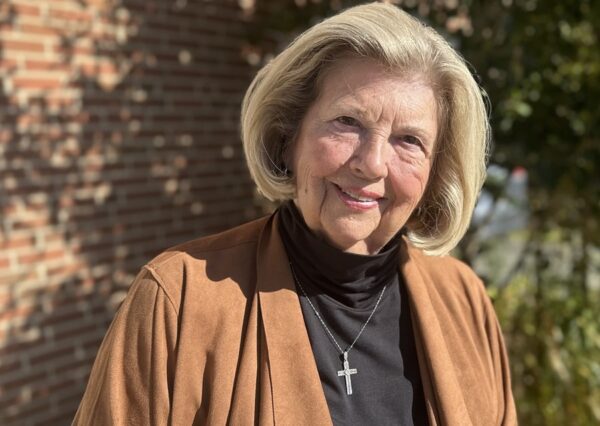
“If only one person walks away feeling the love of God or the support of their church family, then it’s all worth it.” That quiet conviction has guided Nancy McMahon VanPopple through a lifetime at St. Stephen Catholic Church in Bradshaw, where her faith has deepened through joy, service, and heartbreak. Her parents joined the parish in 1950 when they moved to the area. “My father found St. Stephen’s first,” she said. “Then we bought a house, so we centered around our faith.”
Nancy grew up attending the parish school, taught by Franciscan Sisters, whose example left a lasting imprint. “We are St. Stephen’s, but we are Franciscan,” she said. “We are a giving parish. We help anyone.” That spirit has shaped her life ever since.
She met her husband, Bill, in the school auditorium when they were both fourteen. They became class officers and friends before falling in love. They were married in 1965, and this November marks sixty-one years together. “The most important thing is to listen,” she said with a laugh. “That’s how you make it through sixty-one years of marriage.”
Nancy’s life has been intertwined with her parish in countless ways. She has served as a faith formation teacher, a corporator, a choir member, and even a builder of parade floats for the parish’s 150th anniversary celebration. “We’d never been in the Kingsville parade before,” she said. “The first year we won first prize, the second year second prize. And we honored the Sisters of St. Francis. I was told those pictures went all over the world. They said no one ever thanks them.”
But her most meaningful ministry began in grief. Nancy’s daughter, Amy, passed away from breast cancer in 2013 after a four-year battle. “I had a big fight with God,” Nancy said quietly. “She was in her early forties, with two children. They said she was cured, and then it came back. I prayed so hard, but when she got really sick, I leaned on Him again and said, ‘It’s your will. Whatever your will is, I’ll follow you.’”
Her church family helped her through the darkness that followed. “When you have a death, just getting up in the morning can be hard,” she said. “My church family helped me and my faith.” The cards, prayers, and small acts of love she received after Amy’s death became lifelines. “One card changed everything,” she said. “It was from a woman named Patty O’Brien, and it said, ‘May your daughter never be forgotten.’ I still have that card on my refrigerator thirteen years later. That one note started everything.”
That simple act of compassion led Nancy to the parish’s Bereavement Ministry, a small but powerful group founded by Sister Angela DeFontes, Mary Morgan, and Kellie Reynolds more than a decade ago.
 “We meet people where they are,” Nancy said. “If they need to talk, we listen. If they need to cry, we cry with them. Whatever they need, we try to provide.”
The ministry is not one person’s work; it’s a team of hearts joined in service. “This isn’t about me,” Nancy insisted. “We are a team. Sister Angela is our leader, Mary has a nursing background, Kellie helped form the ministry, and Chuck Belzner works with the men’s groups. We all have different gifts, and together we make it work.”
The group has now guided fourteen small circles of grieving parishioners through a journey of prayer and healing using A New Day Journal: A Journey from Grief to Healing by Mauryeen O’Brien as a resource. “We don’t go page by page,” she said. “If someone wants to jump ahead, we do.” Meetings begin with prayer and a simple ritual: each person decorates a small votive candle holder with symbols that remind them of their loved one. “It helps break the ice,” Nancy said. “Someone might draw an Oriole for her husband who loved baseball, or a rainbow for Sister Angela’s brother. It helps them start talking, and it brings light back into the room.”
Nancy has learned that grief doesn’t follow a straight line, and it doesn’t end after the funeral. “The first year, you feel numb,” she said. “I think that’s a gift from God. You can’t take it all in, and He gives you a little bit of protection. But the second year, that’s when it hits you. That’s when the reality sets in that this is permanent, and that’s when people really need support.” It’s one reason the Bereavement Ministry continues reaching out long after a loss, sending cards, making calls, and keeping families close in prayer.
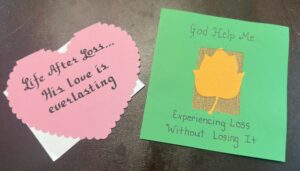
The ministry also organizes remembrance gatherings throughout the year, including a Valentine’s Day event called Life After Loss. “It started when a woman said she would never get another rose,” Nancy said. “So we gave everyone a rose that day, a sign that God’s love is everlasting.”
The most personal part of the ministry’s work is sending handwritten cards to families on the anniversaries of their loved ones’ deaths. “We used to do it for five years, but now we do three because of cost,” Nancy said. “We have a parishioner who gives us money for stamps, and that keeps it going.” Each card is signed by the bereavement team and, as a small but meaningful sign of shared faith and community, includes the names of both parishes in the pastorate, St. Stephen and Holy Spirit.
Nancy has seen firsthand how those simple notes can bring comfort and renewal of faith. “A young woman who had stepped away from the Church wrote back after receiving one of our cards,” she said. “She said it picked her up when she was struggling and she came back to church. What a rejoicing moment that was for all of us.”
Some people who come to the ministry arrive so deep in grief they can hardly speak. “We’ve seen people who couldn’t get out of bed and start living again,” Nancy said. “Some find best friends through the group. You share your soul in that room, and something changes.”
Over the years, the ministry’s quiet outreach has also inspired greater participation in parish life. Many who first came seeking comfort have gone on to rejoin ministries, volunteer for parish events, or simply return to Sunday Mass with renewed faith. In accompanying others through grief, they’ve found themselves reconnected to the heart of the Church, a sign of how compassion can spark both healing and belonging.
The ministry knows when to reach out for professional help, too. “Sometimes grief becomes too heavy, and we help them find counseling,” Nancy said. “We know our limits, but we never stop praying for those who are suffering loss.”
For Nancy, bereavement work has become a spiritual calling and a way of seeing God’s presence in sorrow. “This ministry helped me understand the Holy Spirit,” she said. “I can feel Him coming from all directions now.”
Nancy also serves in the parish’s Resurrection Choir, which sings at funerals. “Sometimes only a few people are there,” she said. “But our voices fill the church. We celebrate their life, even if there are just five mourners.” She remembers looking up at the choir during her daughter’s funeral and seeing the faces of her friends singing. “That day, I told God I would join that choir. And I did.”
Looking back, Nancy says she can see how God worked through it all, through heartbreak, friendship, and the quiet persistence of faith. “I fought with God, but He never left me,” she said. “He sent people, my church family, Sister Angela, that card on my refrigerator, to remind me He was there.”
Nancy believes the strength of Bereavement Ministry comes not from any one person, but from the way the parish comes together to care for one another. “We are a team,” she said again. “And the church itself is part of that team. The priests, the volunteers, the parishioners who give so we can buy cards and stamps, every bit of it matters.”
Across the Archdiocese of Baltimore, ministries like this are quietly at work in parishes just like St. Stephen’s, bringing comfort to those who mourn, hope to those who struggle, and the love of Christ to those who need it most. It’s what the Church does best: showing up, listening, and staying present.
These ministries are possible because parishioners choose to give of themselves through financial support, volunteer hours, and acts of faith that ripple far beyond the church walls. When we give, we make space for grace to reach someone in their greatest hour of need.
