
Blessing of The Brick Chapel
Internment of Remains
St. Mary’s City, Maryland
September 20, 2025
Greetings and Gratitude
It is a pleasure to return to St. Mary’s City, this time to bless the interior of the Brick Chapel and also to bless and re-inter the remains of those who have gone before us in faith and patriotism. Let me thank Dr. Henry Miller together with your colleagues. Dr. Miller, your excellent scholarship and indefatigable efforts have yet again brought us together to celebrate the religious and civic heritage of the Free State and we are most grateful.
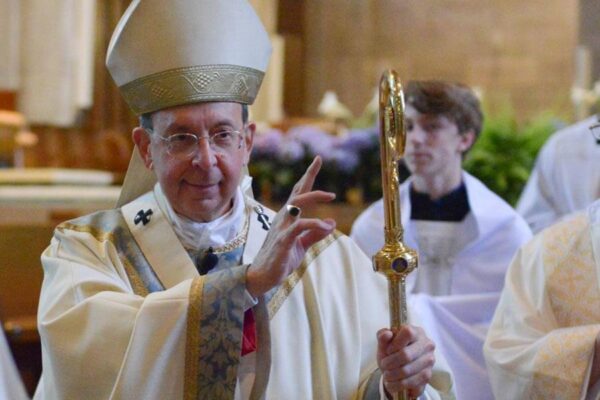
This morning, I decided to wear the pectoral cross that belonged to America’s first bishop, John Carroll of Baltimore. It is a link to the history that we celebrate, for John Carroll’s forebears worshipped on this site and were among those who memory we lovingly keep on this important day.
What Brings Us Together?
Let us take a moment to reflect on what brings us together this morning. The remains that we shall prayerfully and lovingly bury in this space, together with The Brick Chapel itself, bring us back to fundamental truths and values that all of us – no matter our background, our religion, or our political leanings—should regard, not only as self-evident but as a precious gift of Divine Providence, namely, the gift of our fundamental freedoms. We recall what President John F. Kennedy said in his Inaugural Address: “. . . the rights of man come, not from the generosity of the state, but from the hand of God.”
Those whom we re-inter this morning were on the ground floor of what President George Washington called “the great experiment”. They were buried between the 1630’s and circa 1740, including Philip Calvert, Fifth Governor of Maryland, Anne Wolsley Calvert, and their infant son, together with many others. For them, Maryland itself was an experiment in religious liberty as well as an “incubator” of human rights such as freedom of conscience and freedom of speech, as well as toleration, reason, and morality that must accompany and sustain those rights. Like us they had flaws and blind spots and they experienced struggle, turmoil, and setbacks. Yet they persevered, setting the stage for what was to follow.
The Founders of our country called the United States an experiment, not only because we were a fledgling country, but because they knew how fragile human freedoms are and how challenging self-government would be. When asked if the Federal Constitution of 1787 was a republic or a monarchy, Benjamin Franklin famously replied, “A republic, if you can keep it.” How many times our republic with guaranteed liberties has been challenged. And how profoundly it is being challenged in the current climate where ideological extremes of all ilks drown out voices of toleration, reason, and good-will. Those whose memory we keep today – whose remains we inter in the replica of the chapel where some of them worshipped – they tell us that violence, intolerance, and harsh rhetoric undermine the experiment in whose founding they played an indispensable role. As the United States looks to its 250th anniversary, let us ask these souls to pray for us from their place in eternity, that we might find the wisdom, courage, and virtue to mend our societal wounds and thus rebuild our political culture.
Re-buried in a Chapel
As most of you recall, the remains of these noble souls were disinterred when excavations began that would lead to the recreation of the Brick Chapel where we have gathered to reflect and to pray. As Cardinal James Hickey’s priest-secretary, I happened to be present when the lead coffins were disinterred so that this site could be studied afresh and the project of building the chapel could move forward. Now, after more than thirty years, we commit their remains to this very chapel.
The place of recommittal is itself significant. For while this chapel is no longer a Roman Catholic parish church, and is no longer used for regularly scheduled religious services, it does stand as a testament to the deep-seated quest of these noble souls for religious toleration and indeed for religious freedom as a fundamental, God-given freedom, at the heart of human dignity itself.
Like all our God-given freedoms, religious freedom is as precious as it is fragile. Even if not denied or banished, it can be marginalized, ridiculed, and assaulted in a secular society, especially at a time that will not be remembered for kindness and toleration. It is only when religious freedom is practiced and lived that it grows strong. As we re-commit these our forebears to their place of rest, let us re-commit ourselves to the protection of religious freedom, overcoming threats that arise from law, policy, or culture.
May this chapel remain for all time a hallowed place and may the souls of the faithful departed, through the mercy of God, rest in peace.