
In Charity and Truth: Francis at Eight Hundred & the Renewal of Hope
Transitus of St. Francis of Assisi
Conventual Franciscans, Ellicott City
October 3 2026
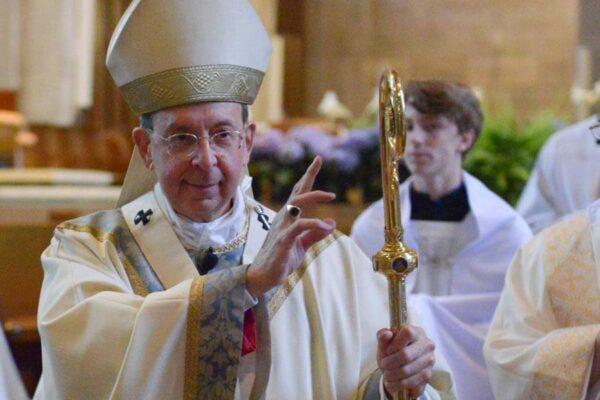
This is a longer version of the reflection Archbishop William E. Lori gave at the prayer service marking the 800th anniversary of the Transitus of St. Francis of Assisi from earthly to heavenly life.
My dear Franciscan brothers – Peace and all good! This evening we gather in a sacred moment. We gather not merely to remember a death that occurred eight centuries ago. We gather to accompany a saint on his final journey. We gather for the Transitus of Francis – the passage of the Poverello from this world into the embrace of the Father.
For eight hundred years, friars, sisters, and lay faithful have paused on this evening to listen again to the story. We hear of the little poor man lying upon the bare earth. We hear of the reading of the Passion. We hear of his final blessing. We hear of the singing of Psalm 141. And we hear once more the words that summarize his life: “I have done what was mine; may Christ teach you what is yours.”
Those words have echoed through eight centuries. Tonight they echo again. For this anniversary is not merely about Francis. It is about us. It is about what Christ is asking of the Franciscan family today. It is about what kind of witness is needed from the sons of Francis in an age marked by division, anxiety, loneliness, and distrust. It is about what it means to live the Gospel in a wounded world.
Remembering Francis Correctly
Anniversaries can tempt us toward nostalgia. We remember beautiful stories – the wolf of Gubbio, the birds, the Christmas creche at Greccio, the Canticle of the Creatures, and the stigmata on Mount La Verna.
All of these matter. But if we remember Francis only sentimentally, we misunderstand him. Francis was not a religious mascot. He was not a medieval environmentalist with a bird feeder. He was not a harmless dreamer.
He was a radical disciple of Jesus Christ. His life began not in success but in conversion. The Francis whom we celebrate tonight was first a young man captivated by status, recognition, and worldly ambition. The Francis whom we celebrate tonight first had to be broken open by grace. The saint emerged because the sinner was willing to be converted. That remains the enduring power of his witness. Francis reminds us that holiness begins when we stop managing our lives and start surrendering them.
A Wounded World and a Wounded Church
Eight hundred years later, Francis speaks with surprising relevance. Our culture possesses extraordinary technological power yet often struggles to answer basic questions about meaning. We communicate constantly yet experience profound loneliness. We have unprecedented access to information but often find ourselves uncertain about truth. We speak frequently about rights but less frequently about responsibilities. We debate endlessly but struggle to listen.
In my pastoral letter from earlier this year entitled: In Charity and Truth, Toward a Renewed Political Culture, I described what I call a wounded political culture. We see signs of that wound everywhere. People increasingly define themselves by opposition. Public discourse becomes anger rather than argument. Disagreement becomes suspicion and relationships become fragile.
The result is not merely political dysfunction – it is spiritual exhaustion. The deeper crisis is not ideological, it is anthropological. We have forgotten who we are. And whenever humanity forgets who it is, Francis appears surprisingly contemporary. Because Francis knew that the answer to fragmentation is not ideology – it is conversion.
Francis and the Gift of Fraternity
One of the most remarkable aspects of Francis’s life is his insistence on fraternity. He did not found an institution first – he formed brothers. He understood something that our culture often forgets. The Gospel is not lived alone; it is lived together. The friars who gathered around Francis were not united by personality, politics, education, or social class. Many of them had little in common. What united them was Christ.
Today that witness may be more necessary than ever. We live in a society increasingly organized into tribes. People sort themselves into communities of agreement. Algorithms reinforce preferences, social media rewards outrage, and difference becomes threatening.
Francis proposes another way. The Franciscan tradition insists that communion is possible without uniformity. Brothers can disagree without becoming enemies. Differences need not destroy fraternity. Charity need not require compromise of truth. Truth need not require abandonment of charity. This insight lies at the heart of the Gospel. It also lies at the heart of the pastoral letter I referenced earlier. Charity and truth belong together. Separated, they become distortions, united they become a path toward renewal.
Francis understood this instinctively. He was capable of remarkable tenderness and remarkable clarity. He loved sinners without approving sin. He embraced the poor without romanticizing poverty. He preached peace without surrendering truth.
The Courage of Humility
Perhaps the greatest gift Francis offers our age is humility. Humility is badly misunderstood. Many people think humility means thinking poorly of oneself. Francis shows otherwise. Humility means seeing oneself truthfully before God. Humility liberates us from the exhausting task of self-construction. Francis knew he was not the center of the story – God was. That realization made him free.
The Church today continues to learn this lesson. Like every human community, we carry wounds. We bear memories that require repentance. We acknowledge failures that have damaged trust and credibility.
The answer is not denial – the answer is humility. Francis never feared the truth. He never protected his reputation at the expense of reality. He stood before God as he truly was. That is why his witness remains credible.
The future of evangelization will depend less upon our ability to defend ourselves and more upon our willingness to be transparent, humble and faithful. Humility does not weaken the Church – humility purifies her witness.
Peace in a Time of Fear
Francis lived during an age of violence. Crusades shaped the political landscape. Conflict marked relations between peoples. Fear, more often than not, drove decision making. His response was remarkable. Francis crossed battle lines. He met the Sultan. He sought dialogue where others expected hostility. He believed peace required courage.
That witness speaks powerfully today. We inhabit a world marked by geopolitical instability, conflict, and uncertainty. Wars continue to devastate innocent lives. Communities experience fear and displacement. Francis reminds us that peace is not passive. Peace is an active vocation. Peace requires listening, peace requires restraint, peace requires courage, and peace requires seeing the image of God in those we may regard as enemies. The Church’s commitment to peace is not naïve idealism – it is confidence that Christ has already overcome the divisions that humanity continually recreates.
The Meaning of the Transitus
Tonight’s celebration offers yet another lesson. The Transitus is not fundamentally about death – it is about hope. Francis approached death with remarkable serenity. Not because suffering was absent. Not because weakness was absent. Not because uncertainty was absent. But because Christ was present.
Francis called death “Sister Death.” As you know, that phrase often surprises the modern ears, and yet it reveals something essential. The Christian does not confront death as an enemy who has ultimate power. The Christian confronts death as a doorway already opened by Christ.
At the end of his life Francis possessed very little – no wealth, no influence, no worldly security – yet he possessed everything that mattered. He possessed Christ and that was enough.
The Eighth Centenary as Examination of Conscience
An anniversary should always provoke reflection. The Church understands this well. Every jubilee asks us to remember, repent, and renew. So tonight, eight hundred years after Francis’s death, we might ask ourselves the following questions: Have we preserved his spirit or merely his memory? Have we embraced poverty of spirit or simply admired it? Have we become instruments of peace? Have we cultivated genuine fraternity? Have we remained close to the poor? Have we lived charity and truth together? Have we trusted Christ enough to follow him radically? These questions are not only for Franciscans. They are questions for the entire Church. But they carry special urgency for those who bear Francis’s name. The world does not need Franciscan museums. The world needs Franciscan witnesses.
A Word of Gratitude
Allow me to express gratitude tonight. Thank you for your witness here in the Archdiocese of Baltimore. Thank you for your fidelity and service to the poor. Thank you for demonstrating that fraternity remains possible. Thank you for reminding the Church that simplicity is not weakness and that joy can coexist with sacrifice. The Church needs Franciscan friars perhaps now more than ever.
A Word of Hope
As we conclude this anniversary year it would be easy to focus on challenges. Religious life faces difficulties. Our culture faces uncertainties. The Church faces significant questions. Yet Francis teaches us something different. Hope is not optimism. Hope is confidence in God. When Francis looked upon the broken church of San Damiano he saw possibility. When he looked upon lepers he saw Christ. When he looked upon poverty, he saw freedom. When he looked upon creation, he saw gift. When he looked upon death, he saw passage to new life.
The same Christ who transformed Francis continues to work in the Church today. The same Spirit who renewed the Church through one humble saint remains active. The same Gospel that captivated Francis still possesses the power to convert hearts. So tonight, as we remember his passing, let us hear again his final challenge: “I have done what was mine; may Christ teach you what is yours.” Eight hundred years later those worlds are still addressed to us. May Christ teach us what is ours to do. May He teach us how to live charity and truth together, may He teach us how to be brothers, and may He teach us how to become instruments of peace. And may St. Francis of Assisi, now rejoicing in the Father’s house, intercede for us until we too make our own blessed transitus from this world to the next.
Pax et Bonum!