
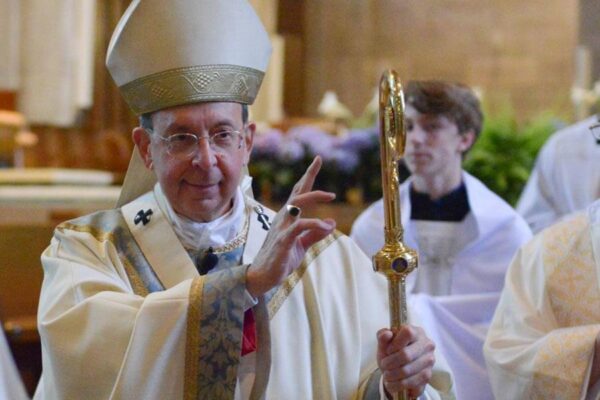
Red Mass
Saint John the Evangelist
Frederick, Maryland
October 22, 2025
Celebrating America’s 250th
In a matter of months, the United States will celebrate its 250th anniversary. Many celebrations will take place throughout the breadth & length of our land: flag displays, parades, speeches, fireworks, picnics, and much more. But it will also be a moment for us to unite in prayer as a Nation for our Nation. Surely we will pray for peace and prosperity. Surely we will pray that our Nation will long endure. Surely we will pray that our country will live up to its noblest ideals.
If our prayer is sincere, God will hold up a mirror before our eyes. The Lord will allow us to see ourselves as we really are – with our strengths and weaknesses, our virtues and vices. In sustained prayer, we will absorb God’s wisdom as we discern what we must do in the years ahead to preserve, protect, and defend the Republic we have inherited, with its Constitution, its laws, and its guaranteed rights and freedoms.
Do we not recognize that much needs to be done? Indeed, the rising tide of political violence is alarming. The slaying of Minnesota state legislators. Threats against judges. Threats of violence against political opponents. Violence directed against ideological opponents. Political polarization to the point of paralysis. The weaponization of the law. The unreliability of the news we consume. Honestly, I don’t mean to depress or infuriate you. I’m simply saying that, as we approach America’s 250th anniversary, we need to set about rebuilding our political culture and restoring the structures of our society that are essential for peace, justice, and security.
If you agree, then perhaps we can consider two questions: First, how does faith and Catholic Social Teaching guide us in this project of mending political structures and relationships?
Second, what is the role of judges and lawyers in the project of rebuilding our political culture?
Catholic Social Teaching
As it happens, we celebrate this Red Mass on the feast of Pope St. John Paul II. The late Pope had a profound understanding of Catholic Social Teaching. Indeed, his wisdom transcends the times in which he lived, so much so, that he can serve as a reliable guide as we seek to repair and rebuild a culture damaged by toxic politics and ideological polarization. How does he guide us to a higher standard of political engagement?
First is his emphasis on solidarity, a recognition that we are all in this together. This is more than feelings of compassion for others in their misfortunes, important and necessary as this is. More than that, solidarity is a bedrock commitment to the common good, “to the good of all and to the good of each individual because we are really responsible for all” (Centesimus Annus). In a just and cohesive society, we share responsibility to uphold the dignity of one and all. Contrast that with the prevailing climate in which narrow and angry partisanship and political gamesmanship fester. Of course, there will always be political disagreement and opposing parties. But these days, there is often an inability or an unwillingness to acknowledge the humanity of one’s opponents, and an unwillingness to find ways to work together for the good of all. Thus, we must strive for what Pope Francis called, “a new kind of politics.”
Second is Pope John Paul II’s insistence that freedom and truth are linked. Not for nothing does the Declaration of Independence begin with the words: “We hold these truths to be self-evident: that all men are created equal, that they are endowed by their Creator with certain unalienable Rights, that among these are Life, Liberty, and the Pursuit of Happiness.”But when freedom is decoupled from truth, it degenerates into license to do whatever one wants regardless of how it affects others – whether it be selfish gain or political violence. The exercise of freedom that flows from truth – the truth about God and the truth about human nature, the truth about what is good and evil, right and wrong –freedom exercised in that way is a force for immense good. When we link freedom and truth, we not only grow to authentic maturity but indeed we help to create a society that is equitable, just, and peaceful. As St. John Paul II said prophetically, “There can be no rule of law unless citizens, especially leaders, are convinced that there is no freedom without truth.”
Third Pope St. John Paul II championed the dignity of the human person. The late Pope insisted on the inviolable dignity of every human being from the moment of conception until natural death and at each and every stage of life in between. He taught that “the dignity of the human person is . . . a moral and theological foundation for building a just society.” The right to life is foundational of every other human right and the unborn are the most defenseless of all. But many others are vulnerable in our society – especially the poor, the disadvantaged, immigrants, and many others. Laws which dehumanize are unjust. So too are political tactics that dehumanize. So too is degrading and inflammatory political language. If we want to rebuild our political culture, let us begin by embracing the dignity of every person at every stage of life.
Finally, Pope St. John Paul II insisted on civility in politics. This is more than a call for politeness in politics, welcome as that may be. It is an invitation to genuine charity, to openness to others, and to a commitment to truth and justice and the common good. It is also a warning that without civility, politics is a struggle for power that degenerates into bitterness and animosity. Such animosity is reflected in the deep divisions in our society and in an alarming increase of violence in our nation.
Role of Judges and Lawyers
Now, it is not my place to lecture you about your role in the judiciary in rebuilding and sustaining a healthy political culture. I simply want to say what you already know, better than I. Crucial to the rebuilding and maintenance of a just and peaceful society is the passing of just and reasonable laws that truly seek the common good and the flourishing of individuals; interpretations of the law that are fair and accurate, and untainted by partisanship and ideology, likes or dislikes; the fair adjudication of claims without “fear or favor”. As members of bench and bar, as advocates and ministers of justice, you are uniquely positioned to help our nation move ahead, in genuine solidarity, in truth and freedom, with an unwavering commitment to the common good and human flourishing. You are in a position to help people, especially those in need, to believe once again in the soundness of our constitutional system in the fairness of our judicial processes, in the goodness of our republic. Thank you for your service to the cause of justice and may the Lord bless you and keep you always in his love.