
2nd Sunday of Lent
St. Ann, Grantsville
St. Michael, Frostburg
March 1, 2026
Introduction
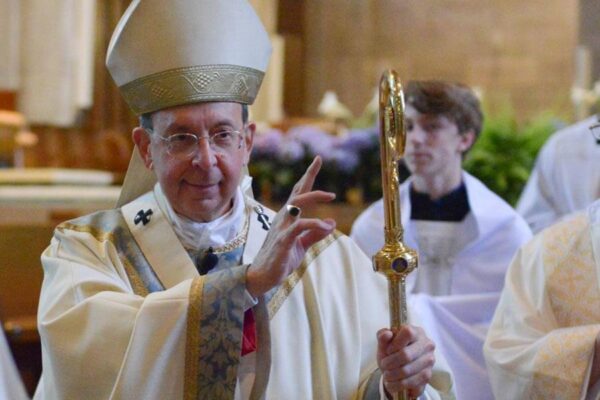
It’s a joy to celebrate the 2nd Sunday of Lent with you. Unfortunately, it’s been too long since my last visit, so I wanted to be with you – not because of an anniversary or a Confirmation – but just because I happened to be in the neighborhood. As you know, it is the 10th anniversary of Divine Mercy Parish, and I am grateful for your many contributions to the ongoing effort of bringing together five parishes into a single community of faith. Let me also thank Fr. Scott Kady, your pastor, for his leadership and for his great love of the Church here in Mountain Maryland!
More Than a Flash of Inspiration
At one time or another, all of us have had flashes of inspiration. Suddenly, we understand something we’ve struggled with. Unexpectedly, we see an old acquaintance in a whole new light. Out of the blue, we find wisdom and insight for a difficult situation.
There’s a bit of that going on in today’s Gospel scene, the Transfiguration as the Apostles Peter, James and John see Jesus in a wholly different way. To be sure, they were with Jesus from the beginning of his public life. They witnessed his miracles. They heard him preach with a wisdom and authority no one could match. In due time, Peter was inspired to acknowledge Jesus Christ as the Son of God, the Messiah, even if he could not grasp fully what his confession of faith meant. It was only when Jesus took Peter, James, and John to the heights of Mt. Tabor that they saw who Jesus truly is, for there, the Lord revealed to them his divine glory.
The Transfiguration was not a product of the Apostles’ imagination. Nor was it a mere momentary insight. On the contrary, the Transfiguration was an encounter, an encounter with Jesus in the glory of his divinity, an encounter in which the whole of God’s saving plan was revealed.
What Did the Apostles Witness?
What, then, did the Apostles see atop Mt. Tabor? The Gospel says that Jesus “was transfigured before them”, and that “his face shone like the sun and his clothes become white as light.” This was no ordinary light. In 2nd Cor, St. Paul speaks of ‘the glory of God shining on the face of Christ.’ But where did this light come from? Did it come from outside Jesus, like a strange, otherworldly light shining down onto Jesus? Quite the contrary. The light shone from within Jesus; his divinity shone through his humanity. At the core of his being, Jesus, God’s Son, is one with Father in the Holy Spirit. It is the beauty of Trinitarian love that dwells within his humanity and now that beauty radiates through his humanity. Let us note that Jesus’ divinity does not overpower his humanity. Peter still recognized Jesus as his friend as “and the Lord of his Heart”, only now he begins to see Jesus as the One in whom humanity is reconciled with divinity.
What else did the Apostles see? Matthew tells us that Moses and Elijah appeared with Christ on Mt. Tabor, Moses and Elijah represent the Law and the Prophets both of which pointed towards the Christ, our Messiah and Redeemer. Matthew tells us that Moses and Elijah were conversing with Jesus. What were they discussing? Only one thing: How the Christ would fulfill the Law and the Prophets: by dying on the Cross and rising from the dead – thereby destroying sin and death and imparting grace and immortality to a suffering humanity.
Gazing at Moses and Elijah, the Apostles also saw Jesus enveloped in a bright cloud, signaling the presence of the Holy Spirit, and from the cloud came the Father’s voice, “This is my beloved Son in whom I am well pleased! Listen to him!” As at Jesus’ Baptism, so now on Tabor God the Father confirms that Jesus is his Son, his Son in whom he takes delight, his Son who he sent into the world to fulfill his loving plan of redemption. He tells the Apostles (and us) to listen to him, that is, to open our hearts, to find in Jesus the fullness of truth and love that will bring us lasting joy. Peter, “all lost in wonder”, wants to prolong this moment by setting up tents for Jesus and his heavenly guests. In reality, that moment has been prolonged for us in this holy liturgy.
Why Did Jesus Manifest His Glory?
Let us make no mistake. Gathered for this sacred liturgy, we, no less than the Apostles, encounter the Lord in his Transfigured glory. His presence in our midst is no figment of our imagination. Just as Jesus manifested his glory to the Apostles before his Passion and Death, so he reveals his glory to us today so that we will neither flag nor fail in our Lenten journey to Calvary . . . to Calvary, where Christ will purify us of sin and enable us to share in his divine and imperishable glory.
After all, what really is the goal of our Lenten journey? Is it not to be purified of sin and emptied of everything that impedes us from sharing fully in God’s own life and love? For even in the midst of our daily life, with all its joys and sorrows, the goodness and glory of God must also shine from deep with us–through our words, our decisions, our actions, our relationships. This is why in Lent we intensify our life of prayer, go to Confession, fast or give up something we enjoy, and give generously to the poor – so that we might be done with whatever crowds out the Lord and encounter the Lord who loved us so much that he gave his life for us. Like Peter, let us seek to prolong this beautiful moment of the Lord’s Transfiguration—this moment that beckons us to embrace our God-given destiny – neither domination nor annihilation but loving communion with the Lord Jesus who lives and reigns with the Father in the unity of the Holy Spirit, God forever and ever. Amen.