
Faith, Freedom, and Friendship: Jesuit Lessons for America at 250
Address to the Jesuit Community of Baltimore
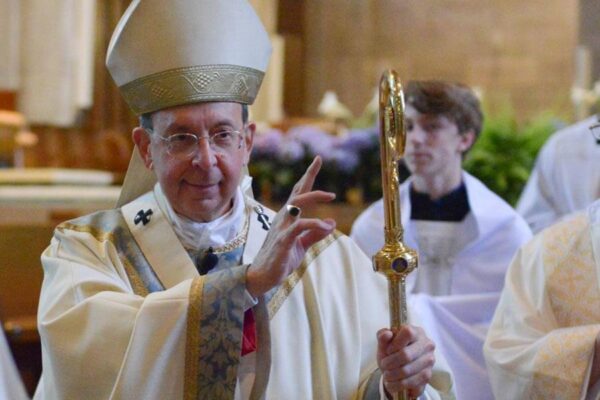
Most Reverend William E. Lori
October 20, 2025
In just a short time, our Nation will celebrate its 250th anniversary – a milestone that invites both gratitude and examination.
Two-hundred and fifty years ago the Declaration of Independence was signed –proclaiming liberty and equality for all—even as, from the beginning, those words rang hollow for so many who were enslaved, displaced, or excluded.
The story of America has always been a paradox – noble ideals, mixed motives, moments of heroism, and chapters of heartbreak. And, in a way, that makes it the perfect story for the Jesuits to inhabit—because your own history, especially here in Maryland, is just as complex – (even as the story of the Archdiocese of Baltimore is complex and paradoxical).
It is a story of great faith and painful failure. Of mission and misstep. But also a story of conversion, community, and deep hope in God’s continuing work. (To repeat, it is a story which the Archdiocese of Baltimore mirrors).
The Jesuit Story in the American Story
The Jesuit presence here predates by more than a century the founding of the United States of America. When The Ark & the Dove sailed from England in 1634, bringing settlers to Maryland, among them were Jesuit priests like Father Andrew White, S.J., who dreamt of a land where Catholics could freely practice their faith and share the Gospel.
In many ways, Maryland was the seedbed of religious freedom in this country. The 1649 Act of Toleration—though fragile and short-lived—planted the idea that people of different faiths might coexist without persecution. And through centuries of shifting political winds, the Jesuits remained – often in quiet perseverance, celebrating Mass in hidden chapels, teaching, baptizing, and serving communities scattered along the Chesapeake. Their pastoral imagination was incarnational – close to the land, close to the people, deeply embedded in the rhythms of daily life. They taught that faith was not an abstraction but a way of seeing and serving the world that God loves.
That incarnational spirit eventually built parishes, missions, and schools, and, of course, Georgetown College, founded in 1789, the same year that the United States Constitution was ratified (and the same year that the Archdiocese of Baltimore was founded).
Freedom and faith were intertwined from the start. But as we know, the Jesuit story in Maryland is not only a story of faith—it is also a story of moral failure. In 1838, Maryland Jesuits sold 272 enslaved men, women, and children to sustain Georgetown and their missions. It is a wound that remains part of your institutional memory, one that you have continued to confront with humility and repentance.
Yet, even in facing that truth, there is grace – because your willingness to acknowledge sin & to tell the truth about your history is itself a deeply Ignatian act. It is the first step of discernment: to see reality clearly and to seek the movements of God within it. The Jesuit story mirrors America’s: full of promise and contradiction; always being redeemed through conversion.
Jesuit Lessons for the American Experiment
Over two and a half centuries, the Jesuits have shaped American life profoundly, not by seeking power, but by forming consciences. Your schools have taught that education is not merely about achievement but about vocation – the formation of men and women for others. Your parishes have served as centers of encounter – places where people of every background could find welcome, purpose, & direction. Your scholars and activists have wrestled with the moral crises of their times—from slavery to civil rights to nuclear weapons and climate change. In every age, the Jesuit contribution to American democracy has been the same: to remind this nation that freedom without virtue is fragility, that liberty without truth is license, and that true greatness is measured, not by wealth or might, but by justice and mercy. And perhaps most powerfully, Jesuits have modelled how faith can engage democracy – not by retreating from it, but by entering into it as leaven, conscience, and companion. To use the Ignatian phrase, you are called to be contemplatives in action in the public square, discerning God’s movement even in politics and culture.
The Call in a Polarized Time
But what does this mean now, for the Church and the Jesuit community in particular, in a moment when our society is so fractured, so angry, so weary? We are living in an age of polarization—political, cultural, even spiritual. It is tempting to withdraw or to shout, to label or to despair. Yet the Jesuit way—the Ignatian way—offers another path. First, it calls each of us to remember with humility. The grace of history is that it humbles us. Your past, both as Jesuits and Americans, is not pristine (nor is mine!). But remembering truthfully allows redemption to take root.
Second, Ignatian spirituality teaches discernment. In an era driven by outrage and algorithms, discernment is a countercultural act. It requires slowing down, listening for the quiet movement of the Spirit beneath the noise. Discernment asks: what is leading me towards love and communion, and what is pulling me towards division and fear?
Third, the tradition of cura personalis—care for the whole person—offers an antidote to polarization. Our politics has become depersonalized, abstract, tribal. The Jesuit charism insists that we see the human face before us. Encounter replaces ideology. Dialogue replaces distain. Healing begins, not in winning arguments, but in seeing one another as children of God. And finally, the Cross reminds us that the way forward is not triumph but love. The Cross is the great unifier of opposites: strength and vulnerability, suffering and redemption. If the Church—and if the Jesuits—can hold fast to the Cross in a polarized culture, we can, together, become the bridge our nation so desperately needs.
The Next 250 Years
The United States remains an unfinished project—it is a country still being born. So too, the Jesuit mission here is unfinished—it is a story still being written by the Spirit. As we look to the next 250 years, I would humbly suggest that the Jesuits’ task is, not to dominate the national conversation, but to deepen it. To form consciences capable of right judgment and compassion amid complexity. To raise up leaders who can hold tension without losing hope. To model freedom rooted, not in self-assertion, but service. The challenge before each of us is to make sure that our reality – our civic and ecclesial life – reflects the idea at the heart both of our faith and our nation: the inherent dignity of every person.
Ad Majorem Dei Gloriam and the Healing of Our Common Home
When Fr. Pedro Arrupe said that the goal of Jesuit education is to form men and women for others, he was really describing the kind of citizens the American experiment most needs: people who use freedom for love, intelligence for service, faith for justice. The Jesuit story in America began on the banks of the Potomac, with small missions and great courage. It has weathered persecution, scandal, and rebirth. It continues today wherever Jesuits and their collaborators teach, pray, and walk with the excluded, still seeking “to find God in all things”, even in this moment of division. So perhaps as the nation turns 250, a Jesuit prayer might be like this: “Lord, teach us again to be companions of Jesus in a wounded land. Make us instruments of dialog in a culture of shouting. Help us see in our shared history, not despair but invitation—an invitation to build the kind of freedom that leads to communion, and the kind of nation that reflects your glory.” Ad Majorem Dei Gloriam, and for the healing of our common home.