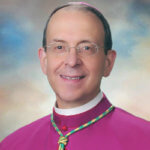
The Future Isn’t Artificial – It’s Human: By Archbishop William Lori, as published in the Baltimore Sun
Artificial intelligence promises astonishing possibilities. It can diagnose diseases, accelerate scientific discovery, translate languages instantly and assist students and workers in ways unimaginable only a decade ago. Yet beneath the excitement lies a deeper question: What kind of human beings are we becoming in an age increasingly shaped by machines?
That question sits at the heart of Catholic social thought — and it echoes powerfully in both Pope Leo XIV’s new encyclical “Magnifica Humanitas” and the Maryland bishops’ pastoral letter, “The Face of Christ in a Digital Age.” We asked a striking question: “Will we allow technology to form us in its image — or will we shape it according to the Gospel?”
To grapple with that challenge, it is worth turning to the great Catholic philosopher and theologian Bernard Lonergan. Long before the rise of artificial intelligence Lonergan recognized that every age faces crises not merely of technology, but of consciousness. Human flourishing, he argued, depends upon our willingness to be attentive, intelligent, reasonable and responsible.
Artificial intelligence can process information at extraordinary speed. But Lonergan reminds us that intelligence alone is not wisdom.
A machine may summarize data, imitate conversation or identify patterns hidden within vast oceans of information. But it cannot engage in moral self-transcendence. It cannot love. It cannot sacrifice. It cannot discern truth in the deepest human sense. In Lonergan’s thought, authentic knowing requires more than calculation; it requires conversion — intellectual, moral and spiritual conversion.
That distinction matters enormously today.
We are entering a world in which algorithms increasingly shape politics, education, labor, relationships and even our understanding of reality itself. AI systems can generate convincing misinformation, manipulate emotions and deepen ideological silos. Entire sectors of the workforce fear displacement. Meanwhile, enormous technological power is concentrated in the hands of a small number of corporations and governments.
Magnifica Humanitas warns that technological progress detached from moral responsibility risks deepening exclusion and injustice rather than advancing authentic human development. Yet the Church does not approach AI from a position of fear.
In our own pastoral letter on AI, we rightly note that technology itself is not opposed to the work of the Holy Spirit. Like the printing press, radio or the internet before it, AI can become a tool for evangelization, education, healthcare and service to the vulnerable when directed toward the common good.
Still, we insist upon a central truth: “AI must always serve the person, never diminish or replace human dignity.”
Here again, Lonergan proves remarkably prophetic.
He believed social decline begins when people stop asking honest questions — when convenience replaces truth and when critical reflection yields to ideology or passivity. One of AI’s greatest dangers may be the temptation toward intellectual and moral laziness: allowing machines not merely to assist our thinking, but to replace it.
Catholicism offers a crucial corrective to this temptation. The human person is not reducible to data, productivity or efficiency. Each individual possesses irreducible dignity because each is created in the image of God. No algorithm can measure that dignity. No machine can replicate conscience, grace or the human soul.
The deeper challenge before us, then, is not technological but spiritual.
Will AI deepen solidarity or isolation? Will it widen inequality or promote the common good? Will it cultivate wisdom or merely accelerate discretion? The answers depend less upon machines than upon the moral character of the societies creating them.
Both Pope Leo and the Maryland bishops call for the formation of leaders capable of engaging AI with both technical competence and what the Maryland bishops term a “deep moral imagination.” Lonergan would surely agree. The future will belong not simply to those who innovate most quickly, but to those courageous enough to think critically, act responsibly and remain open to truth.
Machines may help humanity solve problems. But only human beings — guided by conscience, community and grace — can ensure that technological progress remains truly human.”
Most Reverend William E. Lori
Archbishop of Baltimore