in charity and truth toward a renewed political culture

Introduction – A Moment of Grace and Responsibility

As our nation approaches the 250th anniversary of the signing of the Declaration of Independence, we find ourselves invited into a moment of profound reflection and renewal. Anniversaries are not merely occasions for nostalgia or celebration. Authentic remembrance always orients us toward renewal; it calls us to consider not only who we have been, and who we are becoming–but, by God’s grace, who we are called to be.

This anniversary can be a moment of grace if embraced also as a moment of responsibility. For while we rightly take pride in the achievements of our nation and the vibrancy of our Catholic faith, we cannot ignore the fractures, wounds, and crises that mark both our national life and, sadly, even at times our ecclesial life. The task before us is not to romanticize the past but to offer a hopeful and credible witness today.

At the heart of this witness is a truth the Church never ceases to proclaim: The human person finds his or her full meaning and dignity only in Jesus Christ. As the Second Vatican Council teaches, “Christ …fully reveals man to man himself and makes his supreme calling clear.”1 Our reflections on politics, culture, unity, and civic responsibility must therefore begin–and end–with Christ, who reveals both the dignity of the human person and the path to authentic freedom.

______________________________________________________________________
1 Second Vatican Council, Pastoral Constitution on the Church in the Modern World
Gaudium et Spes (December 7, 1965), 22.

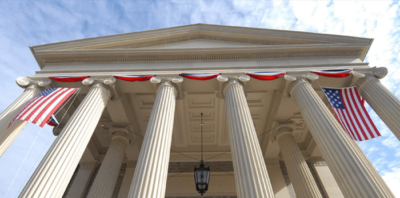
basilica with flags

The Cultural Atmosphere We Breathe

Like the Church herself, we operate in a cultural atmosphere that is something like the air we breathe. Rarely is it entirely fresh and bracing. All too often it is polluted, even toxic. Such is the political atmosphere in which we find ourselves today. Political discourse has become more vitriolic than usual. Political violence and threats of such violence have erupted. There is deep polarization. Extreme ideologies of both the left and the right are being asserted–ideologies that reveal not only political division, but also cultural and even religious polarization.

Few among us are untouched by this. The polarization of our public life has produced an epidemic of loneliness and isolation–an aching sense of being unmoored, misunderstood, or unheard. Pope Francis warned that a culture of indifference and division slowly erodes the human heart.2 At its root, this crisis reflects a wounded understanding of the human person. When we forget that every human being is created in the image of God–body and soul united, destined for communion–we begin to see one another not as brothers and sisters, but as obstacles and threats. Political life then becomes a contest of power rather than a shared pursuit of the common good.

This crisis is not unlike the world Dante depicts in “The Divine Comedy,” where the pilgrim begins his journey, disoriented and alone in a dark wood, reflecting the fragmentation of the human spirit. As he descends into the Inferno, he witnesses the tragic consequences of communities torn apart, of individuals cut off from one another and from the good that gives life meaning. Yet Dante’s path upward begins only when he turns away from this suffocating isolation and embraces a way ordered toward truth, communion, and renewal. But to do this he has to face the depths of the reality of brokenness and sin. For Dante, the way up was down. His journey out of the depths speaks with renewed urgency to our present moment, reminding us that the air of our political culture can once again become breathable only if we choose the path of unity, responsibility, and love.

______________________________________________________________________

2 Pope Francis, Homily at Casa Santa Marta, January 8, 2019.

a moment for renewal, not nostalgia

A Moment for Renewal, Not Nostalgia

Anniversaries can easily tempt us into selective memory–remembering what was noble while forgetting what was painful or flawed. But the Church reminds us that authentic celebration emerges not from denial but from the courage to face both our strengths and our failures.

Our nation has been, from its founding, a land of possibility. Yet, it has also been a land of profound contradictions. The Declaration of Independence proclaimed that all are created equal, endowed with certain unalienable rights. And yet, as we know, many were excluded from those very rights for generations.

Similarly, the Church we love has been radiant with holiness and often disfigured by sin. To love one’s homeland and one’s Church is not to ignore their faults, but to commit oneself to their renewal–always in light of the Gospel.

St. Thomas More, a statesman and martyr, put it best when he declared, “I die the King’s good servant, but God’s first.” His faith-filled patriotism is one we would do well to imitate–a patriotism that loves one’s nation enough to speak the truth and to help it become its best self.

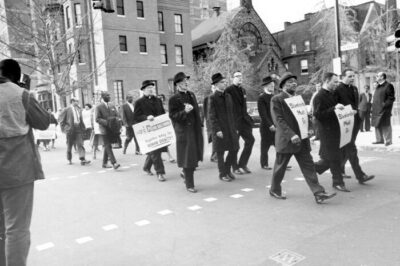
Archdiocese of Baltimore priests participate in a march for fair housing
Archdiocese of Baltimore priests participate in a march for fair housing, November 1965. (CR File)

Synodality – Listening, Discerning, and Walking Together

One of the graces the Holy Spirit offers the Church in our times is the call to synodality. While this term emerges from ecclesial life, its spirit offers wisdom for our civic life as well. Synodality is, at its heart, a commitment to listening with humility, speaking with honesty, and discerning with the Holy Spirit–all while walking together, not apart.

This call to synodality has particular significance for the bishops of the United States, who are entrusted with teaching, sanctifying, and governing in communion with one another, with the Successor of Peter and the People of God. Unity among bishops in not incidental; it is itself a pastoral and evangelical witness. When bishops remain united–despite differences of emphasis, temperament, or prudential judgment–they model for the faithful and for the nation what communion amid diversity can look like.

Such unity does not mean uniformity, nor does it eliminate disagreement. Rather, it reflects a deeper truth. Our communion in Christ precedes our differences. As shepherds formed by the same Gospel, celebrating the same Eucharist, and sharing responsibility for the same people of God, the bishops’ unity serves as a sign that truth and charity need not be opposed.

A synodal spirit offers a kind of wisdom for civic life: it reminds us that no political goal is worth the cost of a fractured people, and no disagreement justifies forgetting our shared humanity. Of course, this insight must be applied carefully, recognizing that the Church’s dynamics, authority, and mission differ fundamentally from those of a secular republic.

What might synodality in politics look like?

  • A renewed willingness to listen, especially to those with whom
    we disagree.
  • A refusal to demonize, recognizing the dignity of every person.
  • A commitment to discernment, refusing the seduction of easy
    answers of ideological rigidity.
  • A shared journey, resisting the fragmentation that leaves so
    many behind.

Pope Benedict XVI once said that “Holiness does not consist in never having erred or sinned. Holiness increases the capacity for conversion, for repentance, for willingness to start again and, especially, for reconciliation and forgiveness.”3–This is a way of saying that true holiness steadies us even as it transforms us. A synodal political culture would possess something of this same steadiness: able to hold difference without rupturing, able to speak truth without rancor.

Synodality in politics does not dissolve disagreement. It expects it, because diverse people will inevitably see the world from different angles. What it seeks is not forced unity, but a way of engaging differences that honors dignity, practices patience, and seeks the common good. It rejects the idea that truth is found in shouting matches or that justice is served by humiliating opponents. And while it values social cohesion, it also recognizes that genuine solidarity sometimes requires naming wrongdoing clearly–even when doing so creates tension. The goal is not unity at any price, but a political life where moral clarity and human dignity guide how we navigate our conflicts.

______________________________________________________________________
3 Pope Benedict XVI, General Audience, January 31, 2007.

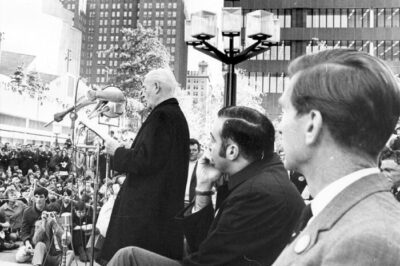
Cardinal Lawrence Shehan speaks at a War Moratorium
Cardinal Lawrence Shehan speaks at a War Moratorium, c. 1960s. (File Photo)

Synodality invites us to walk together. It calls us to resist the temptations of isolation, distrust, and ideological purity. It reminds us that the renewal of our political culture will not come from one movement, one party or one leader–but from a renewed sense of solidarity among the people themselves. The change we need will likely not come from above us but from among us.

A New Kind of Politics Rooted in the Truth of the Human Person

Our world is in desperate need of a new kind of politics–one that begins not with power, but with the truth of the human person revealed in Jesus Christ. Christ, in His Incarnation, affirms the goodness of the human body and the meaning of human history. In His Passion, He reveals the cost of love and the depth of human suffering. In His Resurrection, He discloses humanity’s destiny: not annihilation or domination, but eternal life in communion with God.

Such a vision is not naïve; it is realistic in the most Christian sense of the word. It recognizes that societies flourish only when people place moral and spiritual commitments above the pursuit of power. In “Fratelli Tutti,” Pope Francis called for the “new politics” our world needs–one shaped by social and political charity, animated by a genuine love for the people, and capable of bearing fruit through concrete and effective action. Far from idealism detached from reality, this vision insists that political life grounded in love of neighbor and commitment to the common good is not only possible, but necessary for authentic and lasting renewal.

This new kind of politics calls us to:

  • Resist the idolatry of ideology.
  • Honor the inherent dignity of every human life from conception
    to natural death.
  • Protect the vulnerable and the marginalized.
  • Engage in dialogue rather than accusation.
  • Place the common good above partisan loyalty.

This does not mean we will always agree. It means that disagreement becomes a place of encounter, not enmity.

Unity - a first principle in christian citizenship

Unity – A First Principle in Christian Citizenship

Among the first words of Pope Leo XIV’s pontificate was a call for unity–unity in the Church, and unity among the peoples of the earth. Unity is not a strategy; it is grounded in Christ, who prayed that His disciples might be one. Unity is not uniformity. It is harmony in diversity. It is the recognition that we belong to one another, even when we see the world differently.

Unity requires responsibility. It calls us to be united first in faith and service, thereby strengthening the communion of the Church, while simultaneously working for the good of the communities and nation in which we live. This dual commitment to faith and country does not mean closing our eyes to the flaws of our homeland or pretending that our civic life is free of moral tension. From the beginning, Catholics in this country have wrestled with how to live faithfully in a culture that does not always share or support the Gospel. That struggle continues today, especially in a time when many feel politically homeless and unsure where their faith fits within the current landscape.

Part of our pastoral challenge is that many of our people instinctively identify as Americans, or as Democrats or Republicans, before they identify as Catholics. When that happens, the Gospel is easily overshadowed by partisanship–or even a rigid ideology that demands more loyalty than the Word of God–and thus our witness becomes fractured. Naming this honestly is not a condemnation but an invitation: an invitation to let our faith shape our civic identity rather than the other way around.

The Catholic experience in the United States has always included both gratitude and tension–gratitude for the freedoms we enjoy, and tension when those freedoms are used in ways that wound human dignity. This history also calls us to a necessary vigilance, ensuring that our fundamental freedoms, especially our religious liberty, are never curtailed or compromised. Yet our history also shows that these tensions can be navigated with integrity. Catholics do not need to abandon their faith to participate in public life, nor do they need to abandon public life to remain faithful. Instead, our faith offers the compass we need to walk this path with clarity and hope.

Being Catholic in America has never meant uncritical allegiance, nor has it required withdrawal. It means allowing the Gospel to form our conscience, guide our choices, and inspire our commitment to the common good. When we do that, we contribute not only to the unity of the Church but also to the healing and strengthening of our nation, helping it grow into the best version of itself, even when the journey is difficult.

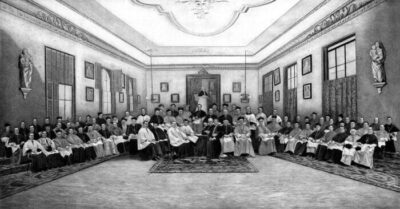
Official portrait for the Third Plenary Council of Baltimore (1884)

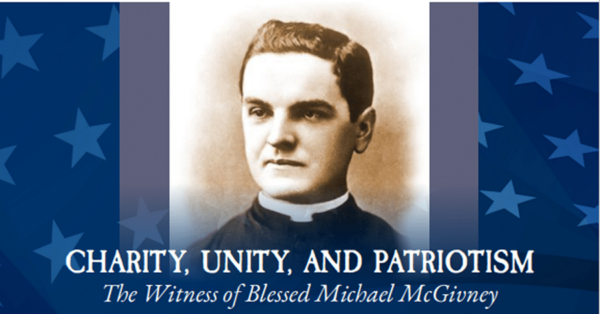
Charity, Unity, and Patriotism – The Witness of Blessed Michael McGivney

At this pivotal moment in our nation’s life, we are blessed with a distinctly American witness in Blessed Michael McGivney, whose life embodies the virtues our time so desperately needs.

As a parish priest serving immigrant families, Blessed McGivney recognized the concrete wounds of his people – economic insecurity, social exclusion, and cultural suspicion. His response was not ideological, but incarnational. He founded the Knights of Columbus which fosters charity, unity, fraternity, and a patriotic love that seeks the good of the nation without sacrificing fidelity to Christ.

Blessed McGivney understood that charity is not abstract sentiment, but love made visible through solidarity and sacrifice. He understood that fraternity flows from baptism, not from political alignment. He understood that authentic patriotism is not blind allegiance, but a commitment to help one’s country live up to its highest ideals.

In Blessed McGivney, we see a lived Christological anthropology: a man who knew that to follow Christ is to serve the whole person – body and soul – and to build communities where dignity is protected and hope is sustained. His witness reminds us that love of country and love of neighbor are not rivals, but companions, when rooted in the Gospel.

Reclaiming a Culture of Encounter

Reclaiming a Culture of Encounter

The polarization of our time has led to a culture of avoidance. We retreat into enclaves, whether political, digital, or ideological. Sadly, this is seen even within our families. But the Gospel calls us to a culture of encounter–to go out to meet the other, to listen, to learn, and to love. To encounter another is to recognize in them a mystery that only God fully comprehends. It is to acknowledge that every human life is ordered toward communion and eternal life, not toward exclusion or erasure.

Jesus Himself modeled this. He encountered the Samaritan woman, the Roman centurion, the tax collectors, the zealots, and the lepers. He did not require perfect alignment before entering into relationship. He saw before Him a person beloved by the Father.

To build a better political culture, we must learn once more how to encounter. This involves:

  • Stepping outside our ideological comfort zones.
  • Seeking out conversations with those on the margins or those with differing points of view.
  • Healing the wounds that divide us.
  • Committing ourselves to forgiveness.
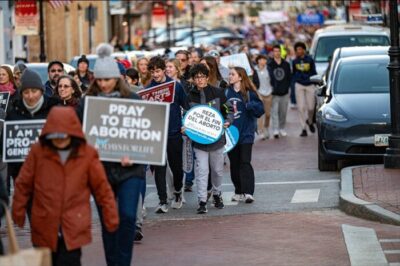
March for Life rally March 11, 2024, in Annapolis.
The Role of Virtue in Public Life

The Role of Virtue in Public Life

A healthy republic does not rest solely on the strength of its institutions, its courts, or its electoral systems. It rests, above all, on the character of its people. The Founding Fathers themselves understood this well. John Adams famously wrote that the Constitution was made “… only for a moral and religious people. It is wholly inadequate to the government of any other.”4 Though he wrote from a Protestant worldview, his insight resonates deeply with the Catholic tradition, which has long taught that political life–not unlike personal life–requires virtue. Law guides and establishes structure, but virtue is what animates.

In our times, we find that many of the crises affecting our political culture–polarization, suspicion, hostility, and the temptation to reduce opponents to caricatures–are ultimately crises of the human heart. They arise from habits of vice: pride, anger, rash judgment, fear, and greed. A renewed political culture will not emerge from policy changes alone. It will require the cultivation of virtue, which begins in individuals and takes root in families. From there, virtue radiates outward into society.

For this reason, the renewal of our political culture cannot begin in legislatures or courts; it must begin in the places where the human heart is first formed. The family is the primary school of virtue, where patience, honesty, responsibility, forgiveness, and concern for others are learned through daily life. Alongside families stand other vital intermediate institutions–parishes, schools, neighborhood associations, charitable organizations, and faith-based communities–which help bridge the space between the individual and the state. These communities foster habits of trust, solidarity, and civic friendship, teaching us how to live with difference, to resolve conflict without hostility, and to seek the common good rather than private advantage. When these institutions are strong, they form citizens capable of self-governance and respectful engagement; when they are weakened or ignored, society becomes more vulnerable to isolation, polarization, and the overreach of both ideology and power.

The classical and Christian traditions identify four cardinal virtues–prudence, justice, fortitude and temperance–which form the moral framework needed for healthy political engagement. These virtues do not belong only to one party or ideology. They are the shared moral grammar that enables people of goodwill to work together for the common good.

______________________________________________________________________
4 From John Adams to Massachusetts Militia, October 11, 1798,” Founders Online,
National Archives, https://founders.archives.gov/documents/Adams/99-02-02-3102.


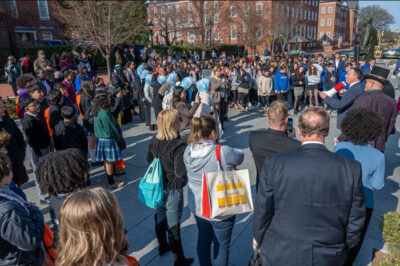
Hundreds gathered on the Lawyers Mall in front of the Maryland State House in Annapolis March 4, 2025, to support funding for the Broadening Options and Opportunities for Students Today (BOOST) Scholarship Program.
Prudence - Seeing Clearly and Choosing Wisely

Prudence – Seeing Clearly and Choosing Wisely

Prudence is often misunderstood as hesitation or caution. In reality, prudence is the virtue of clear-eyed discernment. It enables us to perceive reality truthfully, to judge rightly what should be done, and to act in a way that advances genuine good.

In public life, prudence means evaluating policies not by slogans or emotional appeal but by their actual impact on human dignity. It calls voters, leaders, and citizens to ask: What truly serves the most vulnerable? What best promotes justice? What protects the family? What advances peace? Prudence also guards against the absolutizing of partial truths, which can make ideologies seem more compelling than the demands of the Gospel. Prudence helps us to see clearly, to judge wisely, and to act firmly.

Justice - Respecting Rights and Responsibilities

Justice – Respecting Rights and Responsibilities

Justice is foundational to political life. It is the virtue that moves us to honor the dignity of every human person and to recognize that each person has rights that must be protected and responsibilities that must be fulfilled.

A just society safeguards life at every stage–the unborn, the elderly, the sick, the disabled, and the vulnerable–to offer just a few examples. It ensures that basic needs are met, that work is treated with dignity, that the marginalized are brought to the center, and that the law is applied fairly. Justice also demands recognition of the ways historical sins–such as racism, exploitation, and exclusion–continue to wound communities.

Catholics contribute meaningfully to public life when we insist that justice must never be partisan. It is rooted not in ideology but in the truth of who we are as creatures made in the image of God. Justice helps us to give each person what is owed to them.

Fortitude – Courage to Pursue the Good

Fortitude strengthens us to pursue what is right despite fear, intimidation, or difficulty. In our polarized age, fortitude is indispensable. It empowers each of us to resist the pressure to conform to divisive rhetoric, to endure criticism when standing for truth, and to advocate for the vulnerable even when it is politically inconvenient.

St. John Fisher is a shining model of this virtue. His steadfastness under pressure–his willingness to stand alone for the integrity of the faith–reminds us that courage is not loud or inflammatory. Courage is firm, patient and rooted in truth. Fortitude in political life does not manifest as aggression or dominance, but in a quiet, unwavering commitment to the Gospel and the common good. Fortitude helps us to do the right thing even when it is hard.

Temperance – Ordering Our Passions for Peace

Temperance moderates our impulses and helps us resist the allure of excess. In political culture, temperance is perhaps the virtue most needed today. Our public discourse often thrives on outrage, immediacy, and emotional escalation. Temperance invites us to slow down, to choose words carefully, to avoid rash judgments and to discipline the desire to “win” at the expense of relationship, truth or the common good.

Temperance also applies to how we consume information. It encourages us to avoid media ecosystems that inflame anger, distort reality, and foster cynicism. It calls us to seek sources that inform rather than manipulate, that elevate rather than degrade. Temperance helps us to curb lesser immediate goods (real or perceived) to seek after higher, lasting goods.

The Interdependence of Virtues

The Interdependence of Virtues

These cardinal virtues do not stand alone. They support and balance one another. Prudence without justice becomes manipulation. Justice without temperance becomes harshness. Fortitude without prudence becomes recklessness. Temperance without fortitude becomes avoidance.

The saints remind us that virtue is a habit formed over time. Virtue grows through repetition, through the daily choosing of the good over the easy, the true over the convenient. This applies not only to individuals but to societies. A nation grows in virtue when its people consistently practice it.

Virtue as the Foundation of Civic Friendship

Virtue as the Foundation of Civic Friendship

Virtue makes possible civic friendship–a way of living and relating that seeks the good of one’s neighbor and of society. Civic friendship is not sentimental. It is a strong, stable commitment to the truth that we belong to one another, that our destinies are intertwined, and that the flourishing of one depends in part on the flourishing of all. It is a deep, genuine desire to seek the good of others and of society. This is the antidote to polarization.

Civic friendship challenges us to:

  • See political opponents as brothers and sisters.
  • Build bridges where there are walls.
  • Foster trust in a time of suspicion.
  • Cultivate hope amid fear.

A society marked by civic friendship is better able to weather political disagreements, because citizens do not see opponents as enemies but as fellow children of God. Virtue forms the soil in which trust can grow, and trust is essential for any democracy to flourish.

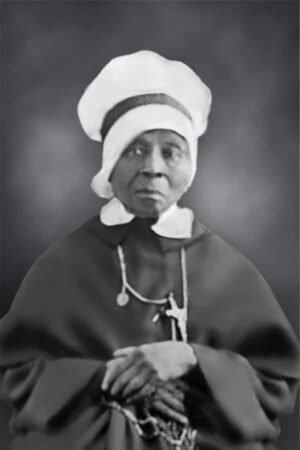
Venerable Mother Mary Lange
Venerable Mother Mary Lange, c. 1789- 882, foundress of the Oblate Sisters of Providence. (Public Domain)
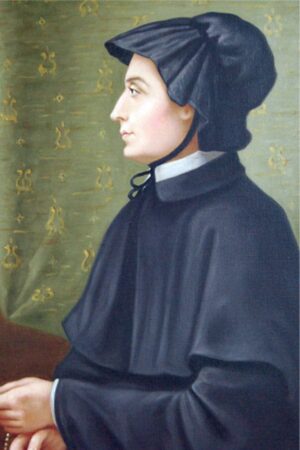
Saint Elizabeth Ann Seton
Saint Elizabeth Ann Seton, 1774-1821, foundress of the United States’ first Catholic School system. (Public Domain)
The Responsibility of Catholics in Forming Virtuous Public Life

The Responsibility of Catholics in Forming Virtuous Public Life

Catholics, drawing from the richness of our intellectual and spiritual tradition, have a unique role to play in renewing public life through virtue. We can model prudence in how we discern public issues, justice in how we advocate for the vulnerable, fortitude in standing for human dignity, and temperance in our tone and conduct.

By practicing virtue–individually and collectively–we contribute to the healing of our nation. We become instruments of peace and bridges across division. We demonstrate that political life, when rooted in virtue, can indeed become a path to holiness and a form of loving service. But to do this we have to be firmly rooted in Christ, rather than in the world.

The Gift & Responsibility of Catholic Citizenship

Catholics in the United States inherit a rich legacy. The American experiment in liberty was shaped, in part, by Catholic minds and Catholics hearts–from the Catholics who arrived in 1634 at St. Clement’s
Island, Maryland, the Carrolls of the 18th century to the millions of immigrants who arrived on our shores.

These immigrant families did not merely seek opportunity; they brought with them a living faith which sustained parishes, built schools and hospitals, and enriched the Church with diverse traditions of prayer, devotion, and service. Often amid hardship, exclusion, and sacrifice, they bore witness to hope, perseverance, and trust in God.

Their contributions remind us that immigration is not only a social reality but a spiritual gift–one that has continually renewed the Church and strengthened the moral and civic fabric of our nation.

Today, we are called to carry forward this legacy. Catholic citizenship is not about aligning the Church with one party or another. It is about witnessing to the Gospel in the public square.

A mature Catholic political presence will:

  • Defend human life in all its stages.
  • Advocate for the poor and the vulnerable.
  • Insist on racial and social justice.
  • Promote peace and reject violence.
  • Uphold religious freedom for all.

This vision transcends party lines. It is neither conservative nor progressive. It is Catholic.

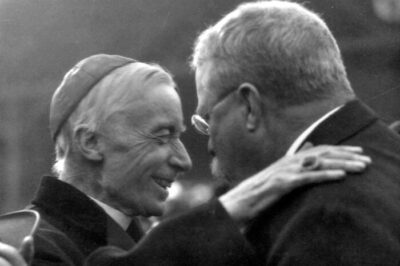
Cardinal Gibbons and President Theodore Roosevelt
Cardinal Gibbons and President Theodore Roosevelt. (Public Domain)
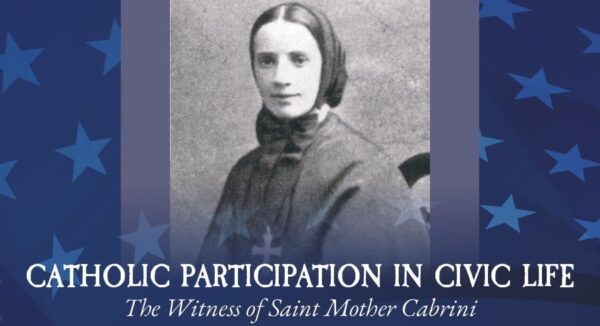
Catholic Participation in Civic Life - The Witness of St. Mother Cabrini

Catholic Participation in Civic Life – The Witness of St. Mother Cabrini

Among the many heroes who shaped this legacy, St. Frances Xavier Cabrini stands as a luminous witness. Arriving in the United States as an immigrant herself, she encountered a nation that did not always welcome her people. Yet she met these challenges with a courageous heart and a faith that refused to be discouraged. Mother Cabrini built schools, hospitals, and orphanages not because the path was easy, but because she believed that every human person–especially the poor, the sick, and the stranger–deserved to experience the tenderness of Christ. Her life reminds us that immigrants have never been merely recipients of charity; they have been builders, healers, and saints who have renewed both the Church and the country through their sacrifice and love. In Mother Cabrini, we see what Catholic participation in civic life looks like at its best: a life rooted in prayer, poured out in service, and committed to the flourishing of the nation without ever compromising fidelity to the Gospel.

The Spiritual Crisis Beneath the Political Crisis

The Spiritual Crisis Beneath the Political Crisis

The political crisis of our time is, at its root, a spiritual crisis. While the symptoms appear in our discourse, our institutions, and our communities, the deeper fracture lies within the human heart. We live in an age marked by distraction, cynicism, fear, and a sense of isolation that corrodes our capacity for communion. Many no longer share a common moral vocabulary; many struggle to articulate the meaning and purpose of their lives. These wounds inevitably manifest themselves in the public square.

St. Augustine understood this dynamic with remarkable clarity. In The City of God, he describes two “cities”–not geographical locations, but spiritual orientations. The earthly city, he writes, is built upon self-love “to the point of contempt for God,”5 while the City of God is built upon the love of God “to the point of contempt for self.”6 These two orientations exist within each person, within every community, and within every age. Politics becomes disordered when the earthly city dominates–when the pursuit of power eclipses moral truth, when fear overrides charity, when parities and ideologies become idols.

Augustine did not propose withdrawal from public life. Instead, he called Christians to engage the earthly city with the virtues and hope of the City of God–anchored in eternal truth yet deeply committed to the welfare of their earthly communities. This is the spiritual task before us today. Our political atmosphere becomes toxic when souls become untethered from the love that grounds them. Healing the political crisis therefore requires tending to the spiritual crisis beneath it: the crisis of hope, identity, and communion.

The loneliness and fragmentation that afflict our nation are not merely social problems; they are signs of spiritual hunger. They reveal a longing for belonging, meaning, and transcendence that politics alone cannot satisfy. When this hunger goes unmet, people cling to ideologies as substitutes for faith or treat political adversaries as existential enemies. The polarization we see is not only intellectual–it is emotional, spiritual, and moral.

The Church’s mission in such a moment is not to claim political authority, but to unveil and proclaim a deeper horizon. She reminds us that the human person is made for communion; that freedom is ordered toward truth; that human dignity and rights are not conferred by the state but bestowed by God; and that no political order, however noble, can be our ultimate home. As St. Augustine reminds us, “Our hearts are restless until they rest in Thee.” Restlessness left untended spills over into public life.

To renew our politics, we must therefore renew our souls. This begins with prayer–opening our hearts to the God who heals and reorders our desires. It continues in the sacraments, where grace strengthens us to love as God loves. It takes shape in works of charity and justice, where faith becomes incarnate. And it is sustained in communities of faith where trust, forgiveness, and authentic belonging are learned and lived.

Political reform without spiritual renewal is a city built on sand. But a people formed by the Gospel can transform even troubled times with hope. When hearts are healed, politics becomes less a battleground and more a field for the pursuit of the common good. When citizens are anchored in the love of God, they are less vulnerable to fear, manipulation, and division. When communities rediscover their spiritual identity, they rediscover their capacity for civic friendship.

Only when the City of God is alive within us can we contribute fruitfully to the earthly city. Only when we ground ourselves in prayer, virtue, and the love of Christ can we begin to heal the wounds of our nation.

______________________________________________________________________
5St. Augustine, The City of God. (translated by Marcus Dods), XIV.28, accessed November 19, 2025, {Logos Virtual Library: Saint Augustine: City of God, XIV, 28}

6Augustine, City of God, XIV.28.
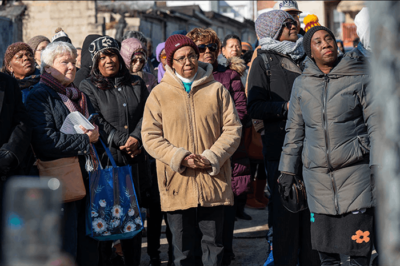
Thirteenth annual Rev. Dr. Martin Luther King Jr - Monsignor Edward Michael Miller Prayer Service and Peace Walk hosted Jan. 19, 2026 at St. Bernardine Catholic Church in West Baltimore.

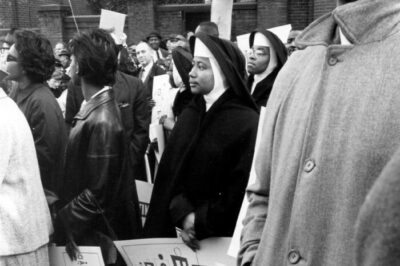
Oblate Sisters of Providence participate in a Fair Housing March, 1965
Oblate Sisters of Providence participate in a Fair Housing March, 1965. (File Photo)

A Path Forward – Practical Commitments for a Renewed Political Culture

In this 250th anniversary year, I invite all Catholics–and all people of goodwill–to commit themselves to the following practices:

  1. Renew Your Prayer for the Nation–Pray for those in authority.
    Pray for those with whom you disagree. Pray for peace.
  2. Practice Civil Dialogue–Listen before speaking. Seek to
    understand before responding. Assume good will.
  3. Reject Hatred and Violence–Refuse to participate in rhetoric or
    actions that dehumanize.
  4. Serve the Common Good–Volunteer. Build community. Support
    families. Work for justice.
  5. Form Your Conscience–Study Catholic social teaching. Discern
    your media intake. Develop your capacity for moral clarity.
  6. Encounter Those Who Differ from You–Build friendships that
    challenge your assumptions.
  7. Foster Hope–Speak of possibilities, not just problems. Remind
    others that God is at work. Witness to a different way to live.
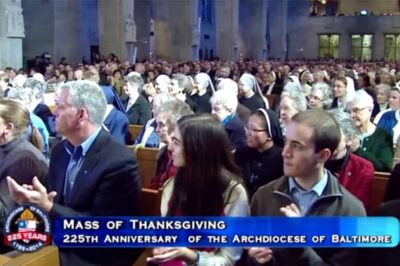
A Mass of Thanksgiving was held for the 225th Anniversary of the establishment of the Archdiocese of Baltimore
A Mass of Thanksgiving was held for the 225th Anniversary of the establishment of the Archdiocese of Baltimore on November 10, 2014 (EWTN Global Catholic Network. Used with Permission.).
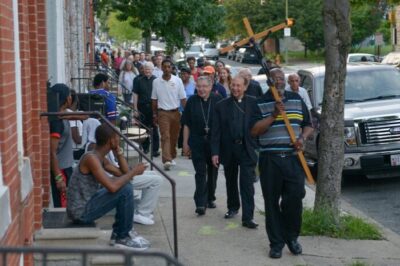
Archbishop William E. Lori and Auxiliary Bishop Denis J. Madden lead a peace and prayer walk through Baltimore City in 2019.
Conclusion - Becoming Instruments of Renewal

Conclusion – Becoming Instruments of Renewal

As we celebrate the 250th anniversary of our nation’s founding, we stand at a crossroads–one marked by profound challenges but also by new opportunities for renewal. The celebration of our nation’s birth is not merely a civic milestone; it is a spiritual invitation. It calls on us to reflect on the gift of our country, the sacrifices of those who came before us, and the responsibility entrusted to us for the generations yet to come.

This letter began by acknowledging the fragility of our present moment–the toxicity of our political atmosphere, the deep wounds of division, and the loneliness that has settled upon many hearts. But it also affirms the truth that moments of crisis can become moments of renewal. The Church has always proclaimed that grace moves most powerfully not in times of ease but in times of difficulty. And so, we trust that God is at work even now, beckoning us toward a better way.

In the midst of political upheaval, the Church does not withdraw from public life, nor does she align herself with any partisan identity. She remains what she has always been: a sacrament of unity, a beacon of hope, and a teacher of truth. Her mission is not to win elections, but to form saints. Not to secure power, but to proclaim the Gospel. Not to mirror the divisions of society, but to heal them.

Our nation needs Catholics who embody this mission–women and men whose lives witness to the dignity of every human person, whose love bridges divides, whose courage resists hatred and whose faith insists that despair does not have the final word. The civic landscape may look dark at times, but the Church has lived through darker times and emerged stronger, purified, and more faithful. So, too, can our nation.

A Call to Hope and Commitment

The saints and countless others throughout time did not wait until circumstances were perfect before offering their lives. They responded to God’s call amid turmoil, uncertainty, and division. They remind us that hope is not optimism; it is fidelity. Hope is the quiet, steady conviction that God is at work even when we cannot see the path ahead.

As disciples of Christ and citizens of this great nation, we are called to that same hope. We are called to participate in the renewal of our political culture not out of fear, but out of love–love for God, love for neighbor, and love for the country that has been entrusted to us. We are called to be saints for our time.

So, dear brothers and sisters, let us walk forward as a synodal people–listening, discerning, and journeying together. Let us speak with charity and disagree with respect. Let us reject violence in all its forms, cultivate the habits of virtue, and anchor our lives in prayer.

May the next 250 years of our nation be marked by greater justice, deeper solidarity, renewed trust, and a profound respect for the dignity of every human person. May the Church–in the Premier See of Baltimore and throughout the United States–be a leaven of unity and a witness of hope in a world thirsting for both. May God bless you and may God bless the United States of America.

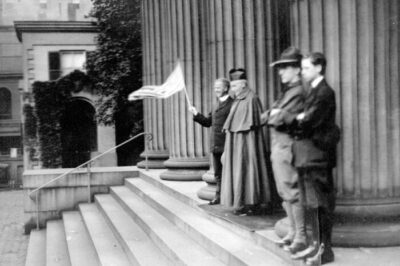
Cardinal Gibbons stands on the steps of the Basilica of the Assumption as Baltimore celebrates the Armistice that ended World War I. (File Photo)

Photos, unless otherwise specified, by Kevin J. Parks/Catholic Review Staff; Courtesy Catholic Review Media


En español »