The Church understands that the government has the responsibility to enforce laws, but that enforcement must respect human dignity. And so we urge authorities to carry out their responsibilities in ways that are transparent, proportional, and never driven by fear.
As a Church, our message is clear: You are not alone. The Church remains a place of welcome and support. We want our immigrant brothers and sisters to know that their presence enriches our Church and our communities. And we will continue to advocate for policies that protect families, promote justice, and recognize the divine dignity of every person.
The Catholic Church is guided by the Gospel and Tradition, and today’s Church leaders have offered messages on many facets of the complex subject of immigration. The faithful are urged to consider the Church’s holistic response to immigration – from efforts to welcome immigrants and promote their successful integration to the responsibilities of a country to regulate its borders and carry out immigration enforcement actions with justice, mercy and compassion. Explore these short frequently asked questions as a place to address some common misconceptions and find information on how Catholic social teaching applies to this subject.
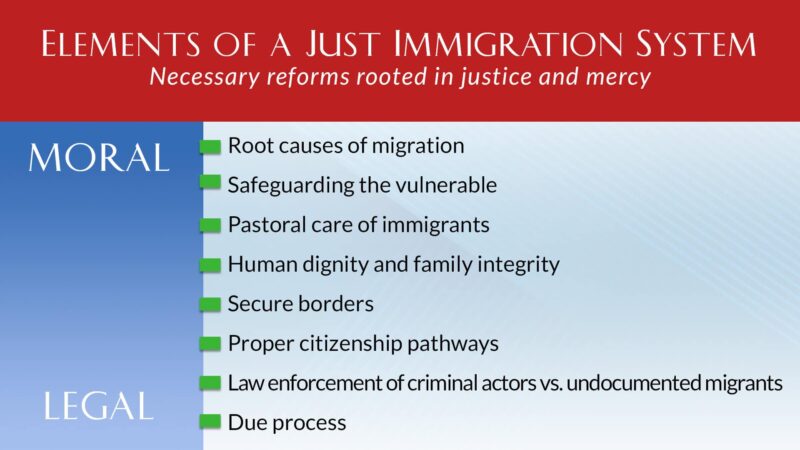
No. The Catechism of the Catholic Church states: “Political authorities, for the sake of the common good for which they are responsible, may make the exercise of the right to immigrate subject to various juridical conditions, especially with regard to the immigrants’ duties toward their country of adoption” (no. 2241). This includes a sovereign country’s right to uphold its borders.
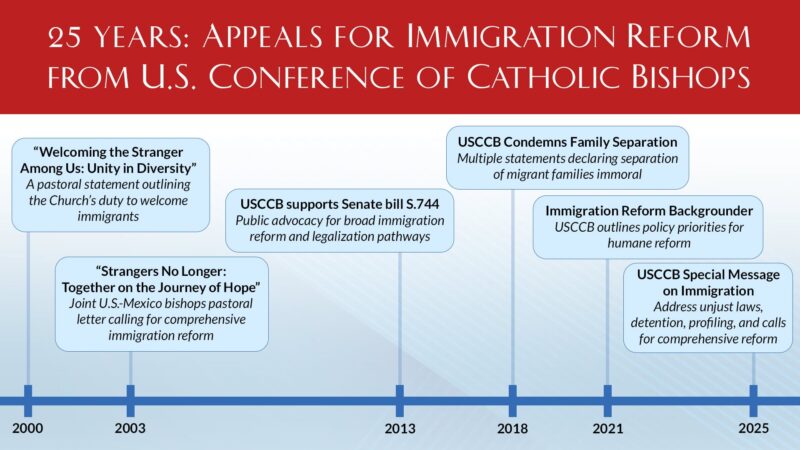
The Church does maintain, however, that this right is not unlimited. It must always be balanced with the duty to welcome newcomers with charity and respect for the human person, as well as the right to life, “upon which all the other inalienable rights of individuals are founded and from which they develop” (Evangelium vitae, no. 101). In their joint pastoral letter from 2003, Strangers No Longer: Together on the Journey of Hope, the Catholic bishops of Mexico and the United States included a country’s right to control its borders among five principles of migration derived from Catholic social teaching, which also include the right to migrate to sustain one’s life and the lives of one’s family members and the right not to migrate, provided that the necessary conditions exist in one’s homeland to achieve a full life.
There is no evidence or research to support the claim that the humanitarian and religious services provided by Catholic organizations incentivize unlawful migration. Rather, many studies have concluded that a varied and often complex set of push-pull factors typically influence a person’s decision to migrate.
The local Church, wherever located along a person’s journey, treats newcomers with love and respect, in accordance with God’s law (Leviticus 19:34). This treatment is also in accordance with civil law; immigration laws generally do not forbid such treatment, and if they somehow did, they would run afoul of state and federal Religious Freedom Restoration Acts and the First Amendment of the U.S. Constitution. “As the Church accompanies migrants and refugees on their journey, she seeks to understand the causes of migration, but she also works to overcome its negative effects, and to maximize its positive influence on the communities of origin, transit and destination” (Message of Pope Francis for the 100th World Day of Migrants and Refugees). Moreover, the Catholic Church does not encourage unnecessary or irregular migration. “Ideally, unnecessary migration ought to be avoided; this entails creating in countries of origin the conditions needed for a dignified life and integral development” (Fratelli tutti, no. 129). In Catholic social teaching, the right to emigrate is generally constrained by the need for “just reasons in favor of it” (Pacem in terris, no. 25). Moreover, the Church regularly uplifts the need to address the root causes of migration and provides recommendations in this regard, in addition to the efforts of Catholic Relief Services, the official international humanitarian agency of the Catholic community in the United States, and other Catholic organizations actively working to alleviate adverse conditions in sending countries.
No. The Catholic Church does not support or encourage illegal immigration because 1) it is contrary to federal law and 2) it is not good either for society because of the presence of a large population living outside the legal structures or the migrant, who is subjected to abuse, exploitation, and death in the desert. Instead, the Church is advocating changing a broken law so that undocumented persons can obtain legal status in our country and enter the United States legally to work and support their families.
The USCCB supports immigration enforcement which secures our border and minimizes the risk of loss of life to migrants. A reform of our legal immigration system will help reduce the need for increased resources for enforcement because it will allow migrants to enter legally and not clandestinely across the border. Specifically, the USCCB supports enforcement provisions in the Secure America and Orderly Immigration Act (S. 1033, H.R. 2330), provided they are accompanied by changes to our legal immigration system, as noted above. Enforcement provisions in S. 1033/H.R. 2330 include: 1) the development of a National Strategy on Border Security, which would enhance information-sharing among federal, state, and local authorities, integrate security technologies, and combat human smuggling; 2) an electronic employer verification system which would feature biometric (such as retina scan) visas for workers; 3) increased cooperation with sending countries to manage the flow of nationals to U.S. jobs, discourage unauthorized migration and criminal enterprise, improve job opportunities in sending communities, and identify potential terrorist threats and 4) funding for the Department of Labor to conduct targeted audits in any new temporary worker/legalization program.
Catholics serve migrants and other newcomers in accordance with our sincerely held religious beliefs, abiding by the teachings of Jesus Christ, affirming the inalienable rights and dignity of every person, and providing Christian charity as a visible sign of God’s love and mercy to those in need.
In the wake of World War II, Pope Pius XII boldly recognized that the “émigré Holy Family of Nazareth, fleeing into Egypt, is the archetype of every refugee family. Jesus, Mary and Joseph, living in exile in Egypt to escape the fury of an evil king, are, for all times and all places, the models and protectors of every migrant, alien and refugee of whatever kind who, whether compelled by fear of persecution or by want, is forced to leave his native land, his beloved parents and relatives, his close friends, and to seek a foreign soil” (Exsul Familia). More recently, Pope Francis has said that chapter 25 of Matthew’s Gospel, which calls us to “welcome the stranger,” is “a constant admonition to see in the migrant not simply a brother or sister in difficulty, but Christ himself, who knocks at our door. Consequently, even as we work to ensure that in every case migration is the fruit of a free decision, we are called to show maximum respect for the dignity of each migrant; this entails accompanying and managing waves of migration as best we can, constructing bridges and not walls, expanding channels for a safe and regular migration” (Message of Pope Francis for the 109th World Day of Migrants and Refugees).
In Strangers No Longer, the U.S. and Mexican bishops also aligned themselves with the “religious and social service providers who, without violating civil law, attempt to respond to the migrant knocking at the door” (no. 4). They explicitly encouraged these “signs of hope” by calling on pastors and lay leaders to ensure support for immigrant families, urging communities to offer migrant families “hospitality, not hostility,” along their journey, commending Church communities that establish migrant shelters that provide appropriate pastoral and social services to migrants, and urging local dioceses to sponsor pertinent social services for newcomers, particularly affordable legal services (no. 42).

No. On the contrary, the Catholic Church has long played a leading role in anti-trafficking efforts and providing, as well as advocating for, expanded services for victims of human trafficking. The USCCB’s programs for unaccompanied migrant children and unaccompanied refugee minors are carried out in strict compliance with applicable laws and policies, prioritizing the best interest and wellbeing of each child.
The USCCB recently endorsed the Frederick Douglass Trafficking Victims Prevention and Protection Reauthorization Act of 2022 and advocates annually for an increase in funding for programs that serve U.S.-citizen and foreign-national victims of trafficking. Internationally, the Catholic Church is a recognized and prominent force against human trafficking, with Pope Francis referring to it as “an open wound on the body of contemporary society, a scourge upon the body of Christ” (Address to Participants in the International Conference on Combating Human Trafficking). The USCCB has also advocated for increased access to the U.S. Refugee Admissions Program in Latin America and the Caribbean, as well as expanded legal pathways and improved processes for economic- and family-based immigrants, as proven ways to undermine predatory smuggling practices.
Unaccompanied children are particularly vulnerable to human trafficking, domestic servitude, and other exploitative situations. The Catholic Church considers it a moral obligation to ensure that all children are protected from such harms, consistent with their God-given dignity. Accordingly, the USCCB regularly advocates for increased protections for these children and opposes measures that would reduce or eliminate existing protections. This includes supporting efforts such as the bipartisan Responsibility for Unaccompanied Minors Act, endorsing the Protect Vulnerable Immigrant Youth Act, and calling for an expansion of post-release services for children placed with sponsors in the United States. Additionally, the Catholic Church has opposed recent and ongoing efforts at the state level to exclude experienced Catholic organizations and others serving these children from state licensure and oversight.
The types of services offered vary, and no two Catholic entities are identical in this regard, but the Church regularly and consistently cooperates in the administration of humanitarian aid with local, state, and federal governments, often at their request.
Catholic organizations along the U.S.-Mexico border, for example, may provide a meal, clean clothes, a shower, medical attention, and temporary shelter for newly arrived migrants. Some Catholic organizations also advise recently arrived migrants on the individual steps they can take to reunite with family or reach the location of their immigration proceedings. Catholic organizations provide resettlement and integration services to newly arrived refugees, helping them to find lawful employment, enroll children in school, learn English, and navigate life in their new communities. Clergy administer the Sacraments to those in immigration detention. Many Catholic organizations across the country provide services to noncitizens who have suffered human trafficking. Catholic organizations also provide affordable immigration legal services, helping qualified individuals to naturalize as U.S. citizens, prepare their cases for immigration court, and more. These programs are designed to assist noncitizens with navigating legal obligations placed upon them by the U.S. immigration system and to promote compliance with applicable laws.
The U.S. Catholic bishops are steadfast proponents of federal immigration reform—both a comprehensive reform of U.S. immigration law (e.g., the Border Security, Economic Opportunity, and Immigration Modernization Act of 2013) and incremental reforms to improve specific areas where possible (e.g., the Farm Workforce Modernization Act).
Immigration reform was a major topic of discussion in Strangers No Longer, and the U.S. bishops’ Justice for Immigrants campaign was specifically created in 2004 to encourage positive immigration reform. The USCCB has consistently supported increased opportunities for legal immigration and the protection for immigrants’ due process rights, while opposing an enforcement-only approach to immigration that prioritizes deterrence and unjust penalties.
Regarding an immigrant’s obligations, the Catechism states: “Immigrants are obliged to respect with gratitude the material and spiritual heritage of the country that receives them, to obey its laws and to assist in carrying civic burdens” (2241). The Catholic Church affirms the rule of law, encourages the use of lawful immigration pathways, and discourages migration simply for the purpose of advancing one’s individual position without regard for the common good in one’s country of origin.
Refugees and asylum seekers—forced migrants—pose a particular challenge for society, however, as their circumstances typically preclude them from pursuing a visa or other advanced benefit on account of life-threatening situations or other serious dangers. It is the element of persecution, threat or danger, or being forcibly displaced that gives rise to a human right to seek protection through irregular means, rather than migrating through ordinary channels (Strangers No Longer, no. 31). The Church is also particularly mindful of family separation and the importance of reuniting separated family members, which can be very difficult or even impossible to pursue through the legal pathways available.
Pope Saint John Paul II directly addressed the subject of undocumented migrants in his message for the 82nd World Day of Migrants and Refugees: “In the Church no one is a stranger, and the Church is not foreign to anyone, anywhere. As a sacrament of unity and thus a sign and a binding force for the whole human race, the Church is the place where illegal immigrants are also recognized and accepted as brothers and sisters. It is the task of the various Dioceses actively to ensure that these people, who are obliged to live outside the safety net of civil society, may find a sense of brotherhood in the Christian community. Solidarity means taking responsibility for those in trouble.”
No. Catholic teaching provides that countries “have the right to take measures against irregular immigration, with due respect for the human rights of all” (Welcoming Christ in Refugees and Forcibly Displaced Persons: Pastoral Guidelines, no. 57). As part of its mission to promote the common good, the USCCB regularly takes positions on legislative proposals before the U.S. Congress and administrative policies that relate to a wide range of issues, including immigration. However, it maintains no blanket policy of opposing all measures designed to increase border security.
The USCCB carefully weighs and assesses the merits of every bill in relation to Catholic teaching to determine whether it might endorse or oppose that bill. For example, the USCCB has previously supported multiple bipartisan bills with provisions intended to increase border security, such as the Immigration Reform and Control Act of 1986 and the Senate-passed Border Security, Economic Opportunity, and Immigration Modernization Act of 2013. Both of these bills included increased resources for enforcement efforts and new penalties for violations of immigration law, which were balanced with opportunities for long-time residents to regularize their status and new legal immigration pathways.
Most often, the USCCB has opposed migration-related measures because they place a disproportionate emphasis on punitive sanctions, undermine family unity, reduce humanitarian protections, or provide no viable solutions for long-time residents without legal status. The USCCB has also observed increasing efforts recently, at both the federal and state levels, to pass legislation that would penalize or restrict the Church’s efforts to serve newcomers, while doing nothing to meaningfully address security or sustainably limit migration.