
Easter Sunday Homily
Cathedral of Mary Our Queen
April 20, 2025
Days That Change Our Lives
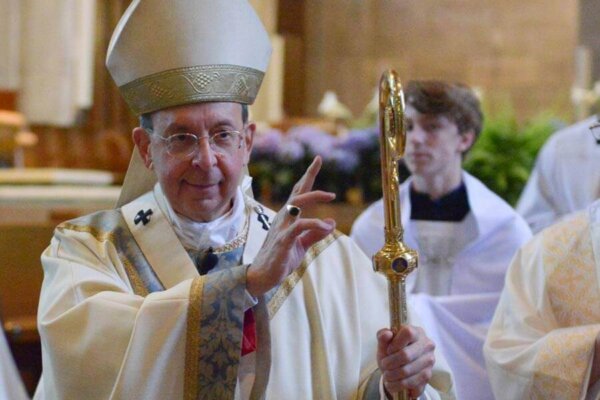
Thirty years ago today, I was ordained a bishop and life hasn’t been the same since. But all of us have had life-changing days. Maybe it was the day you were married. Or the day you began a job you always dreamt of. Or won the lottery. Sometimes life-changing days aren’t so good. Days of loss. Turmoil. Illness. Affliction.
Recalling life-changing days gives us the faintest inkling of what Mary Magdalene, Simon Peter, and the Apostle John experienced. Early in the morning, Mary Magdelene came to Jesus’ tomb only to find the stone rolled away and the body of Jesus not there. She ran to Peter and the others to tell them what she had found. Peter and John in their turn ran to see for themselves. As John, the beloved disciple, peered into the tomb, “he saw and he believed.” But as this morning’s Gospel goes on to say, “…they did not yet understand the Scripture that [Christ] had to rise from the dead.”
That’s putting it mildly. As one author notes, “The first believers’ response to the empty tomb was of trembling & ek/stasis”, a Greek word akin to our English word, “ecstasy”. It means, literally, that they were “outside themselves” (Erik Varden, Healing Wounds, p. 168). It was a moment in time that changed their lives forever: “They had to reconsider all things, gains and losses, graces and sins” (Ibid, p. 169).
The Most Life-Changing Day of All
On this Easter Sunday, we are invited to experience the wonder and the awe and the ecstasy of those disciples who first peered into the empty tomb. My prayer is that this Easter Day will be life-changing, for you and for me, a day when we encounter the Lord who died and rose for our salvation: the Risen Lord into whose life and death we were baptized, the Risen Lord who speaks to us when Scripture is proclaimed, the Risen Lord who gives himself to us in the Eucharist, his very Body & Blood.
What does it mean to encounter the Lord? It means, first of all, that the Risen Lord is Someone real. He is neither a figment of our imagination nor an invention of myth-makers. Whether we believe in him or not, whether love him or not, the Risen Lord is with us, just as he was with his first followers who encountered him in the Garden, in the Upper Room, on the seashore . . . . . who ate and drank with him after his Resurrection. But for our encounter to be complete, we must believe, we must hope, indeed, we must re-orient the whole of our lives towards him, namely, who and what we care about, what we think of, how we spend our time, what our priorities are, what we regard as good and what we regard as bad.
An encounter with the Risen Lord is different than other life-changing events. Such events may alter our lifestyle but we quickly adjust & find ‘a new normal’. Encountering the Risen Lord is different. His penetrating gaze pierces the heart. His Word enlightens. His touch transforms. His Spirit transfigures deep within. Once we have met the Risen Lord and welcomed into our hearts, everything changes, nothing stays the same, there is no ‘new normal’. It is quite like falling in love, head over heels.
Does Everything Change?
But does everything change? Do our relationships improve? Does the world around us suddenly become more peaceful? Do conflict, illness, poverty, and injustice evaporate like the morning dew? What about the wounds of sin and the wounds others inflict on us? You may find yourself saying, “I come to Mass, I go to Confession, I contribute, but life rumbles on pretty much as it always has.” Or you may say, “Life is difficult. I come to church for consolation, but walk away feeling the same or maybe even worse. How does encountering the Risen Lord change things?”
You know, the Lord did not promise to spare us suffering of any kind. What the Risen Lord did do, and does now, is to show us his wounds, the wounds in his hands, his feet, his side – not to elicit our pity but our faith. Today, right now, he is asking us to entrust him with our wounds, ours into his, for from his wounds flow the healing balm of divine mercy and love. Jesus transforms our wounds, making them the portal through which we are healed and through which we share divine glory, partially now, and fully, in the Kingdom of God. Only in heaven is every tear be wiped away. That is why St. Paul urges us to set our hearts ‘on what is above, not what is on earth’ (Col 3:3).
Ah, some may be tempted to say, “Karl Marx had it right! Christianity’s answer to pain and suffering is an escape to a mythical, other-worldly paradise.” But St. Paul is not urging us to clutch at straws. He is urging us, here and now, in the midst of setbacks and suffering, to take the same life-changing step the first disciples took – to step into the eternal light and love of the Risen Lord, who leads through this vale of tears to the joy of the Kingdom. To step into the glory of the Risen Lord means losing our life to find it, giving to the Lord all that besets us, together with our hopes and dreams, so that he may give us back our lives – transformed with his Risen glory.
This, in fact, is the great project of our lives. To die to self and so that even now we can live in that newness of life that Christ’s death and resurrection make possible. This project comes to pass only if we pray daily, confess our sins often, nourish ourselves with the Eucharist, grow in virtue, and serve those in need. Only then we can said with St. Paul, “It is not I who live but Christ who lives in me.” This is what changes our life, once for all. And this is what changes the lives of those around us. May this Easter Sunday be like no other day in your life and mine, for Christ is Risen, indeed he is truly Risen. Alleluia! Alleluia!