Turkey Bowl 100: Naval Academy-bound Card big on ‘brotherhood’

TOWSON – Donald Davis calls senior Kainoa “Kai” Sasaki a coach’s dream.

His teachers at Calvert Hall College High School are equally impressed by his work ethic, humility and faith.

The Cardinals will rely heavily on Sasaki and his leadership in the 100th Turkey Bowl. Promoted from the junior varsity as a sophomore, he has been around for most of their five-game win streak over Loyola Blakefield, which he hopes to extend as a starting slot receiver and punt returner.

“It’s fun,” Sasaki said of the game. “You look to your left and right, you’re seeing thousands of people. The fact that you have alumni and young kids, it shows that you’re not only playing for yourself or your team, you’re playing for those after you and before you. There’s a bigger picture.”

Sasaki, who attended Immaculate Conception School, almost wound up on the other side.

His brother Ethan attended Loyola Blakefield, but Sasaki wanted to attend Calvert Hall from the first day he visited the school.

“It really made me feel like part of a family, the brotherhood here,” he said.

A member of the National Honor Society and Spanish National Honor Society, he holds a 3.95 grade point average. He will attend the U.S. Naval Academy, and play lacrosse there.

“If you look at the core values of any of our service academies and the types of young people they look for, he’s a guy who checks those boxes,” said Davis, the Cardinals’ coach since 2007. “He has tremendous character. He has tremendous work ethic.

“The things that should be important to him are important – his faith, his family, the people around him. Those are things that should be important for anyone representing our country. And he has them.”

Ken Goedeke, who has taught Sasaki religion during his sophomore and senior years, says he embodies three pillars integral to the Calvert Hall mission: “Men of Intellect, Men of Faith and Men of Integrity.”

“He humbly lives his faith and influences others to look beyond themselves,” Goedeke said.

What distinguishes Sasaki, Goedeke said, is that he recognizes his shortcomings as well as his gifts and talents. He makes no excuses, only sincere effort in becoming the best student and person he can be.

Sasaki is quick to acknowledge the support he has found, both at school and home.

“My parents and teachers – it’s not like you’re on your own,” he said. “That’s what makes this school so special. These teachers will come after you. They want to help you. It’s not a job for them. It’s something that they love.”

Davis has seen many top-tier athletes come through the program. Sasaki, who has become more vocal and a mentor, is at the top of that list.

“He’s a coach’s dream,” Davis said. “He’s tough, he’s smart and he’s strong.Kai has worked his body into peak physical shape. He is maximizing his potential.”

Calvert Hall had an 8-3 regular season, with two of its losses coming against Maryland Interscholastic Athletic Association A Conference champion Mount St. Joseph High School.


Turkey Bowl hits 100: Calvert Hall-Loyola Blakefield more than a just game

The football teams from Calvert Hall College High School and Loyola Blakefield meet for the 100th time Thanksgiving Day, but when it comes to the pomp and circumstance preceding the Turkey Bowl, collaboration trumps territorial tendencies.

Sharing more than 340 years of history, the schools predate the Civil War. The Christian Brothers founded Calvert Hall in 1845; the Jesuits opened what is now Loyola Blakefield in 1852.

The mission they share is symbolized in the logo the boys’ schools commissioned for the centennial game (see left). It was produced by Planit Advertising, which was founded by Ed Callahan and Matt Doud, graduates of Calvert Hall and Loyola Blakefield, respectively. Both are part of multigeneration families at the schools.

Loyola Blakefield had no problem with Nelson Coffin, Calvert Hall class of 1966, writing the official, shared history,  “Turkey Bowl 100: The Storied Rivalry” (Cathedral Foundation Press). Similarly, Calvert Hall blesses St. Ignatius Loyola, a Jesuit middle school for boys, organizing and reaping the proceeds of the official game day program.

Through 2013, ad sales and compiling the program was another shared effort, coordinated by a familiar face from each school.

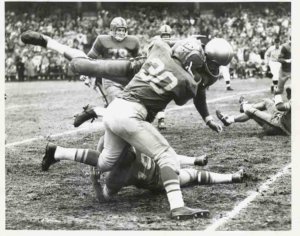
John Stewart, ’60, shown (top right, No. 30) leading Loyola to victory in 1959, spent decades there as a coach and administrator, and remains its special assistant for external affairs.

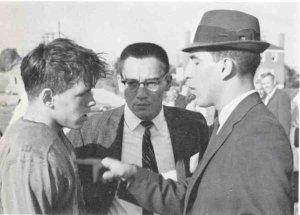
Doing program duty for Calvert Hall was Augie Miceli, a classroom and coaching institution (left) who died last June, weeks after completing 59 years of service to the school.

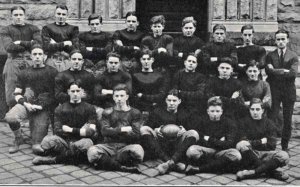
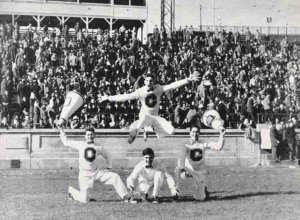
In the 1920s (right), games were played on the campuses of Johns Hopkins University and what was then Loyola College. What is believed to be the oldest continuous football series among Catholic high schools in the United States enjoyed its largest crowds on the site of Municipal (bottom left) and Memorial Stadiums.

The centennial game has meant even more hoopla than normal, as the two schools got together Oct. 11 at the Valley Mansion in Hunt Valley for a well-attended social event.

For Calvert Hall, November began with a surprise visit from Ozzie Newsome, the NFL Hall of Famer and former Ravens general manager, to deliver their custom centennial Turkey Bowl jerseys.

Five days later, the excitement at Loyola Blakefield included groundbreaking on its Innovative Learning Center, schedule to open at the start of the 2021-22 academic year.

Over the next week, CatholicReview.org will roll out other features involving the 100th Turkey Bowl.


TURKEY BOWL 2019

What: Calvert Hall vs. Loyola Blakefield

Where: Johnny Unitas Stadium, Towson University

When: Nov. 28, 10 a.m.

Tickets: $10, available at both schools

TV: WMAR Ch. 2

Radio: 105.7 FM The Fan

Series: Loyola Blakefield leads, 49-42-8. Calvert Hall has won five straight and nine of the last 10.


Email Paul McMullen at pmcmullen@CatholicReview.org


Archdiocese breaks ground for Mother Mary Lange Catholic School

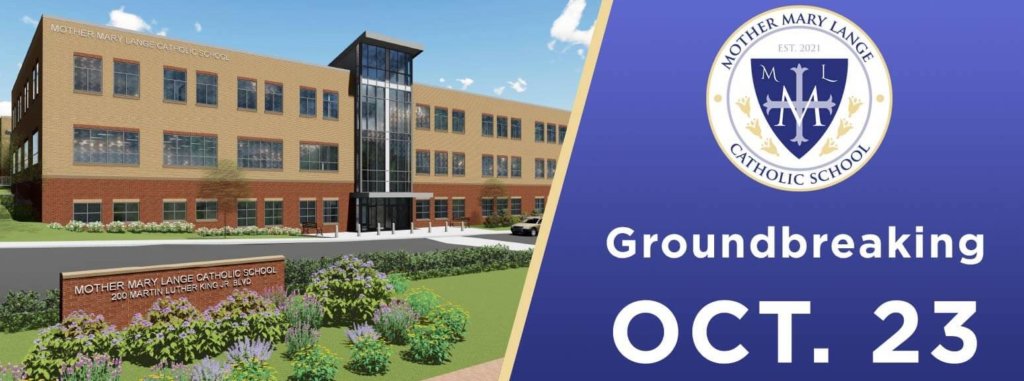
A group of students wearing white shirts emblazoned with “Mother Mary Lange School Class of 2022” formed a receiving line as several hundred guests gathered Oct. 23 for a groundbreaking ceremony at the site.

It’s a bold prediction, since none of the students attends the school. They can’t because it hasn’t been built yet.

The sixth-graders currently attend Holy Angels Catholic School and Ss. James and John Catholic School. They will be combined and be joined by other students from the area when the new Mother Mary Lange School opens in the fall of 2021 on a site just west of Martin Luther King Jr. Boulevard on Baltimore’s west side.

Jaylah Golder, one of the sixth-graders who will be in the first class to graduate from Mother Mary Lange, said it will be great to have a new school in the community. “With double classes, we can bring more children to the school,” she told the Catholic Review before the ceremony, at which she was one of the speakers.

Jaylah, currently at Holy Angels, hopes to spend a lot of time in the planned robotics lab, since she is in the robotics club at her current school. She may want to be a computer engineer.

Another student speaker, Breanna Ervin of Ss. James and John, said before the ceremony that she hopes to get to know the other students her school will be joining. “I want to bring into the world a new friendly face,” she said. “I want to try to bring something into the world.”

She has her career sights set, as well, as a courtroom lawyer. “I can’t wait until I win my first case.”

Breanna and Jaylah shared eloquently with more than 200 attendees what they appreciate about Catholic school education. After their speeches, James Sellinger, archdiocesan chancellor of education and master of ceremonies for the day, said, “Wow! We look forward to having you as eighth-grade leaders” when the school opens.

The two are expected to be among 400 students when the campus opens; the school can eventually accommodate 520 students in pre-K3 to eighth grade with two classrooms per grade.

The 65,000-square-foot facility will include a chapel, a STEM (science, technology, engineering and math) suite, state-of-the-art classrooms, a gymnasium and athletic fields. The project is expected to cost $24 million, of which $20 million has been raised from foundations, businesses and individuals.

The archdiocese also wants to create two $2.5 million endowments – one for tuition grants and aid and the other for operating expenses and facility maintenance.

Archbishop William E. Lori welcomed those attending, including donors, civic leaders and community partners. He recalled how, four years ago, he walked the Sandtown-Winchester neighborhood the morning after the worst night of unrest in the city following the death of Freddie Gray after injuries sustained in police custody.

He said in talking with residents of the area, just blocks from the site of the new school, “It was clear to me then that people weren’t upset just at the death of Freddie Gray. They had had enough of the status quo, of being marginalized, of being cast aside, of being expected to settle for what was presumed to be a life predetermined for them by others, by circumstances outside of their control.

“If the church and other institutions can’t stand with them in protesting these inequities, can’t help them envision a better life for themselves and for their children, then why are we here?” the archbishop said he asked himself.

A photo slideshow follows. Story continues below.

“That is why the archdiocese is making a bold statement and an even bolder investment of $24 million in Baltimore City and in this neighborhood because we believe it is the right thing to do for our children and for this community,” he said to applause.

The archdiocese, along with public and private partners, expects to provide tuition assistance for 80 to 90 percent of the student body, most of whom will not be Catholics. He said the school would appreciate the continuation of the state BOOST (Broadening Options and Opportunities for Students Today) program, and support from the archdiocese’s Partners in Excellence and Women’s Education Alliance, which aid low-income families.

Baltimore City Council President Brandon Scott, one of several civic leaders speaking at the ceremony, said he hears people say that Baltimore is dying or dead, but he doesn’t know what Baltimore they are talking about. Referring to the students with “Class of 2022” shirts sitting on the grass nearby, he said, “These young people will be the people who will build a better Baltimore.

“This investment in them and their families will ensure our future will be in better hands,” Scott said.

City Councilman Eric Costello, whose district includes the site, praised the archdiocese’s investment in the neighborhood. In an interview a few days before the groundbreaking, he said, “We’re going to have more folks in the neighborhood on a daily basis. It’s important because we’re going to have community use of the facility on the inside and the outside, so it’s something that’s really exciting for the neighborhood,” he said.

Costello said community leaders have been meeting quarterly with representatives for the past year or so, and the archdiocese has been receptive to recommendations, and has implemented some of them “I think what we’re getting is a better project than what we already had. It was a good project to start with. We’re making it better by having that community involvement.”

He said everyone – the mayor, the council, the archdiocese, donors and the community – knows that building a school cannot be done overnight. “But I think everyone in this process has been patient, understanding that the end product is going to be something that is really incredible, and is really going to benefit our kids,”

Councilman John T. Bullock, whose district borders the area where the school will be built, said in advance he’s “very excited” as a parent and educator. “Having another institution of education within our neighborhood would be great in terms of access for young people. I think it’s a great usage of the land,” he said.

Bullock has one son who currently attends Holy Angels School, and another son soon to start there. “What we see ahead of us is a truly 21st-century school, one that has the capability of preparing our young people to be successful in the future,” Bullock said. “We already have great administrators, teachers and staff. But also having the physical plant to match that is really a positive step.”

Community organizers in the area around the new campus are eager to see its completion, too. Sonia Eaddy, president of the Poppleton Now Community Association, and Paulette Carroll, president of the Townes at the Terraces, were among those to toss shovels of dirt for the formal groundbreaking.

“It’s going to change the nature of our kids, with another opportunity to see beyond,” Eaddy said. “This opens up opportunities to learn more and believe people care about them. Our community always feels left out – like nobody cares.”

Carroll said she is very grateful for the school, because she and her organization have been fighting for neighborhood facilities for years. “Kids can’t even bounce a basketball here.”

The ability to use the facilities at the school – including the gymnasium, athletic field and community rooms – will be a great benefit. She said people in the neighborhood will be very interested in the school, and many will offer to volunteer.

“We’re all working and praying that a change is coming,” Carroll said.

A Facebook livestream of the groundbreaking ceremony follows. Story continues below.


In an interview the week before the groundbreaking, Archbishop Lori said that although the school site is on the west side of MLK Boulevard, it’s close enough to the central part of the city to attracts students and families from the east side as well.

“I’m excited to see a beautiful new school be created on that site. I’m thinking about all the opportunity that this school will provide young people who live in our city, to grow in every way – spiritually, physically, intellectually, emotionally, socially,” the archbishop said.

He said the site is close to most of the students the archdiocese serves. “We’re within a half a mile of the demographic bullseye of the kids that we serve in our various schools.”

He highlighted the partnership with the neighborhood, for which the school’s facilities will be a community resource. The archdiocese also hopes to build partnerships to provide “wraparound services” for parents and students that can be provided easily on site.

Some of those wraparound services may be provided by the nearby University of Maryland, Baltimore, just one of approximately 50 business and civic partners working on the new school.

UMB President Dr. Jay Perman said the university is already highly engaged in the community, providing health and social services in a variety of venues. “With regard to the school itself, we have yet to formalize partnerships, but our intention is in some way to contribute to the health services that would be provided to children in the school.”

Children – in the new Mother Lange School or in public schools in the city – don’t go to school in isolation. Many live in areas that are considered “food deserts,” where there are not a lot of grocery stores to provide healthful options for nutrition. “They need support. They come from home environments which at times need a bit of help,” Perman said.

As a pediatrician, he believes “if we can get the children of our most-needy communities educated, everything else will take care of itself. Now that may be an over-simplification, but I’m sure that it’s not too far from the truth.” He said educating the community is “our passion. That’s our commitment,” at UMB, Perman said.

Perman told the gathered crowd that his office, across MLK Boulevard from the school site, looks out at the campus. “The University of Maryland Baltimore will be a close neighbor and a partner.”

He also said that the students at Mother Mary Lange will be able to see the university all around them, and hopes that inspires them to become students, faculty members or key employees. Visitors to his office will also see the children learning, laughing and playing at the school. To see children and watch them interacting in a good way, “It’ll be good for my soul,” he said.

Jack Dwyer, chairman of the board of Capital Funding Group, made the largest single donation for the new school, $3 million. He said that after the unrest in Baltimore in 2015, he wanted to help get something done on the west side. He then met with Archbishop Lori, who told him the archdiocese was already making plans to open a school in the area. He said he told the archbishop, “I’m in.”

Dwyer, who now lives in Florida although his businesses are mostly based in Baltimore, said, “Baltimore is important to me. Corporations that do business here have an obligation to give back to the city.”

He said he has focused his philanthropy on education and recreation, and the plan for the school to include updated educational athletic facilities that can be used by students and the community fits that goal.

“In my life, it was education and recreation that kept me out of trouble,” Dwyer said a few days before the groundbreaking. “If I can help 500 kids have access to an excellent school program, we’re going to make a difference in the world.”

Dwyer, who helped toss a shovelful of dirt, said when the school opens in the fall of 2021, he hopes to see “a lot of smiling kids’ faces. And I hope that they understand what a great opportunity they have.”

Archbishop Lori said it is a priority for the church to invest in the city “and particularly in West Baltimore which needs allies and friends.”

The school is named for Mother Mary Lange, a woman of color who came to Baltimore from the Caribbean before the Civil War. “Even in a city that had Southern sympathies and where slavery was still sadly practiced, she opened up a school for young women of color, St. Frances Academy, which exists today,” he said. Mother Lange also founded the Oblate Sisters of Providence “to do this work on a grander scale, as they continue to do.”

“I couldn’t think of a better patron for what we’re trying to do at this school which is to embrace and love young people, particularly young people of color, who live in our city and to offer them a place of safety and place a love, a place of respect and a place where they can flourish,” the archbishop said.

Oblate Sister of Providence Rita Michelle Proctor, superior general of the order founded by Mother Mary Lange, said the groundbreaking was one of the happiest moments in the 192-year history of her community. Mother Lange founded the first school for girls of color in her Fells Point home in 1828 and founded the Oblate Sisters of Providence, the first religious order for women of African descent, in 1829.

The new school will be “a way of continuing Mother Lange’s legacy,” she said.

Referring to the ongoing cause for canonization of Mother Lange, Sister Rita Michelle said, “It’s in God’s own time, but that would be the greatest day in our community life for the school to change from Mother Mary Lange to St. Mary Lange.”

For more on Mother Mary Lange Catholic School, click here.

Email Christopher Gunty at editor@CatholicReview.org.



Archbishop Lori: Baltimore archdiocese to break ground on new city school

The following op-ed appeared in the Oct. 21 issue of The Baltimore Sun.

It’s been said that faith makes possible that which circumstance renders implausible.

In the case of Elizabeth Clarisse Lange, who emigrated from Cuba in the early 1800s to settle in Baltimore, her remarkable faith was matched by an indomitable will and a burning desire to serve those most vulnerable, mainly the young and uneducated. She was on a mission to enlighten the children of French-speaking Catholics who were flooding into Maryland at the time as refugees from the Haitian Revolution.

Lange, together with her friend and housemate Marie Magdelaine Balas, provided instruction for as many young black children as they could accommodate in their modest Fells Point home. She professed vows and established the first religious order for women of African descent in 1829, and devoted herself to serving the needs of black youth and adults of the city.

Now, in our day and time, the legacy of Mother Mary Lange continues. We of the Archdiocese of Baltimore also recognize that pervasive inequity and inability to access quality education represent among the greatest threats to the realization of young talent and potential. It’s in the spirit of Mother Mary Lange that we are putting our determined efforts and resources in service to the young people of our community by breaking ground for the first Catholic elementary school in the City of Baltimore in nearly six decades.

Named in honor of Mother Mary Lange and slated to open in the fall of 2021, this 21st century, pre-K-8 school will serve students who are currently attending Baltimore’s Holy Angels and Saints James and John Catholic schools. We anticipate offering tuition assistance for between 80 and 90% of what will be a mostly non-Catholic student population which is expected to grow to 520 students in the first five years of operation.

Among the state-of-the-art amenities that will motivate learning and spur ambition in these young people will be art and music rooms, a new library commons and media center, a STEM Lab with makerspace and robotics, a gym and a soccer and lacrosse field with an exercise circuit. The professional staff will number some 35 teachers, teacher-aids and administrators, and will include a full-time counselor as well as medical and dental care professionals and a speech and language clinician.

During the construction of the 66,500 square foot complex representing a $24 million investment by the archdiocese, our contractor, Whiting-Turner, will involve a large contingent of minority and women business owners to bid on the extensive array of services involved with the school’s construction and operation, while also providing low-income city residents opportunities for pre-apprenticeship training programs.

Preparations for the new school have focused on forging extensive community partnerships. The invaluable leadership of the Southwest Partnership, the University of Maryland and Bon Secours, in particular, is helping us to develop strong ties to local community associations, other public schools and other anchor institutions in the area. Going forward, we will continue to assess local community needs and determine how the new school can best serve families in the area.

Education has been at the core of the Catholic Church’s mission in the United States for more than 200 years, and today some 69 Catholic schools in nine Maryland jurisdictions educate nearly 25,000 students from kindergarten to high school, in addition to the four colleges and universities operated by religious orders that serve nearly 11,000 undergraduate and graduate students. Parents of all religious backgrounds send their children to our schools because they are safe, academically-excellent and rooted in the Gospel values that transcend religious denominations. Nearly all of our students graduate high school, and the vast majority go on to college and become valued contributors and leaders of their communities.

In prioritizing young lives at risk, we summon all within our communities to nurture and care for those who will determine our future, inasmuch as we make possible their own. It is our sad though unacceptable reality that so many young people of our city are prey to senseless violence and the cruelty of hopelessness. It’s for them, therefore, that we invoke the enduring memory and selfless devotion of Mother Mary Lange, who demonstrated in her time the power to defeat attitudes and conditions that threatened the God-given potential of those many young people in her care. May we all, in our every capacity, commit our constant efforts to doing the same for those now in ours.

Learn more about the new school here

William E. Lori is archbishop of Baltimore. He can be reached at communications@archbalt.org.


How Mother Mary Lange Catholic School got its name

When a new school opens in September 2021 bearing Mother Mary Lange’s name, it will be thanks in small part to community activist Ralph Moore and a well-timed letter to the editor in The Baltimore Sun.

In 2018, the Archdiocese of Baltimore needed a name for its first new city school in 60 years. For Moore, the solution was clear and her name was Mother Mary Lange.

During the 19th Century, Mother Lange and her sisterhood, the Oblate Sisters of Providence, were the only providers of Catholic education to black children in Baltimore, many of them the children of slaves. Mother Lange and the sisters, the first sustained religious order for women of African descent in the United States, also gave shelter to orphans and tended to the sick during the cholera epidemic of 1832. Named a “servant of God” by the Vatican, Mother Lange is line for sainthood and could become the first ever black American saint.

“Naming the school for her makes a strong statement about acknowledging the contributions of black Catholics in Baltimore despite longstanding racial prejudice by the church,” Moore wrote in his August 2018 letter to the newspaper.

The letter and subsequent online petition by the local community, attracted the attention of the Archdiocese of Baltimore and less than a month later Archbishop William E. Lori announced that the school would carry Mother Lange’s name.

“I couldn’t think of a better patron for what we’re trying to do at this school, which is to embrace and love young people, particularly young people of color, who live in our city and to offer them a place of safety and place a love, a place of respect and a place where they can flourish,” Archbishop Lori said this week.

The school was originally named after Cardinal William H. Keeler, but the archdiocese reversed course after a Pennsylvania grand jury report questioned then-Harrisburg Bishop Keeler’s handling of allegations of sexual abuse in Pennsylvania.

Moore’s connection to Mother Lange and the Oblate Sisters of Providence runs deep.

As a boy, Moore was taught by the Oblate sisters at St. Pius V Catholic School in the city’s Harlem Park neighborhood. And for 10 years, Moore worked for the Oblate sisters as the director of the St. Frances Academy Community Center.

Moore said he was impressed that Mother Lange and the Oblate sisters educated black children despite the prevailing racial prejudices of the time.

“She is sort of the mother of literacy in this area. The mother of education,” Moore said of Mother Lange. “(She and her fellow sisters) showed great courage, and their commitment was to a higher law.”

With state-of-the-art features such as a robotics lab, the 65,000 square-foot elementary school will primary serve black students from across the city.

“It makes a great statement for this community that the Catholic Church would name the school after Mother Mary Lange,” he said. “Many in the community, particularly in the African-American community, feel that Mother Mary Lange is a saint. We know she’s in heaven. … There was no question that she deserved that the school be named for her.”

Moore said he also pushed for the name because the archdiocese had named a school for Mother Lange before in 2005, only for it to close in 2010.

Moore said the new school, at Martin Luther King Jr. Boulevard and Lexington Street, will be “a shot in the arm” and “a great boon” for the city’s Poppleton neighborhood just west of downtown.

“The school will impart certain values. Certain values are taught in Catholic schools such as love, kindness and care for those in need,” Moore said. “If it’s one thing people want, it is quality education for their children.”

For more on Mother Mary Lange Catholic School, visit www.mmlcs.org.

Email Tim Swift at tswift@CatholicReview.org


Meet Mother Mary Lange, the namesake of the Archdiocese of Baltimore’s newest school

On Oct. 23, Mother Mary Lange, a trailblazing Catholic woman of African descent, will be honored yet again as the Archdiocese of Baltimore breaks ground on its first new city school in nearly 60 years. Here’s a look at her incredible life:

Early life

Elizabeth Clarisse Lange was born in the late 1700s in Santiago, Cuba, where she was well educated and lived in a French-speaking community. Earlier stories had said she had lived in Haiti, but Sharon Knecht, archivist for Oblate Sisters of Providence, says there are no historical records to indicate any connection to Haiti. By 1812, Mother Lange had immigrated to Baltimore, joining a large number of French-speaking Catholics from Haiti. While there are no historical records explaining why Mother Lange moved to the United States, Knecht believes that Mother Lange left Cuba rather than swear an oath of allegiance to Spain, which had recently consolidated power on the island. Knecht says Mother Lange described herself as “French to the core.”

Educating immigrants

After moving to the Fells Point area of Baltimore, Mother Lange discovered that there were few educational opportunities for black children in the city. As Southern state, Maryland practiced slavery and many black people in Baltimore at that time were enslaved. Meanwhile, free African Americans and the recent Haitian immigrants faced intense prejudice and were denied access to most schools. Along with her friend, Marie Balas, Mother Lange opened a school open to anyone in her small home.

Pioneering work

Mother Lange and Balas’ small school later attracted the attention of Sulpician Father James Hector Nicholas Joubert. A former soldier who had fled the slave rebellion in Haiti, he sought to teach the recent Haitian immigrants Catholicism, but found that many did not know how to read. After visiting Mother Lange’s school in 1828, Father Joubert, with the backing of Archbishop James Whitfield, encouraged Mother Lange to found a religious order to educate African-American girls. The Oblate Sisters of Providence would become the first sustained religious order for women of African descent in the United States. Mother Lange, who had long wanted to become a nun, followed her calling and took the name of Mary. For decades, the Oblate Sisters of Providence were the sole providers of Catholic education for black children in Baltimore.

The sisters’ school would eventually become St. Frances Academy — the oldest continuously operating school for black Catholic children in the United States. With little outside support, the sisters also performed other charitable work, including establishing homes for widows and orphans and treating the terminally ill during a cholera epidemic in 1832. After years of service to the church and the community, Mother Lange died in 1882 at her convent. The Oblate Sisters continue their work today with about 80 sisters working in Maryland, Florida, New York and Costa Rica.

Watch a video of the 2013 reinterment of Mother Mary Lange’s remains at the motherhouse of the Oblate Sisters of Providence. Story continues below.

Possible sainthood

In 1991, the Catholic Church opened an investigation into whether Mother Lange should be considered for the sainthood, naming her a “servant of God.” But the road to sainthood is a long one. Knecht says that Xaverian Brother Reginald Cruz has recently complete writing his “positio,” a document arguing for Mother Lange’s sainthood. Once published, the Congregation for the Causes of the Saints will evaluate the document, and if approved the “positio” will be forwarded to the Pope, who could grant Mother Lange the title of “venerable.” After the approval of the “positio,” church scholars will then have to document two confirmed miracles attributed to her intercession. Knecht says the Oblate Sisters of Providence are currently working to raise Mother Lange’s profile globally to ensure her success in the lengthy process.

For more information about Mother Lange Catholic School, click here

Email Tim Swift at tswift@CatholicReview.org


Children reminded of their power at Rosary Congress

When Father James Boric asked more than 150 Catholic school students to name the most powerful person in the world, youngsters offered suggestions far and near: Pope Francis, President Donald J. Trump and Archbishop William E. Lori.

While the rector of the Basilica of the National Shrine of the Assumption of the Blessed Virgin Mary in Baltimore agreed those were good selections, he insisted that it was the children themselves who held the real power.

“I think you all have more power, and that’s because of the power of prayer,” said Father Boric, speaking Oct. 8 during a special children’s event on the fourth day of the 2019 archdiocesan Rosary Congress.

The congress, which includes the hourly praying of the rosary, round-the-clock eucharistic adoration, spiritual talks, opportunities for confession, liturgies and more,  runs through Oct. 11 at the basilica. Several parishes are also concurrently offering special activities.

“When you pray, God will listen to what you say,” Father Boric said, “and he will do what you ask. That’s real power.”

Father Michael DeAscanis, pastor of St. Philip Neri in Linthicum, told the students that when the Blessed Virgin Mary appeared to three peasant children more than 100 years ago in Portugal while the world was at war, she asked them to pray the rosary every day for the intention of peace.

“She said that the adults are making a mess and I need the children to clean it up,” Father DeAscanis said. “The children listened and now two of them are canonized saints and the other is on her way.”

Father DeAscanis cited St. Bernadette as another example of a young person who knew the power of prayer. When St. Bernadette was 14, the Blessed Virgin Mary appeared to her in Lourdes, France. Mary asked her to dig in the ground near a grotto, from which sprang flowing waters that had healing effects for many of those who washed in them.

The priest noted that Mary appeared to Bernadette 17 times and that St. Bernadette took up the challenge to carry forth the message of prayer and penance. Since that time, there have been 70 recognized miracles at Lourdes, he said.

“Miracles still happen for those who believe and pray,” Father DeAscanis said.

Father DeAscanis asked the children not to wait until they are older to pursue holiness. They can start now, praying the rosary regularly.

“God wants you to change the world in some way,” he said. “We need to ask him how. Ask God to show his way for your life and help you to desire it.”

Children participating in the Oct. 8 event at the basilica hailed from St. Augustine School in Elkridge, Our Lady of Mount Carmel School in Essex, St. Mark School in Catonsville, St.Michael-St. Clement Mary Hofbauer School in Overlea, St. Philip Neri School in Linthicum, Cardinal Shehan School in Baltimore, St. Pius X School in Rodgers Forge and St. Ursula School in Parkville.

A student from Archbishop Spalding High School in Severn joined several basilica docents in giving tours of America’s first cathedral.

In the presence of the Blessed Sacrament exposed on the altar in a monstrance, the youngsters solemnly moved fingers over plastic beads as they prayed the Sorrowful Mysteries of the rosary. Five student representatives led each decade.

Father DeAscanis asked the children to pray in their hearts for a different person during each of the 50 Hail Marys offered.

Alexis Morgan, an 11-year-old sixth grader at St. Pius X School, and Nolan Morrison, a 12-year-old sixth grader there, said they live in a time when they can feel powerless. Hearing about the power they hold in prayer was eye opening, they said.

“I feel like prayer gives you power because your soul is opening up to God so you feel like you are better able to deal with these bad times,” Nolan told the Catholic Review. “If there’s something bad happening and you want to fix it, you call on God to fix it in that moment. You ask for help.”

Onyinye Igbanugo, a 7-year-old second grader at St. Mark School in Catonsville, is a member of her school’s rosary club. More than 25 students of all ages gather every Monday after school to pray the rosary. Onyinye said she also sometimes prays the rosary with her family on weekends.

“It’s important to pray to God,” she said, “especially to pray for others who are sick.”

The girl was emboldened to think of the power she holds in prayer.

“It makes me feel special to know that I have a voice to speak to God,” she said.

For more information about the Rosary Congress and a schedule of events, visit archbalt.org/rosarycongress

Email George Matysek at gmatysek@CatholicReview.org.


Mount de Sales enjoying a stellar fall sports season

While volleyball has gotten the most attention, it is one of just four teams from Mount de Sales Academy in Catonsville enjoying strong fall seasons.

Cross country, field hockey and soccer are also faring well, and also poised for their championship seasons in the Interscholastic Athletic Association of Maryland.

Eric Dummann, athletic director at the all-girls’ school, noted a recent pep rally, where students cheered all four teams at a time when none had lost a conference competition. He said the Sailors’ fall success has given the school a boost.

“I think it certainly gives the young ladies a sense of confidence and pride when you’re winning,” Dummann said. “We’ve been (stronger) from the beginning this year. They knew right from the get-go that this would be a strong season.”

On the volleyball front, Mount de Sales is 10-0 in the IAAM A Conference through Oct. 6. The Sailors are seeking their third straight title A Conference title, and haven’t skipped a beat under new coach Gary Troy, who said this team simply does its work on a daily basis and isn’t obsessed with any streaks.

“They want to three-peat, but they also know that in order to three-peat, they have to take care of business,” Troy said after a recent four-set victory at McDonogh. “They are a hard-working team.”

The Sailors have a solid core of players, led by juniors Mary Grace Goyena, who has already committed to play at the University of Pennsylvania, and Chidinma Onukwugha. The latter’s sister, Kelenna, is a freshman who is developing into a force, as she played a big role in the win at McDonogh.

The mother of the Onukwugha sisters, Ebere, is an associate professor of pharmaceutical health services at the University of Maryland’s School of Pharmacy in Baltimore. She wanted her daughters to find a sport to enjoy, which they have done. (Their father, Chidi, is an attorney).

“They are mentally tough, and it shows on the court,” Troy said of his team. “When they have a little bad streak, they’re the first to know what they did wrong.”

Cross country, meanwhile, is poised for a similar feat. It includes many holdovers from last season, when it dominated the IAAM championships, starting with sophomore Juliette Whittaker, who posted a mild upset over then-senior Samantha Facius to take individual honors.

Whittaker continued to emerge as one of the top runners not just in the state, but the nation, with an outstanding campaign in spring track and field that IAAM titles at 800- and 1,600-meter runs. Her cross country season includes taking the Elite Division race at Hereford High School’s Bull Run Invitational, covering 3.1 miles in 18 minutes, 25.5 seconds. Her sister, Bella, one of the Mid-Atlantic’s best at 400 meters, is slowly making her way back from a foot injury.

The IAAM championships will be held Oct. 29 at McDaniel College in Westminster.

Soccer started 8-1 overall, 5-0 record in the IAAM B Conference, where the Sailors lost to Roland Park Country School in the tournament semifinals last season. Obviously, they want more this time around.

Field hockey also plays in the B Conference. It started 8-4 overall, but 5-0 in the conference. Last year, it lost in the conference title game to St. Mary’s.

Steve Weber, who coaches cross country as well as track and field, is also a philosophy professor at Loyola University Maryland. He has been working on a new mission statement for the Sailors’ athletic program, one, he said, which mentions seeking excellence in sports through the practice of courage, moderation (self-control), justice (fair play) and wisdom.

“Its virtue is that it’s simple and clear,” Weber said. “We all realize that this is what we’ve all been seeking.”


Schools gala keeps creating Catholic scholarships in Baltimore Archdiocese

The 11th annual gala for Archdiocese of Baltimore schools Sept. 28 saw more than $720,000 raised in scholarships funds, raising to approximately $8 million the effort has brought in since its inaugural in 2009, one that had already created more than 1,300 scholarships for students in need.

“It is a true partnership and fraternity,” Archbishop William E. Lori said during his remarks.

He noted the work of students and “our outstanding priests, religious, deacons, school presidents, principals, teachers and school board members … They are why our schools are so excellent.”

The archbishop spoke at length about Mother Lange School, and the Oct. 23 groundbreaking on the first new Catholic school to be built in Baltimore City in more than 60 years.

“It is a tangible symbol of the church’s commitment to Catholic education, to the City of Baltimore and to our children of today and tomorrow,” he said. “The commitment to build a new school … represents a major investment.

And while we could choose to make that investment in any of our nine surrounding counties, we have chosen to do so in Baltimore, on a block of land on a street named after Martin Luther King Jr., a champion of peace and of human dignity. “And we’ve chosen to name the school after Mother Mary Elizabeth Lange, who founded the first order of nuns of African descent and the first Catholic school for children of color – just a few blocks from the site of our new school.

“We pray others will be inspired to make a similar investment in our city and in those who call it their home.”

The evening’s entertainment included familiar faces in the form of the choir from Cardinal Shehan School in Baltimore, and students from one of its newest collaborators, Krieger Schechter Day School, on “Ain’t No Mountain High Enough.”

That segment began with Harrison Fribush, an eighth-grader from the Jewish day school, playing a bongo solo. Fribush has raised $5,000 for enhancements to the music room at Cardinal Shehan School. According to his mother, Nicole, as part of his Bar Mitzvah project, Fribush established a Go Fund Me page to raise money for both Cardinal Shehan’s music program, and Believe In Music, an after school music program for Baltimore City youth.

The event at the Marriott Waterfront included a video presentation on First Fruits Farm and remarks from founders Rick and Carol Bernstein, on the contributions Catholic schools have made in the volunteer-led harvesting of approximately 15 million pounds of fruits and vegetables that has been donated to local food banks, homeless shelters and other food providers.

Andre Hepkins and Lacee Griffith of WBAL-TV served as hosts of the event, whose chairperson was Laura Gamble, a regional president of PNC Bank. The blessing was provided by Bishop Adam J. Parker.

Editor’s note: This story was updated Oct. 1, 10:30 a.m., to correct the source of the donation for Cardinal Shehan’s music program.

To see more photos or purchase prints, visit our Smugmug gallery here

Also:

Listen here to a Catholic Baltimore radio program about First Fruits Farm


Philanthropist Mary Catherine Bunting gives record $2 million gift to IND

Mary Catherine Bunting, a Baltimore philanthropist, has given a record $2 million gift to the Institute of Notre Dame in Baltimore, according to a Sept. 30 news release from the school.

The donation, which will be used for student scholarships, is the largest single philanthropic gift in the school’s 172-year history.

“This is an exciting time to be both an IND student and potential student,” said Head of School Christine E. Szala in the release. “Ms. Bunting’s gift will allow IND to help girls in Baltimore City and surrounding neighborhoods attend and be part of our great institution.”

Bunting is known for her philanthropic work throughout Baltimore City. The granddaughter of the founder of the first Noxzema Chemical Company, she is is a former Sister of Mercy and retired nurse practitioner. She has donated to numerous Catholic causes, including providing a major gift toward a $400 million capital campaign to build a 20-story tower for Mercy Medical Center in Baltimore that opened in 2010 and is named in her honor.

“IND is special,” Bunting said. “Since 1847, the school has remained true to its identity and has stayed committed to Baltimore and educating girls in the city. It is a place that will continue to grow, and I recognized the importance and that is why I chose to support the school’s scholarship efforts.”

The first scholarships through the gift will be awarded in the upcoming 2020-2021 school year.

“Ms. Bunting’s gift speaks to IND’s mission and its commitment to the city and the important role the school plays in educating young girls,” Szala said. “We are extremely grateful for her generosity and willingness to help shape tomorrow’s leaders.”

IND, founded by the School Sisters of Notre Dame, first opened its doors in 1847 under the guidance of Blessed Teresa Gerhardinger, who traveled from Germany and settled in Baltimore.


NDP well on its way in $10 million campaign for Innovation Wing, endowment

TOWSON – Notre Dame Preparatory School broke ground on a new Innovation Wing in June 2018, when it had barely scratched the surface on a $10 million capital campaign that would pay for the latest transformation of the school.

Asked to measure that leap of faith, the president of the all-girls school referenced the history of the School Sisters of Notre Dame who opened NDP in 1873, a generation after their foundress left Munich for the United States and encountered several dead ends before finding a foothold in Baltimore.

“To say we’re going to break ground when we haven’t raised the money, that’s a defining moment,” School Sister of Notre Dame Patricia McCarron said, “but it really is consistent with Mother Theresa (Gerhardinger) coming to America, and with our moving from our original site on Charles Street to Hampton Lane.

“The spirit of the School Sisters is trust and dare. You trust in God’s providence and action.”

That faith has been rewarded, as the school formally announced to its community Sept. 26 developments that the 800 girls at the grades 6-12 school have been witnessing come to fruition.

NDP is more than 80 percent of the way toward reaching a $10 million capital campaign, the largest in its history. It had less than $2 million in pledges, however, when it broke ground on the Innovation Wing, which is near completion. It will open in January and be formally dedicated next April 22, Earth Day 2020.

The new, 23,500-square-foot-wing will accentuate opportunities for students in both its burgeoning STEAM program and the Bette Ellis O’Conor Humanities program. In addition to a new gathering space, it includes a biomedical suite; a classroom dedicated to computer science and cybersecurity; and a two-story “Design and Build” laboratory.

Whereas students had to construct theater sets on stage, for example, now they will be able to construct them in that lab and then be transported as needed. According to Mary Agnes Sheridan, STEAM director at the school, there will simply be more room to innovate with tools such as 3D printers and CNC routers, computer-controlled cutting machines.

Since 2006, more than 1,000 NDP students in the upper level have gone off campus for Women in (WIN) experiences, which can mean internships with doctors, engineers and other professionals. The Innovation Wing allows students to further explore some of that learning in house.

“We’re always about responding to the needs of the time and looking towards the future,” Sister Patricia said. “We know our girls can do it; We’ve seen them do it. What this space does is allow them to take their dreams to the next level.”

The Innovation Wing is on the south side of the school, bridging the existing science and English department wings on the west and east, respectively. With the Mother Philomen Library on the north, the new wing creates a second, larger courtyard on campus, covering nearly 12,000 square feet.

The “Limitless: Redifining Possibilities, Unleashing Potential” campaign has received nine pledges of $250,000 or more, and another 21 of more than $100,000.

In addition to the construction, the campaign will provide more than $2 million for scholarships to NDP, one of three Catholic schools in the Archdiocese of Baltimore where the annual cost of attendance has surpassed $20,000.

The campaign’s co-chairs are Lilly Hunter, an alumna and current NDP parent, and Scott Wilfong, a former NDP parent and current NDP grandparent.

“NDP must keep tuition competitive and scholarships available,” Wilfong said in a news release from the school, “and (campaign) support through endowed scholarships and the annual fund will help with both of those directives.”


Our Lady of Mount Carmel School modernizes campus

ESSEX – Our Lady of Mount Carmel School took a major leap into 21st century over the summer, heeding the call of Pope Francis to become better stewards of the environment.

Improvements to the power grid and stormwater run-off provided the foundation for much of the modernization, which honors the pope’s 2015 encylical on the environment, On Care for Our Common Home (Laudato Si’).

Our Lady of Mount Carmel  and St. Mary in Annapolis are the only parishes in the Archdiocese of Baltimore whose campuses include K-12 education.

Students returning to class for the 2019-20 school year in Essex were greeted to a lengthy list of improvements, which included new carpeting in the elementary school; new drop ceilings in the high school; a modernized chemistry lab; and brighter hallways and classrooms, thanks to fresh paint and a self-adjusting state-of-art LED lighting system.

Mike Naunton, assistant principal for the upper school and special assistant to the president, oversaw the summer project.

“This is my 28th year here at the school and I’ve never seen it look this good,” Naunton said. “There’s a sense of pride. “It was like we moved into a renovated house.”

He gave credit for the school’s transformation to Larry Callahan, OLMC’s president, who in August received the 2019 Doris Musil Award, the archdiocese’s highest honor for Catholic educators.

“He has always been open to the next project,” Naunton said. “He wants ideas … and then he sits down with his team and tries to figure it out and make it happen.

“Over the spring break, we were able to design a lab that’s very sleek and modern, with more storage, stations where kids can work together, and open space for robotics and forensics.”

Callahan, Naunton said, wanted the class of 2019 to witness those changes.

“He was committed to that,” according to Naunton.

Alexander Brodsky, director of athletics and alumni relations, said it’s a “significant amount of infrastructure” and pointed to a generous donor who made possible overhauling the power system.

Air conditioning was added to the gym, and fiber optic cable runs were completed, allowing for the use of up to 4,000 devices simultaneously and improved collaboration between teachers and students using Google School and Chromebooks.

With a grant from the Knott Foundation, students in grades 9-12 have take-home Chromebooks, while grades 6-8 have Chromebooks for in-school use.

“Our lives move faster,” reflects Brodsky, an OLMC alumnus who’s been on staff for six years. “We can harness those same powers (used in social media) too and engage them (students) academically.”

Brodsky described how students can review, collaborate, edit and submit assignments using Google Classroom from anywhere with Wi-Fi access.

Teachers display learning material on large flat screens using Chromecast.

“All the technology happens seamlessly. A lot of our assignments are handed out digitally (which) instills a certain level of work ethic and engagement.”

A partnership with the Gunpowder Valley Conservancy allowed for the creation of rain gardens and micro bio retention ponds to handle stormwater run-off from over 10,000 square feet of roof, which makes its way through Middle River into the Chesapeake Bay.

Native plants with root systems reaching some 30-feet deep allow for natural water filtration, while attracting pollinators such as butterflies. Staff are evaluating how best to use those enhancements in the science curriculum.

“So many people have seen the quality of the kids we have and the quality of our teachers,” Naunton said. “Every improvement gives us an idea for another.”

Our Lady of Mount Carmel School has spent $2.46 million on the renovations and improvements, according to Callahan. The school is in the second year of a capital campaign to raise $3 million.