13th Annual Rev. Dr. Martin Luther King Jr. & Rev. Msgr. Edward Michael Miller Peace Walk

For Immediate Release:
Contact: Christian Kendzierski
Tel. 410-547-5378
christian.kendzierski@archbalt.org

St. Bernardine Catholic Church with Historic St. Peter Claver announces the 13th Annual Rev. Dr. Martin Luther King Jr. & Rev. Msgr. Edward Michael Miller Peace Walk, to be held on Martin Luther King Jr. Day, January 19, 2026, at 12:00 p.m. This annual tradition gathers community members, civic leaders, clergy, and neighbors from throughout the region for a prayer service and walk dedicated to peace, justice, and unity.

This year’s event will feature Pulitzer Prize winner Taylor Branch as the guest speaker. He is recognized for his award-winning trilogy chronicling the life of Dr. King and the American Civil Rights Movement.

“What a privilege to have the renowned author Taylor Branch come to West Baltimore to speak at our annual Peace Walk. Our city neighborhoods need the message of hope and peace left to us by Dr. King and recorded so eloquently by Taylor Branch.”

The celebration and walk will be led by William E. Lori, Archbishop of Baltimore, and Monsignor Richard J. Bozzelli, pastor of St. Bernardine Catholic Church.

Following the prayer service, participants will join in a community peace walk through Edmondson Village, stopping and praying at several sites of crime and violence in the neighborhood. The service and walk honor the legacies of Rev. Dr. Martin Luther King Jr. and Rev. Msgr. Edward Michael Miller, the late pastor of St. Bernardine Church.

The service will take place at:
St. Bernardine Catholic Church
3800 Edmondson Avenue
Baltimore, MD 21229

“Lord, make me an instrument of your peace…”


Archbishop Lori’s Homily: Black History Month Mass

Black History Month Mass
St. Matthew Church
February 4, 2025

I’m glad to see so many of you here today representing so many Catholic schools in the Archdiocese of Baltimore. Thanks for coming to celebrate Black History Month and to pray for an end to racism and progress in achieving racial justice.

History is important. It matters. Black History matters. It is important to know about the lives of people who lived before us. To know what they faced. To know how they struggled. To know the heroes. Black History Month is designed to help us do that –whether you are in elementary school, high school, or beyond.

It is important that we face up to injustices of the past, especially slavery. No one is anyone else’s property. No one owns another human being. We are made in God’s image. We are his people. We belong to him. The truth is that God loves each of us and has endowed us, as the Declaration of Independence says, “with certain inalienable rights, among them life, liberty, and the pursuit of happiness.” Almost 250 years later, our country is trying to live up to that ideal.

History has more than its share of villains. The slave traders and slave owners, sadly, some of them Catholic. Those who made it hard for emancipated slaves to break out of poverty and servitude. Those who put into place Jim Crow laws and turned a blind eye to oppression and violence against Black people. Among the villains are people who were indifferent. Who couldn’t be bothered. Who just wanted the status quo.

But there were heroes. Reverend Dr. Martin Luther King; Jr. Rosa Parks; Frederick Douglas; Harriet Tubman; Booker T. Washington; W.E.B. DuBois; Thurgood Marshall. Every one of these were great citizens and heroes. They helped break down barriers. They paved the way for progress. They devoted their lives to making our country more just and equitable.

Some of these heroes were Catholic. We call them the “Saintly Seven”. Mother Mary Lange, who educated young women of color in Baltimore prior to the Civil War and founded the Oblate Sisters of Providence. The others are: Pierre Toussaint, Henriett Delille, Fr. Augustus Tolton, Julia Greely, Thea Bowman, Martin Maria DePorres Ward. In November we celebrated Black Catholic History Month. I hope you learned about these remarkable women and men of color who are on track to be recognized as saints in the Catholic Church.

They lived in different times and had different callings. Three of them were religious sisters. Two were lay people. One was a priest. All of them sought to follow Jesus and to serve his Church, and did just that in spite of discrimination and racism. Each of them gave everything to serve Christ and his people. Each of them is a hero, a role model for us.

Black History Month is a good time to refresh your knowledge of them. We need to know who they are what they did. We need to pray that they will be recognized as saints. And we need to ask their prayers and imitate their virtues.

History shows us villains and heroes. We honor our those who laid the foundation for the civil rights movement and those who taken up the cause of racial justice down to our own day. They are people who helped make the world a better, more just place. But the true heroes of history are the saints, the saints God has raised up from the Black Catholic community. They are praying for you. They are rooting for you. They love you.

Here’s how you can honor them. During Black History month, resolve to write a chapter of history of your own. Resolve to develop your God-given talents, make good use of the Catholic education you are receiving, ask for God’s help and the help of your parents and mentors in becoming the very best possible version of yourself. Become one of those heroes who is willing to make sacrifices to make our country a better place, a place that is just and compassionate, a place where everyone has the opportunity to live happy, productive lives. We are equal in the eyes of God. May we be equal in the eyes of the law. May we be equal in one another’s eyes. You are being called up to write a new chapter in history. Through the intercession of the Saintly Seven, may it be a glorious chapter of history, a chapter that those who come after you will celebrate. May God bless you and keep you always in his love.


Archbishop Lori’s MLK Jr. Day Message

January 12, 2024

Dear Friends in Christ,

All around us we can find the chance to draw inspiration from the strength of civil rights leaders who have gone before us. You can walk across the Edmund Pettus Bridge in Alabama in the footsteps of peaceful demonstrators who were attacked with tear gas and billy clubs in 1965 as they attempted to march from Selma to Montgomery. Still standing is the Little Rock Central High School in Arkansas that was bravely desegregated in 1957 by nine African American students who faced harassment and threats.

Here in Maryland, courageous families integrated the Gwynn Oak Park in Woodlawn alongside members of clergy, Catholic parishioners and many others. Once home to a carousel and wooden roller coaster that barred Black children, the long-closed amusement park is now beautiful open green space that invites its visitors to pause in reflection of the country’s progress.

Like the monuments, museum exhibits and historical structures, the wisdom passed down by great leaders like the Rev. Dr. Martin Luther King Jr. lives on. Each year as the calendar reaches the third Monday in January – this year, Monday, Jan. 15 – we are prompted to pause to remember his life and impact. We have the opportunity to learn from Dr. King’s witness to truth and justice through the surviving gift of his preaching, letters and speeches.

While the Christian pastor changed the course of the country for the better, the sin of racism, sadly, continues. The work of rooting evil out, adopting Dr. King’s principles of nonviolent direct action and abiding by the principle of “solidarity” in our Catholic social teaching is up to all of us. As I wrote in my pastoral letter, The Enduring Power of Dr. Martin Luther King Jr.’s Principles of Nonviolence, it takes a change of heart to spur us to act differently and in a positive way to achieve good. We must join our African American brothers and sisters in this struggle. We are all equal because we share a common humanity, and God is recognized in every person and every person in God.

The Archdiocese of Baltimore continues to examine questions of past and ongoing racism, future investment and opportunities to bear authentic witness to Christ and to the Gospel of the Beatitudes. The Commission on Slavery is studying the sin of racism in the local Church, documenting economic benefits tied to enslaved labor and creating opportunities to promote healing. This is part of the local Church’s Journey to Racial Justice, as we look to collectively confront the evil, heal the harm and work toward a more just and equitable future for everyone.

On Dr. King’s day of remembrance and reflection, I invite you to offer your time in service to someone, join in on a prayer walk, attend a parade or a lecture and pray. Please also consider sitting together with your child or grandchild to teach them about the life of this remarkable human soul we commemorate each year – and help the young ones to know about the work we must carry on.

Open wide our hearts

Mary, friend and mother to all, through your Son, God has found a way to unite himself to every human being, called to be one people, sister and brothers to each other. We ask for your help in calling on your Son, seeking forgiveness for the times when we have failed to love and respect one another.

We ask for your help in obtaining from your Son, the grace we need to overcome the evil of racism and to build a just society. We ask for your help in following your Son, so that prejudice and animosity will no longer infect our minds or hearts but will be replaced with a love that respects the dignity of each person.

 Mother of the Church, the Spirit of your Son Jesus warms our hearts: Pray for us. Amen.

 Faithfully in Christ,

Most Reverend William E. Lori

Archbishop of Baltimore


Black Catholic Mass Choir to debut Nov. 28 for National Black Catholic History Month

For Immediate Release:

Monday, Nov. 27, 2023

Contact: Christian Kendzierski

Tel. 410-547-5378

christian.kendzierski@archbalt.org


Black Catholic Mass Choir to debut Nov. 28 for National Black Catholic History Month

Hispanic/Latino Archdiocesan Choir to premier in December

BALTIMORE, MD – Bringing together sopranos, tenors, baritones and singers in between, the Black Catholic Mass Choir will debut at the 5 p.m. Mass on Nov. 28 at New All Saints Church to offer inspired worship music and highlight the contributions of African American Catholics across the Archdiocese of Baltimore.

It is one of two specialty ensembles launching this fall – emphasizing unity among Catholics and the celebration of the Church’s rich diversity.

Premiering at noon on Dec. 9, the Hispanic/Latino Archdiocesan Choir will perform at the Our Lady of Guadalupe Mass in the Cathedral of Mary Our Queen. Archbishop William E. Lori is the scheduled celebrant.

“Vibrant liturgies are one way to attract more Catholics to the faith,” said Lia Garcia, director of the Office of Hispanic Ministry. “This is one of the things Archbishop Lori has called for us to do in his pastoral plan.”

While strengthening bonds across parish communities, the Black Catholic Mass Choir will pull singers and musicians from a half-dozen parishes, according to Adrienne Curry, director of the Office of Black Catholic Ministries. She said music is a connection point, especially for African Americans, as old spirituals have been handed down one generation to the next since they were sung among the enslaved.

“There is nothing like a spiritual being sung; it gets into your soul,” said Curry, who was inspired by the Archdiocese of New Orleans Mass Gospel Choir. “It is part of our essence.

“The Black community is united through music, and we have a gift to give the Archdiocese of Baltimore.”

Archbishop Lori will also celebrate the Nov. 28 Mass of thanksgiving in honor of Black Catholic History Month. The Mass will feature a procession with portraits of the “Saintly Six,” the six African American candidates for sainthood, including Baltimore’s own Mother Mary Lange. A reception with light refreshments will follow.

Deitrick Goodwin has volunteered to serve as the choir director. A social studies teacher at Our Lady of Mount Carmel School in Essex, Goodwin is choir director at St. Ambrose Church in West Baltimore and leads the Catholic Community Chorale.

“Having musical expertise is not a prerequisite of the choir,” Goodwin said. “A prerequisite of the choir is to have a love for Christ and a love for music and, if those two things can come together, then you are qualified.”

Goodwin said he expects the choir will debut with about 30 parishioners from St. Ambrose, St. Ann, St. Bernardine, St. Cecilia, St. Francis Xavier, New All Saints and St. Wenceslaus churches.

Melvin Alvarado Flores, a longtime choir director at St. Joseph in Cockeysville, will lead the Hispanic/Latino Archdiocesan Choir of about a dozen singers who were recruited through an open invitation. It is also a volunteer role.

“Music is a universal language, and it is a tool that helps us express the emotions of the heart,” Alvarado Flores said. “Music and singing are instruments of evangelization and through it, the Word of God can penetrate people’s hearts.”

Both Curry and Garcia said the creation of the choirs is aligned with the mission of the Archdiocese’s Seek the City to Come initiative that is reimaging the Catholic experience in Baltimore. Seek the City, named for a passage in the Book of Hebrews, recently moved from the listening phase to the envisioning phase.

“I am looking at this through the ‘Seek the City’ lens: If we can sing together, we can certainly pray together and worship together,” Curry said.

To read this release in Spanish, click here


A Message from Archbishop William Lori: Juneteenth 2023

June 17, 2023

Dear Friends in Christ,

When word of freedom finally reached enslaved African Americans in Texas, the Emancipation Proclamation had already been signed by President Abraham Lincoln for two and a half years. After a lifetime of waiting, the enslaved African American population in Texas had to endure another two and half years of slavery before hearing of slavery’s abolition. Our brothers and sisters in Christ did finally receive the announcement of the abolition of slavery when it reached the Confederate South on June 19, 1865, or Juneteenth. This celebration of freedom is our country’s second Independence Day.

Now, 158 years later, the sin of slavery still greatly influences the world we live in. We are called by God to recognize these detrimental influences and to create lasting change for the benefit of all. As Pope Benedict XVI pointed out, God bestows his love upon us and this love “unites us to God; through this unifying process it makes us a ‘we’ which transcends our divisions and makes us one until in the end, God is ‘all in all’ (1 Cor 15:28).”

As you may know, our local Church is undergoing a period of self-assessment, which includes the creation of the Commission on Slavery. This Commission will oversee a historical study that will prayerfully examine the Archdiocese’s connection to slavery. At the same time, I would ask each of us to continue to understand and address the ways that racism destroys human dignity, shatters the unity of the human family, and rejects the Good News of Our Lord, Jesus Christ.

Together as brothers and sisters of Christ may we strive for true and lasting freedom, freedom from the power of sin which alienates us from God and estranges us from one another. In Christ, may we ever discover and rejoice in the One who sets us free and who makes us sisters and brothers to one another.

Faithfully in Christ

Most Reverend William E. Lori

Archbishop of Baltimore


Archbishop Lori encourages all to reflect on meaning of Juneteenth

June 18, 2022

Dear Friends in Christ,

Juneteenth is short for “June Nineteenth” and is considered the longest-running African American holiday. It marks a time of celebration and a symbolic end to a horrific era in our country’s history. We commemorate the June 19, 1865 announcement of the abolition of slavery in Texas, and more generally the emancipation of African American slaves throughout the Confederate South. On that day, the word finally arrived in Texas, a full two and a half years after the signing of the Emancipation Proclamation. Juneteenth honors the end of slavery in the United States. A joyful day yes, but also one that reminds us of one of our country’s gravest sins and how the impact of slavery, though abolished, still greatly influences the world we live in today.

As Catholics, we strive to nurture faith in action for peace and justice for all people through prayer, education, and social action.   Join us in prayer for peace and justice on Juneteenth. One suggested act of support could be donating to museums that aim to preserve and educate about African American history. This can be an impactful way to mark the day. Locally we have the Reginald F. Lewis Museum of Maryland African American History and Culture or the National Museum of African American History and Culture in DC.  Also, reflect with us on our collective history and the future of our society through thoughtful meditation.

The Office of Black Catholics Ministries invites all of us in the Archdiocese of Baltimore to celebrate this day as a reminder of the transformative power of human liberation. We encourage all to spend time with our families, reflecting on the meaning of the day by using this as a day of education about our collective history and taking the time to pray for real change.

With kind personal regards, I remain

Faithfully in Christ,


Most Reverend William E. Lori
Archbishop of Baltimore

Click here to view this message in Spanish


Archdiocese of Baltimore will use this moment in history to combat racism

Sherita Thomas and her husband were watching news reports during this tempestuous time when one of her daughters saw a TV headline and asked, “Are we safe?”

After Thomas and her husband spoke with her about justice and racism, the daughter asked her, “What are you going to do?”

One of the things that Thomas will do is take on the role of interim director for the Office of Black Catholic Ministries for the Archdiocese of Baltimore. She will retain her job as global associate engagement manager at T. Rowe Price, where her experience includes key roles with the T. Rowe Price Foundation, Diversity and Inclusion, and Global Client and Investment departments.

Thomas said her children were one of the reasons she accepted the appointment to the Office of Black Catholics from Archbishop William E. Lori.

“I realized that I could and should do more,” she told the Catholic Review via email. “From the time I was a youth, I worked behind the scenes to create a community where people of color could feel they rightfully belonged.

“I worked with the Office of Black Catholics during my teen years and later volunteered as a young adult. Given my daughter’s response, I knew at such a critical time as this it was time for me to step up and use my gifts in service of the church,” she said.

Thomas grew up in St. Edward Parish, now worships at New All Saints in Liberty Heights and recently served as president of the Home School Association at St. Agnes School in Catonsville.

Thomas will work with a team of consultants to initiate an arch­diocesan-wide series of dialogues on racism and assist in examining and improving efforts to increase diversity and inclusiveness at every level of the archdiocese.

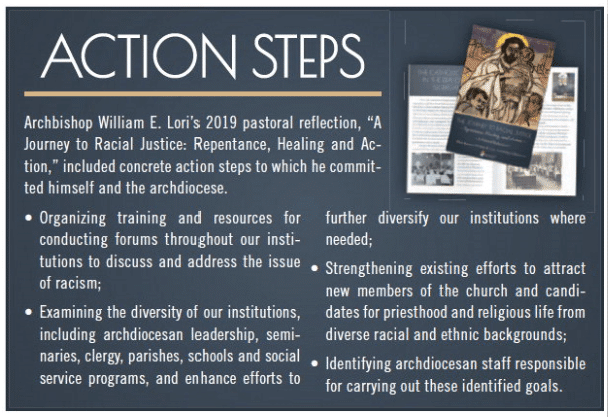
Archbishop Lori has written two pastoral reflections on the topic: “The Enduring Power of Dr. Martin Luther King Jr.’s Principles of Nonviolence,” released in 2018 to mark the 50th anniversary of the civil rights leader’s assassination; and “The Journey to Racial Justice: Repentance, Healing and Action,” which called for listening, consultation and action. Released in 2019, two months after the U.S. bishops released a pastoral letter against racism, “Open Wide Our Hearts: The Enduring Call to Love,” “A Journey to Racial Justice” included concrete actions the archdiocese needed to take.

“The aim in writing a pastoral letter is not to say the last word on any particular subject,” the archbishop told the Catholic Review. “I think that these efforts, these pastoral letters do help to raise consciousness. But I also think events like the tragic death of George Floyd bring the issue back home to us, front and center.”

Thomas said statements and pastorals from popes and bishops have acknowledged the sin of racism, including the U.S. bishops’ 1979 pastoral letter, “Brothers and Sisters to Us,” that said, “Racism is a sin: a sin that divides the human family, blots out the image of God among specific members of that family, and violates the fundamental human dignity of those called to be children of the same Father.”

The work of the Office of Black Catholics, the Racism Work Group and consultants must “ensure that we do more – that we do all we can to guarantee change and justice for all people,” Thomas said.

The work group will set up formal and informal settings for listening and input from a broad section of people in the archdiocese. The work is necessary but won’t be easy.

“We expect to hear stories about the hurt and harm people have endured over the years – stories about the impact of bias and racism, and even stories about shortcomings of our church,” Thomas said. “Above all, this process will require patience, prayer and careful discernment.”

The bishops who make up the governing board of the Maryland Catholic Conference – representing the archdioceses of Baltimore and Washington and the Diocese of Wilmington, Del., on public policy matters – released a statement June 15 that recalls “our own church’s past sins and failings and admit to them freely.”

“With regret and humility, we must recognize that as Catholic leaders and as an institution we have, at times, not followed the Gospel to which we profess and have been too slow in correcting our shortcomings,” the statement said. “For this reason, it is incumbent upon us to place ourselves at the forefront of efforts to remove the inequalities and discrimination that are still present in Maryland and our nation today.”

All the bishops of Baltimore signed the MCC statement, which noted, “prayer and dialogue, alone, are not enough. We must act to bring about true change.”

Thomas noted that after Floyd’s death at the hands of Minneapolis policemen, people around the world are asking what they can do to effect real change. “The first thing we can all do is to actively encourage this inquiry and help create moments to explore and dialogue about our differences and commonalities,” she said.

Both Thomas and Archbishop Lori said the protests after the deaths of Floyd and others have created a moment that seems poised for change. The archbishop said that such events bring racism to the front burner and help people focus on it in the immediate crisis.

“When that fades, instead of going to more serene and mature reflection aimed at making changes that bring us together in a new way in our diversity, we often instead put the issue on the backburner and let it simmer,” he said. “That’s not what we should let happen this time. This time should be different. I hope and pray to God it will be.”

Thomas noted that voices around the globe – including people and institutions that have formerly been silent – are calling for the eradication of racism.

“I have been deeply touched by the outpouring of so many people who want to work for change – Catholics, non-Catholics, interfaith communities, people who have left the church – all wanting to do more and push for equality and justice,” she said. “This is a special moment of solidarity that many have longed for, and I am so pleased to assist the archdiocese take a lead on this.”

Email Christopher Gunty at editor@CatholicReview.org


Kirk Gaddy, black Catholic educator and father figure to many, dies suddenly at 55

One of the final works of mercy of Dr. Kirk P. Gaddy’s life as a Catholic educator occurred June 13, when he helped transform St. Frances Academy into an impromptu cooling station for a Black Lives Matter protest.

Gaddy, 55, suffered a heart attack the next day, and died unexpectedly June 20. A lifelong parishioner of Historic St. Francis Xavier in Baltimore and major influence in the education of black youths from pre-K to college, Gaddy was in his second stint on the staff at St. Frances Academy, where he had been in the class of 1983.

“We were graduating kids individually (June 13), and couldn’t leave campus because the roads were blocked by protest traffic around the prison,” said Deacon Curtis Turner, principal/head of school. “It was a hot day, and Kirk made the most of the situation. He helped people cool off. That’s my last memory of him.”

That protest wound around the Baltimore City Detention Center on to Eager Street, where Gaddy’s life as a catechist, teacher, scholar, administrator and advocate for the Oblate Sisters of Providence had its roots.

His four older brothers include Redemptorist Father Kenneth Gaddy, associate pastor of Sacred Heart of Jesus/Sagrado Corazón de Jesús in Highlandtown. Their parents, John and Beatrice, headed a home that included two of her sisters and their children, 15 people all told in a rowhome on Eager Street.

“There was a lot of noise, as you can expect,” Father Gaddy said. “There was also a lot of support and encouragement.”

All the Gaddy children attended Catholic K-8 schools, Ss. James and John for Kirk. In 2008, he recounted to the Catholic Review how he and his siblings spent Saturdays cleaning the schools they attended, and how he helped mow the grass at Redemptorist cemeteries.

“It’s something they instilled in us very early on,” Gaddy told the Review, of his parents’ sense of service.

He went on to St. Frances Academy, the oldest Catholic school in the U.S. founded for black children, by Mother Mary Lange and the Oblate Sisters of Providence in 1828.

“The Oblate Sisters had a tremendous influence on his life,” Father Gaddy said. “The Oblate Sisters run through his veins.”

Sister Rita Michelle Proctor, the general superior of the order, taught Religion and Physical Education to Gaddy when he was in the ninth grade.

“His spirit of generosity, and caring for others, was already there, not only at St. Frances Academy, but at our convent,” she said. “He would go there after school to help Sister Brenda Motte, who coordinated the convent. Even when he was 13, you could depend on him.

“When he became principal at St. Katharine, he posted a message. ‘You enter to learn, and you leave to serve.’ It’s a powerful statement, one I’ve borrowed. … For all of his degrees and awards, he lived a life of Providence. I believe he was motivated by the spirit of Mother Mary Lange.”

Gaddy served as president of the Mother Lange Guild. In February, he served one last time as MC at the 23rd annual Mother Lange Awards, held by the archdiocesan Office of Black Catholic Ministries.

Gaddy earned a bachelor’s degree in psychology, with a minor in history, from what is now Loyola University Maryland in 1987. Two years later, he earned a master’s degree in educational curriculum and instruction from Loyola. In 2004, he earned a doctorate in education leadership from NOVA Southeastern University in North Miami.

“His goodness, kindness, compassion, concern for the have-nots and the poor … he would do anything for the poor,” Father Gaddy said. “At the center of the conversation was the Gospel of liberation, and Kirk knew that the way to liberation is through education. He felt he would have the greatest impact there.”

Gaddy’s first job out of Loyola College was back at St. Frances Academy, as a teacher and dean of students. He served as assistant principal of St. Katharine School, 1990-94;  as principal of St. Alphonsus-Basilica School, 1994-98; and principal of St. Katharine School, 1998-2008.

In 2008, he became a founder, CEO and headmaster of the Bluford Drew Jemison-STEM Academy. In 2012, he took an administrator’s role at St. Francis International School in Silver Spring. He began teaching at Xavier University in Louisiana’s Institute for Black Catholic Studies in 2008, and became its associate director in 2014.

A year ago, Gaddy returned to St. Frances Academy as assistant principal. He was to become principal for the 2020-21 school year, with Deacon Turner becoming the school’s president on a full-time basis.

“He was the definition of tough love,” Deacon Turner said. “Many of our students come to us unchurched. One day a student did something disrespectful in our daily chapel, which he ran. Kirk was able to impart why it was disrespectful, and instill a sense of wonder and awe in the kid within an hour.”

The young St. Frances Academy educators under Gaddy’s tutelage included his son, Kirk E. Gaddy, class of 2012, who always saw his father’s stabilizing presence.

“When I was in the first grade (at Ss. James and John), one of my friends didn’t have a Dad in his life,” the younger Gaddy said. “Mine stepped right into that role. He was a father figure to so many of his kids at St. Katharine.

“When I was a freshman at St. Frances Academy, the baseball team won the (C Conference) championship game. It was played at Calvert Hall. He took the whole team to Red Robin afterward, and paid for everyone. He wasn’t just my father. He was everyone’s father.”

An RCIA instructor, Gaddy’s professional development included reaching level three of the Archdiocese of Baltimore’s Equip for Ministry training, in 1990. He  contributed to “Keep on Teaching,” which served as a manual for the African-American Community; “What We Have Seen and Heard-Essays and Stories from Black Catholics of Baltimore”; the African American Catholic Youth Bible; and the Africentric column that ran in the Catholic Review when it was a weekly publication.

His substantial volunteer efforts, his brother noted, included teaching at the Baltimore City Detention Center.

At Historic St. Francis Xavier, Gaddy served as parish council president and for 16 years was chairman of the board of its Head Start program. He also served on the boards of the Institute of Notre Dame and the Cardinal Shehan School. In addition to their son, Gaddy and his wife, Crystalyn, raised two daughters, Courtney and Kirby.

“Our time is not always lined up with God’s,” said Gaddy’s son, of the suddenness of his passing. “We have to remember his legacy and what he stood for.”

In order to accommodate larger gatherings with social distancing in place, a  funeral Mass will be offered July 3, at 11 a.m., in the St. Frances Academy gym. Visitation will also be there July 2, 2-8 p.m.

Email Paul McMullen at pmcmullen@CatholicReview.org


A prayer to celebrate Juneteenth — a light of hope for freedom and justice

Juneteenth marks a time in history that has remained largely unknown within the white community.

It has long been celebrated among the African American community. The brutal history of slavery and segregation continues to inflict pain on our society, and Juneteenth offers a light of hope on the fight for freedom and justice.

As noted by the National Museum of African American History & Culture, Juneteenth is a time to celebrate, to gather as a family, to reflect on the past and look to the future. Within the African American community, Juneteenth is known as our second “Independence Day”. It is a holiday that commemorates the June 19, 1865 announcement of the abolition of slavery in Texas, and more generally the emancipation of African American slaves throughout the Confederate South.

Emancipation did not finally come until General Gordon Granger rode into Galveston, Texas and issued General Order No. 3, on June 19, almost two and a half years after President Abraham Lincoln signed the Emancipation Proclamation on January 1, 1863.

Celebrated on June 19, the word is a portmanteau of “June” and “nineteenth.” The Office of Black Catholics invites all of us in the Archdiocese of Baltimore to celebrate this day as a reminder of the transformative power of human liberation. We encourage all to spend time with our families, reflecting on the meaning of the day by using this as a day of education about our collective history and taking the time to pray for real change.

We pray, O Lord, for change.

Jesus you revealed God through your wise words and loving deeds,

and we encounter you still today in the faces of those whom society has pushed to the margins.

Guide us, through the love you revealed,

to establish the justice you proclaimed,

that all peoples might dwell in harmony and peace,

united by that one love that binds us to each other, and to you.

And most of all, Lord, change our routine worship and work into genuine encounter with you and our better selves so that our lives will be changed for the good of all.

Amen

Prayer adapted from Racial Healing and Liturgical Resources.


Maryland bishops call for action against racism

The bishops who make up the governing board of the Maryland Catholic Conference – representing the archdioceses of Baltimore and Washington and the Diocese of Wilmington, Del., on public policy matters – released a statement June 15 that recalls “our own Church’s past sins and failings and admit to them freely.”

“With regret and humility, we must recognize that as Catholic leaders and as an institution we have, at times, not followed the Gospel to which we profess and have been too slow in correcting our shortcomings,” the statement said. “For this reason, it is incumbent upon us to place ourselves at the forefront of efforts to remove the inequalities and discrimination that are still present in Maryland and our nation today.”

The bishops of Baltimore — Archbishop William E. Lori, Auxiliary Bishops Adam J. Parker and Denis J. Madden, and Bishop-designate Bruce Lewandowski, C.Ss.R. – were among the signers of the MCC statement, which noted, “prayer and dialogue, alone, are not enough. We must act to bring about true change.”

The statement noted despite the painful history, the church in Maryland is connected to the longtime ministry of black Catholics.

“We think of Mother Mary Lange, who founded the first Catholic school for Black children in the United States, in Baltimore in 1828.” A year later she founded the Oblate Sisters of Providence, the first religious order for women of African descent and is currently in the process to be canonized a saint.

The statement notes that archbishops in the state have been at the forefront on race relations, including Cardinals Patrick O’Boyle of Washington and Lawrence Shehan of Baltimore. This history provides the context for the church’s action today.

The unjust killing of George Floyd and other black Americans, and the subsequent protests, rallies and vigils that continue to take place make it clear that the conscience of our nation is on trial as questions of race and equality confront each and every one of us.

“United, we seek healing, harmony and solutions that recognize that every person has been created in the image of God and that every person possesses human dignity,” the statement said. “Over the years, the Catholic Bishops of Maryland have stood firmly in our support of laws that sought to bring about justice and an end to unequal treatment based on race.”

The full text of the letter is below. 

June 15, 2020  

Dear Brothers and Sisters in Christ, 

For centuries, our country and our State have been plagued with problems of racial inequality and injustice. Although many people have acted in good faith in service and prayer to bring about just change, to acknowledge the dignity of each life, and to love one another, our current crisis causes us to reflect on how much we still must do together to make impactful progress. We vividly recall our own Church’s past sins and failings and admit to them freely 

With regret and humility, we must recognize that as Catholic leaders and as an institution we have, at times, not followed the Gospel to which we profess and have been too slow in correcting our shortcomings. For this reason, it is incumbent upon us to place ourselves at the forefront of efforts to remove the inequalities and discrimination that are still present in Maryland and our nation today 

Despite our painful history, the Church in Maryland has been deeply enriched by the gifts of Black Catholics. We think of Mother Mary Lange, who founded the first Catholic school for Black children in the United States, in Baltimore in 1828. One year later, she founded the Oblate Sisters of Providence, the first religious order for women of African descent. Today, she is a Servant of God, in the process to be canonized a Catholic saint, a cause for which all Catholics should pray 

Maryland is also home to the National Black Catholic Congress, which acts as a witness and guide to the realities of the Black Catholic experience across the United States. It is also home to the Josephite priests and brothers, whose mission is to serve the African American community. 

At a time when school segregation, sadly, was the norm in Maryland, two of our predecessors – Cardinal Patrick O’Boyle and Cardinal Lawrence Shehan began the process of desegregating Catholic schools and parishes 

On March 12, 1950, in a homily on race relations, then-Archbishop O’Boyle said, “Unless the full resources of the Church are placed at the disposal of every single member of the church and made available to every man, there is no Catholicism worthy of the name. Our Sacraments, and our societies, our Mass and mysteries of the Faith are a common possession. Just as God is Our Father What is Catholic is ours; it is all of us united as one.” 

This history provides the context for us today and should act to animate our prayers, thoughts and actions for an end, finally, to the sin of racism that remains with us and in us. The unjust killing of George Floyd and other Black Americans, and the subsequent protests, rallies and vigils that continue to take place make it clear that the conscience of our nation is on trial as questions of race and equality confront each and every one of us 

We must recognize that all of us share the same human nature and dignity because we are all created in the image and likeness of God; this is why human life is sacred. We call all people of good will to prayer, to root out any hatred and animosity that has taken hold in one’s own heart. Inspired by Jesus’ command to “love one another as I love you” (John 15:12), we must seek to know and understand one another and to work to break down barriers through listening, prayer and a commitment to change hearts and minds 

However, prayer and dialogue, alone, are not enough. We must act to bring about true change. United, we seek healing, harmony and solutions that recognize that every person has been created in the image of God and that every person possesses human dignity. Over the years, the Catholic Bishops of Maryland have stood firmly in our support of laws that sought to bring about justice and an end to unequal treatment based on race 

This includes access to health and maternal care, meaningful educational opportunities, prison reforms, restorative justice initiatives, housing anti-discrimination efforts, juvenile justice reforms, and ending the grossly disparate practice of capital punishment. We commend the efforts of our state lawmakers to convene working groups to discuss legislative initiatives that are needed for reform, transparency, and racial equality. We look forward to playing an active part in these conversations on both a state and national level, and to lending our voices to those whose own have been stifled or altogether silenced by those who seek to quiet them 

We continue to pray that the Holy Spirit will enlighten the minds and hearts of our elected representatives so that truth and justice will prevail over the falsehoods of discrimination and injustice. 

We pray that God will guide us during these difficult times and give us the courage to act with conviction in our duty to seek racial equality, heal divisions, and build bridges of understanding and hope. 

In Christ,  

Most Reverend William E. Lori
Archbishop of Baltimore

Most Reverend Wilton D. Gregory
Archbishop of Washington 

Most Reverend W. Francis Malooly
Bishop of Wilmington

Most Reverend Roy E. Campbell Jr. 
Auxiliary Bishop of Washington 

Most Reverend Mario E. Dorsonville-Rodriguez
Auxiliary Bishop of Washington

Most Reverend Michael W. Fisher 
Auxiliary Bishop of Washington 

Most Reverend Adam J. Parker
Auxiliary Bishop of Baltimore

Most Reverend Denis J. Madden
Auxiliary Bishop Emeritus of Baltimore 

Bishop-designate Bruce Lewandowski, CSsR
Auxiliary Bishop-designate of Baltimore 

Download the letter in English here
Download the letter in Spanish here
Download the letter in French here
Download the letter in Korean here
Download the letter in Vietnamese here


Josephites among religious and laity joining ‘Black Lives Matter’ protests

WASHINGTON (CNS) — The streets in front of the White House of late have been filled with thousands of youthful faces carrying signs or wearing T-shirts calling for racial justice, with fists raised in the air, or posing for selfies with a large “Black Lives Matters” sign.

That sign now hangs on a tall piece of fencing meant to keep the protesters out of Lafayette Park, the place tourists would usually flock to and have their pictures taken with the iconic building in the background.

But on June 8, the space was filled with women and men religious donning their habits and priests with Roman collars; some carried rosaries and signs with Our Lady of Guadalupe and the image of St. Oscar Romero. And hundreds of laity and at least two bishops from the Archdiocese of Washington joined in the Catholic-centered protest.

“The Catholic voice as a group, as a family needs to be heard,” said Father Cornelius Ejiogu, a member of the Baltimore-based Society of St. Joseph of the Sacred Heart, best known as the Josephites. He, along with others, helped organize the event. “I know a lot of priests and sisters have come out here individually to pray for peace and justice, but we feel that our church, as one, can come together.”

Washington Auxiliary Bishops Roy E. Campbell and Mario E. Dorsonville attended the event that featured prayer, songs and Bible readings and a reading of names of black Americans who died in violent acts of racial injustice, most recently George Floyd,

His May 25 death, while pinned to the ground by a white Minneapolis police officer seen in a video pressuring his neck with his knee for almost nine minutes, sparked protests, not just in the U.S., but in other parts of the world.

Retired Bishop John H. Ricard of Pensacola-Tallahasse, Florida, superior of Josephites and a former auxiliary bishop of Baltimore who resides at the Josephites’ headquarters in Baltimore, also attended the event.

The crowd prayed for those whose names were called out but also for “those who have died and whose names we don’t know,” said Father Ejiogu. The event was to pray for justice and peace “and ask God for reconciliation,” he said.

“What we’re seeing these past couple of weeks … it’s not the nation that we want, the America we believe in,” he said in an interview with Catholic News Service. “America is torn up by pride and racism and injustice. So, we want to use this opportunity to ask God to reconcile us.”

Catholics have joined the throngs of protesters who have taken to the streets of Washington since the killing of Floyd, but the event was a hope to unify Catholics to recognize the injustice behind the killings, he said.

“I believe all lives matter, Jesus specifically would say all lives matter, but is everybody in this country having the same justice? Do we all have the same privileges? No. There are some folks who don’t have the same privileges,”  Father Ejiogu said.

“So, we are saying that those folks who are disenfranchised, those folks who are experiencing racism more, their lives matter along with all lives,” he added. “So, it’s not a question of separation, no. We’re asking God to heal us so we can recognize that we’re all brothers and sisters.”

He said he recognized that not all Catholics agreed with what the group was setting out to do.

One of them was Maryanne Pennell, from Front Royal, Virginia, who was carrying a “Trump Pro-Life” sign near the group. “I’m here so say pro-life is what matters,” she said. “All people, not based on your skin or your nationality or your history, based on being an American or being in America.”

What is needed is more dialogue, she told CNS, and she was doing her share of it, peacefully speaking with others who, curious about her sign and defense of President Donald Trump, stopped to talk to her.

“That’s part of what today should be,” she said. “Others say, ‘What do you think?” and I say, ‘What do you think?’ That’s how America works, not in judgment. It works in dialogue and we can disagree respectfully.”

Of course black lives matter, “but all lives matter, beginning with the unborn,” she said, adding that she believed no other president had done as much as Trump for the pro-life cause.

“I’m here to say Mr. Trump has given us a voice for life,” she said. “He has stood for life and for the Constitution of the United States.”

But to those like her, Father Ejiogu said, he just wanted to say that “we’re simply here to pray and to call on our Blessed Mother of the church, the saints, to help us to heal so that we can recognize that black lives matter, white lives matter, Spanish lives matters, Asian lives matter, all lives, yes, but there are a few of those lives that seem to feel that they do not matter. That’s all we’re calling for.”

Darwin Kemp, a member of the Knights of Columbus in Washington, said he attended because, like, others, “people are sick and tired of the injustice.”

“We all have gone through some injustice for quite some time, including myself. I’ve been fighting for a long time, but I’ve been fighting individually,” he said.

Now it’s time to do so as group, he said, because racism needs to end.

“I hope that we all come together as one and be able to sit down, have a conversation, even if we agree to disagree, at least we’re having a conversation and actually getting some things done,” he said. “Get rid of racism. It’s been around too long.”

Sister Nancy Conboy, of the Franciscan Sisters of the Atonement, said she attended in solidarity with others, but also to affirm church teachings that say that “as Catholics, we really believe in equality for all people and we thought it was important to come down and take part in this service.”

“We really believe in the dignity of every person,” she said. “We just thought it was important to come down and show support and solidarity with our brothers and sisters. It’s true that all lives matter but I think in our country, we have a history of racism so that’s important that we recognize that.”

Though not everyone would agree with the event, said Father Ejiogu, he would continue to pray for unity on the issue within the church as well as outside of the church.

“I can’t tell God what to do but I can ask,” he said. “What I’m asking God with my friends, families and parishioners who are helping organize this, I’m praying to God to heal us. That’s all we can do is pray for healing and hopefully God will heed our petitions and answer, and our country may be much better than it is because simply sitting at home doing nothing just doesn’t cut it for me.”

Along with the hundreds of who joined the peaceful protest, which took a route from the White House fencing and ended at the National Museum of African American History and Culture, he chanted and prayed into the distance.

He said the images that most have given him hope, even in the midst of the tense protests, were of the young white, black, Asians, Latinos, “people of all colors coming out and peacefully protesting.”

“That’s the image that stood out for me,” he said.

And despite what others may say of the protesters, he wanted to portray the Catholic angle of it, “speaking truth to power and doing it in a more prayerful way,” he said.

Also see:

Archbishop Lori offers invocation at ‘Protest with a Purpose’

Baltimore faith leaders call for peace and unity



Archbishop Lori offers invocation at ‘Protest with a Purpose’

Baltimore Archbishop William E. Lori offered the invocation before a “Protest with a Purpose” outside the U.S. District Court for Maryland in Baltimore June 8.

The event came two weeks to the day after the death of George Floyd on videotape while a Minneapolis policeman kneeled on his neck. It evoked the 2015 death, while in custody of Baltimore City police, of Freddie Gray Jr.

The archbishop prayed for the Holy Spirit to consume racism and the conditions that led to the deaths of Floyd, Gray, Ahmaud Arbery, Breonna Taylor and others around the nation.

The violent aftermath that followed Gray’s death contributed to a federal consent decree calling for extensive reform of the city’s police department.

The archbishop spoke at the invitation of Ray Kelly, the lead community liaison for that Consent Decree Monitoring Team, a parish leader at St. Peter Claver/St. Pius V in Sandtown, and, in January, the inaugural recipient of the archdiocese’s Faith in Baltimore Award.

“We chose this site, outside the federal courthouse, where officials are overseeing the consent decree,” Kelly said. “We have a conduit. The court is serious about getting this done. Change only comes when the policies and laws change.”

A number of speakers addressed police brutality and racism. They included Erricka Bridgeford, who organizes Baltimore’s “Ceasefire” weekends; Rabbi Daniel Burg of Beth Am Synagogue; and Zainab Chaudry, director of Maryland Outreach for the Council on American-Islamic Relations (CAIR).

Organized by the Citizens Policing Project, the protest lasted several hours and highlighted 14 steps that would lead to Baltimore residents being “policed equitably and effectively.”

Those steps range from fully implementing the consent decree to increasing transparency ending state control over the city police department.

“We have a majority white state dictating terms to a majority black city,” Kelly said. “Do we need a better example of systemic oppression?”

The measures include reinstating “relationship-building,” such as the Police Athletic Centers for youths that were once part of Baltimore’s fabric. William J. McCarthy Jr., executive director of Catholic Charities of Baltimore, spoke to that latter point, emphasizing encounters among police and the populace that are non-confrontational.

The crowd included Josephite Father Ray Bomberger, Kelly’s pastor at St. Peter Claver/St. Pius V. Father Bomberger is also pastor of St. Gregory the Great in West Baltimore.

Also see:

Baltimore faith leaders call for peace and unity
Email Paul McMullen at pmcmullen@CatholicReview.org