Catholic Review survey shows Catholic high school tuition remains more affordable than most nonpublic schools

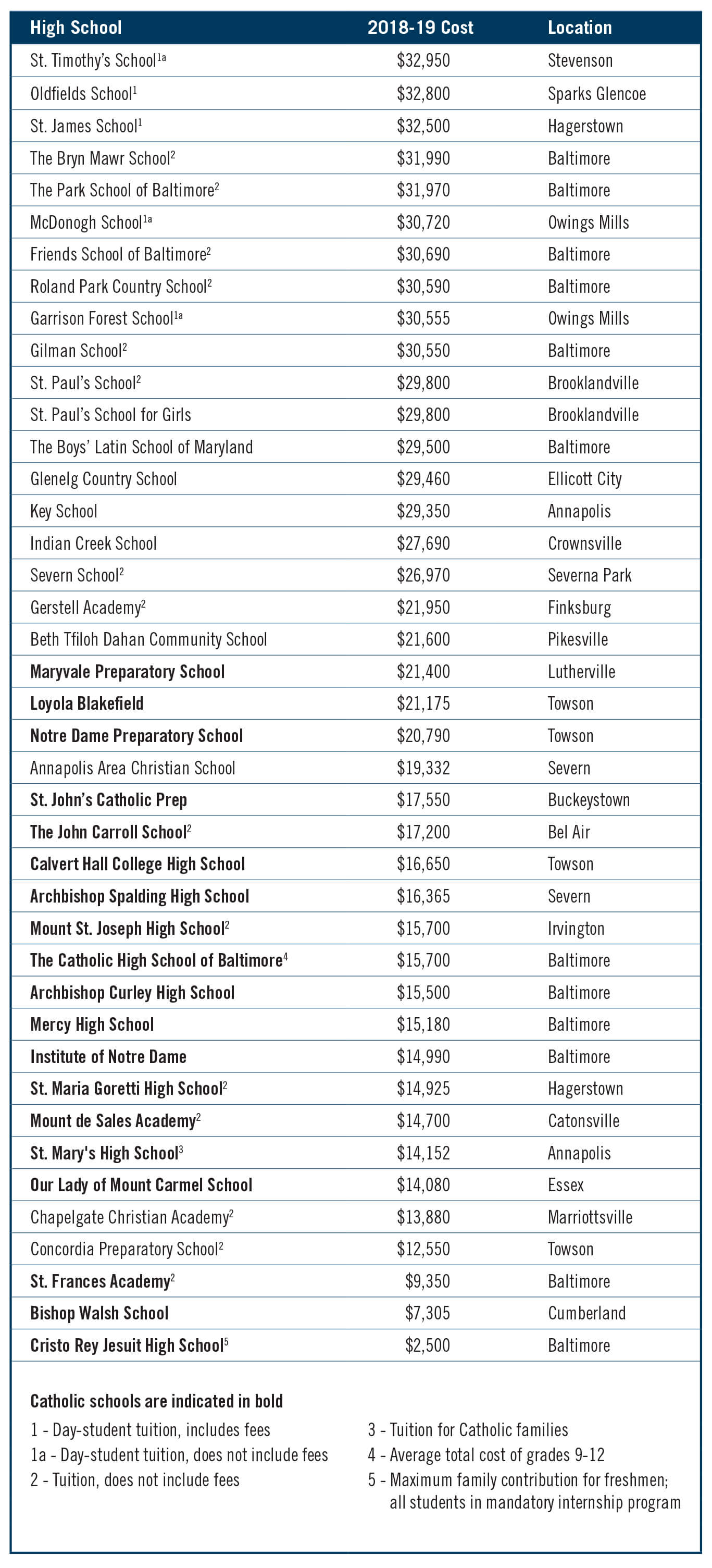
Catholic high schools are more affordable than most of their peers, as evidenced in the Catholic Review’s annual survey of cost of attendance among nonpublic schools within the Archdiocese of Baltimore, which encompasses Baltimore City and nine counties.

The information in the following chart was compiled from high school websites and administrators. For comparative purposes, it includes fellow members of the Maryland Interscholastic Athletic Association and the Interscholastic Athletic Association of Maryland.

When available and consistent across all grades, fees were added to tuition to come up with the cost of attendance for the 2018-19 school year. Fees for athletics and graduation were not included, nor were costs for special enrichment programs.

For complete information about high school costs, parents and students should visit individual schools and their websites.


For more information about Catholic schools in the Archdiocese of Baltimore, click here.


IND makes it six straight, 69-27, over Mercy in 53rd installment of ‘The Big Game’ 

TOWSON – The Institute of Notre Dame’s “A” game was too much for Mercy High School.

The Penguins rolled over their traditional rival, 69-27, in the 53rd installment of their showcase basketball game Feb. 1 at Towson University’s SECU Arena. IND scored the game’s first 11 points, and its 10 threes accounted for more points than Mercy’s total.

The outcome was to be expected, as the Penguins are literally playing in a different league than the Magic this season after moving up to the Interscholastic Athletic Association of Maryland A Conference.

Playing against the likes of defending three-time champion St. Frances Academy, the Penguins are 7-11 overall and 4-7 in conference play, a pressure cooker that certainly prepared them for the intensity of “The Big Game,” which drew its typical crowd of several thousand despite cold and snow that had closed schools early.

“Playing in the A Conference has toughened us up,” said senior La’Shyra Williams, who has been part of the last four wins in IND’s six-year streak over Mercy. “It makes you get rid of your minor mistakes.”

It’s also been an adjustment for coach Robert DuBose.

“It pushes you to become a better team, and coach; I catch myself in situations where I need to get better,” said DuBose, who last winter led the Penguins to their first-ever IAAM B Conference championship. “I was always looking forward to moving up. Everything we expected (in the A Conference), we’re getting.”

A year ago, Eniya Russell appeared rattled in her first appearance in “The Big Game,” as the crowd included coach Brenda Frese of Maryland, among the many major-college programs recruiting her. Now a junior, the 5-foot-10-inch do-it-all wing dropped a game-high 21 points on the Magic.

Her new running mates include AAU teammate Ajae Petty, a 6-1 transfer from New Town High School who had IND’s first five points and finished with 13. Smith added 11 points, including a pair of three-pointers, as she was one of seven Penguins to connect from beyond the arc against Mercy’s collapsing zone.

“That’s the best-shooting game we’ve had from the perimeter this season,” DuBose said.

Junior Channell Henson led Mercy, which dropped to 3-12 overall and is 1-7 in the B Conference, with 11 points.

After a five-year absence, Mary Ella Marion is back coaching the Magic, and the school’s dean of students basked in the pre-game trappings of one of the Archdiocese of Baltimore’s unique traditions.

The National Anthem was sung by a combined select choir. It included Mercy seniors Sara Coffman and Mary Huebler, in their basketball warm-ups, and was directed by IND senior Destiny Bell, director of equity and inclusion for wINDows, the student newspaper.

First came a prayer, composed and offered by Rebecca Hogg, Mercy’s director of mission and ministry, and a member of its class of 1989. It referenced both the participants and the religious women who founded the two all-girls institutions, the Sisters of Mercy and the School Sisters of Notre Dame.

“Keep us safe, we pray, from injuries, and hard feelings, and the temptation to make this game anything other than a positive event,” Hogg prayed. “For the religious orders who have helped to shape us and the thousands of women with whom we have traveled our respective halls together, we thank you.”

The crowd ranged from infants in sleepers to girls from St. Ursula Parish in Parkville sporting their CYO jerseys, to Dan Popera, the former Archbishop Curley High School coach who was cheering on his granddaughter, Bailey Krahl, Mercy ’20.

Mercy won the alumnae giving challenge, with halftime including president Mary Beth Lennon announcing pledges of more than $12,400. Christine Szala, IND head of school, announced that it had raised $8,600 on its end.


Email Paul McMullen at pmcmullen@CatholicReview.org


Bishop Parker celebrates Catholic Schools Week

TOWSON – “Why Catholic schools?”

Ashley Nwafor, a senior at Notre Dame Preparatory School in Towson, questioned her peers at the beginning of the Jan. 31 Catholic Schools Week Mass celebrated by Auxiliary Bishop Adam J. Parker.

She reflected on her time at her parish school, Sacred Heart School in Glyndon, when as a young student, she was captivated by the liturgical dancers. The confidence she gained from her community led her to overcome her shyness and become one of the performers.

Nwafor carried that confidence to Notre Dame Prep, where her passion for music has continued to grow, as a singer in the liturgical band and as a participant in musicals.

“Over and over again, I have found the courage to do things I never thought I could because I have been part of such amazing Catholic school communities with teachers and staff who cared about me beyond my grades,” Nwafor said in the Call to Worship, an opportunity for Notre Dame Prep students to share their faith stories at the beginning of school Masses. “I knew that I could dare, dream, leap, stumble and fall because there were people along the way who would catch me or help me get back up.”

Nwafor kicked off the energetic Mass, which was the first stop for Bishop Parker on a blustery morning that, along with icy roads, prompted a two-hour delay for Baltimore County. It was his first time visiting the all-girls school serving students in grades 6-12.

Though it was his first time in the school, Bishop Parker said in his homily that he knew it well from articles, social media posts and bumper stickers that adorn many of the families’ cars.

Just as the students and families share the wonderful news about Notre Dame Preparatory, he said, they should share about Jesus, and how they have come to know him as a Catholic school student.

“It’s why you’re here at this Catholic school – so that not only can you come to know about Jesus, but so that you can come to know him in a personal way,” Bishop Parker said, adding that might be through sacraments, Scripture, prayer and friendships with others who share their faith.

“It has to be taken out beyond this building,” Bishop Parker said. “If we want to be true missionary disciples, we have to carry that message forth.”

Senior Katie Reiners witnessed the power of a Catholic school when she transferred from a public school to Notre Dame Prep in sixth grade.

“It was a huge change,” said Reiners, a parishioner of the Catholic Community of St. Francis Xavier in Hunt Valley. “It was OK to talk about faith and religion in school.”

She found her niche in campus ministry, especially in planning liturgies. Reiners led the procession and served as an usher during the Mass with Bishop Parker.

“It lets (Bishop Parker) see how our community is living out our Catholic faith,” Reiners said of the Catholic Schools Week Mass.

School Sister of Notre Dame Patricia McCarron, headmistress, said collaborating with other Catholics in the local area, as well as globally, is an important part of sharing the faith.

“We’re all working together to bring the message of the Gospel to the world,” Sister Patricia said. “We recognize it’s God work that’s been entrusted to our care.”

“Having Christ at the center of our education calls us to approach life and our world from a spiritual perspective.”

After spending time with students at Notre Dame Prep, Bishop Parker traveled a few miles south to St. Pius X School in Rodgers Forge, the only Catholic school in the state of Maryland to use a Montessori program for its students in pre-K through fifth grade, who are divided into primary, lower and upper classes.

Students in the primary and lower classes in St. Pius’ program periodically work with students in the upper class and the transitional middle school (which bridges the Montessori program with typical high school structure) as “Panther Pals,” giving the older students a chance to collaborate and aid younger students.

For a Catholic Schools Week project, St. Pius X School has been collecting stuffed bears for local children in emergency situations. Keeping with the “bear” theme, the Panther Pals collaborated the morning of Jan. 31 to make “Prayer Bears” for the younger students – stitching, stuffing and adding a heart to each one, which the students are to take home and place on their pillows to remind them to pray every night. (Older students made Prayer Bears for themselves in the afternoon.)

The young students were eager to show Bishop Parker their bears when he visited with them during lunch. He also had the opportunity to visit  multiple classrooms to pray with the students as they ate, before heading north east to Immaculate Heart of Mary School in Baynesville, to attend the school’s band and choir Winter Concert.


Email Emily Rosenthal at erosenthal@CatholicReview.org


Trending up: Some schools see substantial enrollment gains

How does a Catholic school not just maintain a solid student body, but grow it? Enrollment at the 19 Catholic high schools, three middle schools and 42 K-8s in the Archdiocese of Baltimore remains stable across the board, thanks in part to the BOOST scholarship program – and innovative leadership and marketing.

More than 750 students at Catholic schools in the archdiocese are receiving more than $1.75 million in scholarships during the 2018-19 school year through the state of Maryland’s Broadening Options and Opportunities for Students Today (BOOST) program, which benefits families based on household income.

In its third year, the BOOST program’s influence is seen in Baltimore City, where it has contributed to gains at Archbishop Borders School, Holy Angels Catholic School and Cardinal Shehan School, which have enjoyed enrollment growth of 70, 44 and 37 percent, respectively, over the last five years.

“BOOST has been of substantial impact to providing Catholic educational opportunities for children in Baltimore City,” said James Sellinger, chancellor of education for the archdiocese.

It’s also benefited schools beyond the Beltway, which have carved distinctive success stories, often with the help of local pastors.

Cumberland

Bishop Walsh School made a splash in prep basketball last spring with the hiring of coach Dan Prete. His international roster includes players from Botswana, Canada, Ghana, Finland, Spain and Turkey, the homeland of former John Carroll School star Yavuz Gultekin, familiar to Baltimore Catholic League fans.

“Athletics are part of our strategic plan,” said Ray Kiddy, principal. “Your scores are in the paper, whether you win or not.”

A renaissance in Cumberland preceded the basketball emphasis. Bishop Walsh, a K-12 school, had fewer than 300 students when Kiddy became principal in 2016. The petitions at a  Jan. 8 school Mass included a prayer for five students who were added after Christmas, bringing enrollment to 370.

BOOST helped, as did dedicated financial support for new students from the Department of Catholic Schools, similar to that offered to Archbishop Curley High School and the former Seton Keough High School.

“That allowed us to attract some new families that had been on the fence,” said Connie Milligan, director of admissions and communications, who has broadened the school’s social media presence.

More than 130 Bishop Walsh students live in West Virginia, where the Diocese of Wheeling-Charleston was lending support before Archbishop William E. Lori became its apostolic administrator. The school’s regional brand extends into Pennsylvania.

“Bishop Walsh is the only Catholic school (in the archdiocese) west of Hagerstown,” said Father Edward Hendricks, pastor of Divine Mercy Parish in Frostburg, who sits on its board. “We have hopefully turned a corner.”

Linthicum Heights

At the recommendation of the Department of Catholic Schools, St. Philip Neri School began partnering in 2015 with the Healey Education Foundation, which, in a news release, said the school shifted from traditional candy and bake sales and “invigorated its alumni base and created sustainable fundraising.”

It has since grown by 24 percent, 11 percent of that coming in the last year. It went from 365 students in 2017-18 to 408 at the start of 2018-19. Dividends include $20,000 in awards from the Healey foundation.

The surge included Sue Wenzlick, a former St. Philip Neri parent and math teacher, becoming advancement director at the urging of principal Kate Daley. Wenzlick knew not just the school, but the community in northern Anne Arundel County, as she serves as one of the emcees of the Linthicum Fair. Local options  include nearby Linthicum Elementary, a 2014 National Blue Ribbon School.

As Father Michael A. DeAscanis, pastor, put it to Wenzlick, “What makes us different?” That led to his collaboration on a new logo, “Nourishing the soul, mind and body,” and increased social media.

Father DeAscanis and associate pastor Father Isaac Makovo, equally athletic, serve as moving billboards.

“Father Isaac said ‘I run a lot, I can advertise the school.’ They’re big parts of the success here,” Wenzlick said.

The school’s academic substance includes Notre Dame of Maryland University helping prepare teachers for a new Maker Space lab.

Westminster

How did St. John School increase enrollment by 13 percent, from 231 students to 265, over one summer?

In addition to an academic base that has produced a robotics team that beats high schools, “Catholic identity has grown here,” according to Jo Marie Tolj, principal. For that she credits Father Mark Bialek, the pastor who placed her on the parish leadership team, which involved attending an Amazing Parish Conference in Dallas last April.

“He is the strongest supporter I have,” Tolj said. “When the parish makes decisions, it includes the school. That includes fundraising, use of the building and planning the liturgical season. How do we involve school students in Mass, help us foster our ‘young disciples’?”

Ninety-four percent of St. John’s students are Catholic. It’s the only Catholic school in Carroll County, and Tolj points 16 miles south to Sykesville, where Marianist Father Neville O’Donohue is the pastor of St. Joseph.

“Father Neville is another big supporter, of us and other Catholic schools,” Tolj said. “I’ll speak at one his Masses at Catholic Schools Week.”


Changed landscape: Girls’ athletic programs at Catholic high schools elevate their game

Mary Ella Marion enjoyed a Hall of Fame athletic career at what was then Loyola College, before its women’s teams even had the opportunity to compete for NCAA championships.

Now all-girls Mercy High School, her prep alma mater and where she’s the dean of students, is constructing an artificial turf field as part of $10 million in recent capital improvements.

After a five-year absence, Marion is back as the Magic’s basketball coach. Come Feb. 1, when Mercy meets the Institute of Notre Dame in the 53rd installment of “The Game,” her opposite will also attest to the fact that when it comes to sports, girls have certainly come a long way.

Robert DuBose moved the Penguins up to the Interscholastic Athletic Association of Maryland A Conference this winter, despite key losses to graduation, most notably his daughter, Madison.

Watching her develop and head off to play college basketball and run track and field for LIU Post in New York, Dubose couldn’t help but think of his late mother, Mary.

“She was 6-feet tall, and built like Madison,” he said. “She was a left-hander, and wore glasses, just like Madison. She was a good athlete, but there weren’t a lot of opportunities for her growing up in South Carolina. She used to tell the boys, ‘If I can’t get on the basketball court with you, I can beat you in the field.’ She was a good BB shooter.”

Mary Dubose’s experience was hardly unique.

The IND-Mercy tradition began in 1967, when the notion of females exerting themselves was discouraged.

Girls’ basketball in parts of the United States was 6-on-6, with offensive and defensive specialists restricted to one half of the court. Through 1968, the longest footrace for women at the Summer Olympics was 800 meters. It wasn’t until 1971 that the Association for Intercollegiate Athletics, eventually superseded by the NCAA, was formed.

Most seasons, Dubose takes IND to a tournament in Washington, D.C., that celebrates Title IX, the federal civil rights law enacted in 1972 that prohibited discrimination based on sex. In the short term, it opened doors for girls’ athletics. Over the long haul, it made the U.S. the leader in the women’s medal count at the Summer Olympics.

“The Game” nonetheless remained something of a local novelty, as local Catholic girls’ athletics, with the exception of the occasional dynasty, such as Towson Catholic basketball in the early 1980s, lagged behind public school jurisdictions, first Baltimore County, and then Anne Arundel County.

Contrast that to this winter’s area rankings by The Sun, which in mid-January showed a clean Catholic sweep, with the girls from St. Frances Academy (basketball) and Mount de Sales Academy (indoor track and field) joining the boys from Calvert Hall (indoor track) and Mount St. Joseph (basketball and wrestling) atop area consideration.

No one has a better perspective on that altered landscape than Mary Bartel.

She was hired by Notre Dame Preparatory School in 1981, the day after she had graduated from what is now Towson University. Now chairwoman of the physical education department, Bartel developed a championship lacrosse team, coached volleyball and basketball, and taught – all while serving as athletic director for 25 years.

“When you consider the number of girls participating, the number of programs, and the number of facilities you have to manage, the athletic director position has become a full-time job,” said Bartel, who went to Perry Hall High, she noted, when “Baltimore County was getting it right.”

The emphasis on athletics gradually grew among NDP and its peers.

“When we realized that athletics played a part in admissions and opened additional avenues for our graduates on the college front, things changed,” Bartel said.

Byproducts range from NDP having the state’s top-ranked lacrosse team, to a variety of No. 1 programs at Archbishop Spalding High School, to IND having four alumnae rowing in college.

On the facilities front, Maryvale Preparatory School had a championship track team before it built a track. Now Mercy, which reached the A Conference soccer final in 2016, is advancing both its campus and access to it  with its artificial turf facility.

It’s all a heady experience for Marion, the Magic coach, who remembers playing her first college basketball game for Loyola in a skirt.

“We’re talking about a top-of-the-line field,” Marion said. “Just the continuity aspect, being able to practice and play if it’s raining, that’s huge. It’s another way to level the playing field.”


Special Olympian ‘a light that shines’ at Gambrills school

GAMBRILLS – Walking the halls of the School of the Incarnation in Gambrills, Alicia Gogue’s bright disposition radiates.

Gogue is in her 15th year as a valued member of the Incarnation community, where she works in the after-school program and volunteers as a classroom helper.

The 34-year-old has Down syndrome.

The genetic condition can cause varying degrees of cognitive disabilities and physical challenges, but Gogue’s determination and positive spirit have produced a child care certificate and the honor of representing the United States in the Special Olympics.

Faster, higher, stronger

Her parents, Alex and Junghee, met while both were serving in the U.S. military. She was born in Germany, and her family supported her in a number of activities.

She was 6 when she hit the the pool for the first time. Teaching her to ride a bike when she was 8, her father described it as a “miracle” when he finally let go and she kept pedaling herself.

“My hands just basically withdrew from the bike and she just rode, and that’s when I had tears in my eyes,” he said. “When that happened, I knew that there was potential for not only my daughter, but for other kids who are not afforded the opportunity or given the time.”

He lost count of the medals she’s won in cycling, swimming, skiing, bowling and golf in the Special Olympics, where she first competed in 2003.

Cycling took her to the 2015 Special Olympics World Games in Los Angeles. Her two silver medals were the only ones brought home by a Team USA female cyclist in her ability group.

Her father remains her training partner, accompanying her on 2- to 3-hour rides every weekend when the weather allows.

“In order to be successful at anything you actually have to work to master it,” he said, noting that Gogue bikes up to 15 miles during a workout.

Competition helps her relate to classroom challenges, where Gogue said, “We work through the obstacles, (just) like cycling.”

‘First Grade Angel’

Alex Gogue said his daughter always loved being around children, which led her to work with religious education classes, first at St. Joseph in Odenton, and now at Our Lady of Peace Catholic Community on Fort Meade, where her family worships.

In 2002, Gogue, through the Community College of Baltimore County’s Center for Alternative and Supported Education (CASE), completed a 90-hour Maryland child care certification program. Last February, she completed the Basic Health and Safety Training required by the Maryland State Department of Education.

“She loves her work, she loves the kids,” her father said. “Otherwise, she wouldn’t be here (at Incarnation).”

Working in the Extended School Program (ESP) at Incarnation, Gogue is careful to keep track of her second-graders as they transition from the cafeteria to the classroom, and the playground to the computer lab.

Since 2011, she has spent the first half of her day on campus in the first-grade classroom of Julie Guenther, who calls Gogue her “First Grade Angel.”

“She does anything and everything that I would ever ask her to do,” Guenther said. “She never sits idle. If I don’t give her something to do, she finds something to do.”

As soon as she arrives, Gogue is busy, monitoring lunchtime in the cafeteria, and then preparing for classroom projects. Guenther said Gogue is adept at helping students get organized.

Described by Guenther as diligent, methodical and careful, Gogue does every task to the best of her ability.

“She’s a great example for the kids because they see her work hard,” Guenther said.

Asked how she liked working at Incarnation, Gogue was quick to make a correction.

“It’s not liking working here, because I love working here,” she said.

Matthew 19:14, when Jesus says, “Let the children come to me, and do not prevent them; for the kingdom of heaven belongs to such as these,” has special resonance with her.

“That’s the word (verse) I always remember,” Gogue said. “That’s my favorite phrase.”

“Having (Gogue) is just a beautiful example of how someone lives out their faith in a positive way,” said Guenther, who notes that the children adore having her in class. “I just think that she brings joy every day.

“She just has a light that shines all the time.”


Northeast Baltimore schools collaborate in service   

Five schools in Northeast Baltimore collaborated to collect canned goods for local food pantries, allowing the students a fun way to compete and serve others at the same time. In the 2018-19 competition, more than 10,000 cans were collected.

The participants included St. Michael-St. Clement School in Overlea, Immaculate Heart of Mary School in Baynesville, St. Ursula School in Parkville, St. Stephen School in Bradshaw and St. Joseph School in Fullerton – the winner of the 2018-19 trophy. St. Joseph also won the 2016-17 trophy, and St. Stephen School won the 2017-18 trophy.

The pre-Thanksgiving drive came with an extra incentive for the students of St. Joseph, whose canned goods supported the food pantry at St. Clement in Rosedale. Their principal, Ken Pipkin, made a deal with the students: if they collected 5,000 canned goods, he would don a turkey costume – a promise he fulfilled Nov. 21, after the students collected more than 6,000 items.

St. Ursula School has been sponsoring canned food drives for much longer than the three-year-old competition, but Debbie Glinowiecki, principal, said it’s a welcome addition.

“This just gave a little competition,” Glinowiecki said. “It upped the ante.”

Supporting a local food bank, she said, helps the students understand the impact their donations make.

“Faith in action – it’s part of our mission,” Glinowiecki said of the school’s mission statement. “That’s why we do these things.”

The northeast schools will continue service activities during Catholic Schools Week, Jan. 27-Feb. 2. Prayer partners at Immaculate Heart of Mary School will create “blessing bags”; St. Stephen School is hosting an out-of-uniform day benefitting Vet Dogs; and each grade at St. Joseph School will provide a thank-you gift for community helpers, which might include police, mail carriers or maintenance crews.


$10 million to BOOST, more updates, as General Assembly begins

Two weeks into the 2019 Maryland General Assembly, measures supported by the Maryland Catholic Conference are getting attention in Annapolis.

For the fiscal year 2020 budget, Gov. Lawrence Hogan Jr. has increased funding by $3 million for the Broadening Options and Opportunities for Students Today (BOOST) scholarship program, according to a news release from the Office of the Governor. The total allotment to boost would rise to $10 million if approved by lawmakers as part of the overall $46.6 billion state budget.

“The increase in funding would go a long way for these kids,” said Garrett O’Day, deputy director for the Maryland Catholic Conference. “We hope and pray the legislature will act to keep the program funding on their behalf.”

Scholarships through the BOOST program allow students in low-income households to attend a nonpublic school. This increase fulfills Hogan’s commitment to double the program’s funding over a three-year period, according to the news release, bringing total funding to $10 million.

“BOOST has provided new opportunities to so many kids over the last four years,” O’Day said. “It has also acted to sustain educational continuity for so many others whose families are struggling.

“Hundreds of thousands of low-income students are thriving in their educational environment across the nation because of programs like BOOST, and Maryland is no different.”

The Maryland Catholic Conference pointed out that lawmakers have historically approved less BOOST funding than what the governor proposes. The legislature has until April 1 to pass the fiscal 2020 budget. Funding has increased each year since the state created BOOST in 2016, just not on pace with the governor’s recommendations.

Therese Hessler, associate director of respect for life for the Maryland Catholic Conference, has been working on a bill with Del. William Wivell, a Republican from District 2A in Washington County. The “Health – Abortion – Reporting Requirements” bill would mandate the reporting of abortions.

The bill was designed not as pro-life or pro-choice legislation, but as a women’s health bill, as policymakers and program planners use report data to evaluate and improve women’s health.

Maryland has not reported abortion data since 2006, and is one of only three states in the nation to not have a mandatory abortion reporting law (the others are California and New Hampshire).

This bill does not promote either side of the abortion debate, according to supporters of the bill, but rather would help to provide accurate data to both, and would ideally decrease unintended pregnancies.

Anne Zmuda Wallerstedt, associate director of social and economic justice for the Maryland Catholic Conference, has been partnering with the Maryland Human Trafficking Task Force on the Anti-Exploitation Act of 2019. The bill would make labor trafficking a felony offense, and would come with a maximum penalty of 25 years imprisonment and/or a $15,000 fine.


USCCB education secretary is used to thinking outside the box

WASHINGTON — Mary Pat Donoghue, the new education secretary at the U.S. Conference of Catholic Bishops, knows that Catholic schools have to be creative not just to compete, but sometimes to survive.

She knows this firsthand because she’s been there.

As a former principal of a Catholic elementary school just outside Washington, Donoghue was hit with the major factors that could close a school and almost did. St. Jerome in Hyattsville, Maryland, the school she attended as a student, and where she taught and was its vice principal before becoming principal, had rapidly declining enrollment and escalating debt when she became its principal in 2009.

That same year, the school was given one year by the Archdiocese of Washington to turn this around.

It did this and then some.

Fast forward 10 years: Today the brick school building has waiting lists for nine of its classes and is in the process of adding one class per grade each year. Families are moving to the area just to attend the school which now goes by the name St. Jerome Academy and follows a classical school curriculum with an emphasis on Greek and Roman studies.

This model, followed by a handful of Catholic schools across the country, was relatively unheard of for Catholic schools a decade ago. A group of parents, facing the school’s potential closing, came up with an entirely new curriculum, working with Donoghue, the faculty and the pastor.

The idea brought new life to this struggling school which opened in 1943 and was run by the Sisters of Notre Dame de Namur, who had been teaching religious education at the parish since 1914. It also inspired other Catholic schools to follow a similar model.

When Donoghue left St. Jerome’s in 2016, she served as a Catholic educational consultant, advising other schools looking to try something new.

And last August, she took on something new herself as head of the USCCB’s Secretariat of Catholic Education.

In announcing her appointment, Msgr. J. Brian Bransfield, USCCB general secretary, said: “Mary Pat has brought a strong enthusiasm for the special role of Catholic education in the evangelical mission of the church.”

In a Jan 9 interview with Catholic News Service, Donoghue noted that many Catholic schools “are at the end of their runway,” meaning they need to come up with ways to exist and thrive that are not tuition dependent.

As she sees it, Catholic schools have much to offer and their strength lies in their long sense of tradition and integral formation of students.

She said the attempts to emulate public schools don’t work because then Catholic schools are not distinguishing themselves.

She acknowledged that the big challenges today for Catholic schools are sustainability and affordability and stressed that schools need to find new ways to address this, not necessarily by taking up a classical curriculum either. She said some of the new ways have included tuition-free schools with parish stewardship or the Cristo Rey model of a corporate work-study program where students work one day a week, earning job experience and a wage for tuition.

Today there also are regional Catholic schools and consortiums where schools share resources, all which are branching out from the traditional parish school model.

But for all the current and future changes for Catholic schools, one thing remains the same, Donoghue noted, pointing out that the goal of Catholic education is “to know, love and serve God” and “that hasn’t changed.”

And despite challenges Catholic schools face, she is optimistic, noting in true Catholic form that she “always has hope.”

“The Holy Spirit will direct our efforts,” she said.


Copyright ©2019 Catholic News Service/U.S. Conference of Catholic Bishops.


Future city Catholic school receives $3 million donation

The future Mother Mary Lange Catholic School in Baltimore is $3 million dollars closer to opening its doors.

Jack Dwyer, sole owner and chairman of the board of the Capital Funding Group family of companies, presented the donation to Archbishop William E. Lori Nov. 30, according to a Jan. 3 news release.

“I have always believed that a solid education creates the foundation for our community’s future success through our youth,” Dwyer said in the news release. “My wife, Nancy, and I decided to make a $3 million commitment through my bank, CFG Community Bank, to boost the fundraising in hopes to raise enough for the school.

“Equally important was to stimulate private investment in the west side of Baltimore which has been neglected for years.”

The donation will aid in development and construction of the school – the first new Catholic K-8 in Baltimore City in nearly six decades.

“On behalf of the generations of children who will benefit from the education they receive at the Mother Mary Lange Catholic School, I wish to thank Jack and Nancy for their extraordinary generosity and commitment to the children of Baltimore,” Archbishop Lori said in the Jan. 3 news release. “This is truly a gift that will endure and bear much fruit for many, many years to come.”

Mother Mary Lange Catholic School’s students will include those currently attending Holy Angels Catholic School, on the campus of the former Seton Keough High School in Southwest Baltimore, and Ss. James and John Catholic School in the Johnston Square neighborhood.

The new school will be built on a tract of city-owned land along Martin Luther King Jr. Boulevard, between Lexington and Saratoga Streets.


Sister Ursula Tisdall, OSF, taught at Rosedale school

A funeral Mass for Sister Ursula Tisdall, a professed member of the Sisters of St. Francis of Philadelphia for 66 years, was offered Dec. 18 at Assisi House in Aston, Pa. A native of Ireland who received her higher education in the Archdiocese of Baltimore and spent most of the 1960s teaching here, she died Dec. 13.

Born in Dublin, Sister Ursula professed her first vows in 1952. She earned a bachelor’s degree in history from Mount St. Mary’s University in Emmitsburg, and a master’s in educational administration from what is now Loyola University Maryland in Baltimore.

She ministered primarily in education and pastoral care, including teaching at St. Clement School in Rosedale from 1961 to 1968. Her 22 years in the Diocese of Wilmington, Del., included teaching at St. Anthony of Padua School and Holy Angels School in Newark; and as principal of Immaculate Conception School in Elkton, in Cecil County, and St. John the Beloved School in Wilmington.

She also served for 17 years in the Archdiocese of Boston; at Our Lady of Lourdes School in Bethesda, in Montgomery County; and as principal of schools in North Carolina and South Carolina.


Thanks to Coach Clatchey, Mount St. Joseph alums dot the basketball map

A college basketball program relies on more than just the players it puts on the court.

The Maryland men make only their second trip to Baltimore in 19 years Dec. 8, when they meet Loyola University Chicago at Royal Farms Arena. Sister of Charity of the Blessed Virgin Mary Jean Dolores Schmidt, the 99-year-old chaplain who added to the charm of the Ramblers’ run to last season’s Final Four, doesn’t travel in the regular season, but the high school coach responsible for developing 40 percent of the Terps’ starting lineup will be in the house.

Jalen Smith, a 6-foot-10-inch freshman and two-time Baltimore Catholic League Player of the Year, averaged 12.6 points and 7.3 rebounds for the Terps during a 7-1 start. Their wings include sophomore Darryl Morsell, the MVP of the 2017 BCL tournament.

Both developed at Mount St. Joseph High School under Pat Clatchey, who’s is in his 27th season as the Gaels’ varsity coach. Before he took over at his alma mater, it had never won a BCL championship. Mount St. Joseph, however, won seven of the 15 BCL tournaments from 2003 to 2017, making Clatchey the first coach in league history with that many tournament titles.

“Find (players) who fit the profile, meaning they meet the criteria of the school and are young men of character,” Clatchey said, when asked the philosophy behind Gaels’ basketball. “Look for exceptional students, and from a basketball standpoint, guys who are coachable and willing to work hard.”

National names

Morsell and Smith, who carried a 3.6 GPA at Mount St. Joseph and is majoring in information science in College Park, fit that description.

Terp fans know to enjoy Smith while they can, as he is projected to go high in the first round of the 2019 NBA draft. He figures to be Clatchey’s third NBA player, behind Henry Sims (class of 2008) and Jaylen Adams (’14), a rookie with the Atlanta Hawks.

Sims starred at Georgetown, Adams at St. Bonaventure. Phil Booth, a two-time BCL tournament MVP for the Gaels, is a fifth-year senior at Villanova, where he’s already played on two NCAA championship teams, in 2016 and ’18, and is a Big East Conference all-academic selection to boot.

“It’s no coincidence that our (graduates) are playing for and learning at prominent Catholic universities,” said George Andrews, president of Mount St. Joseph. “Not only is Pat producing good basketball players, (they) represent the shared values of Catholic education at Mount St. Joseph and these universities.

“What makes Pat notable is his commitment to our Xaverian tradition of enduring personal relationships. Our student athletes remain loyal to the school and the program, as do their parents.”

That legacy includes Eric Atkins (’10), who started 105 games for the University of Notre Dame and is now the video coordinator for the Fighting Irish. Clatchey, Atkins said, did more than teach him the “little intricacies” of playing point guard.

“Pat let me make mistakes, a huge reason for my success,” Atkins told the Review. “He didn’t pull me out when that happened, but helped me through it. He gave me the ball as a freshman to run the varsity. I wasn’t sure if I was ready, but it sped my development.

“He always told me the truth about my game, even if it was harsh. That made me ready for college basketball.”

(Not everyone goes to Division I. The big man for the 2014 BCL champions was Kyle Doran, who starred for and earned a degree from Johns Hopkins University.)

Last March, Loyola Chicago became the fourth No. 11 seed to reach the Final Four. The second was George Mason in 2006, when the Patriots’ leader was Will Thomas, a sophomore forward who was two years removed from Mount St. Joseph, where he famously frustrated Archbishop Spalding and Rudy Gay, now in his 13th season in the NBA.

“Will Thomas was the guy who took our program to another level,” Clatchey said. “He raised the bar of expectations. He had a high basketball IQ and an abundance of toughness and credibility. He brought a ‘refuse to lose’ attitude to practice every day. I respect so many of the guys who played for us, but Will’s up on a pedestal.”

Local knowledge

Clatchey does not abide the parental histrionics that detract from youth athletics, preferring to recruit boys from stable families who do not complain about officiating, let alone coaches.

He grew up in St. Benedict Parish in southwest Baltimore, and began his education at its parish school. Richard and Virginia Clatchey, his parents, also happened to be members of the Order of the Alhambra, a Catholic fraternal organization that since 1961 has hosted a postseason tournament in Allegany County for Catholic high schools.

“I started going up there when I was 10 or 11 years old, I thought it was the greatest thing in the world,” Clatchey said. “You’re watching great high school basketball in a small-town atmosphere. … My mom still raises money, as best she can, for the cause (Alhambra). My parents, they’re troupers.”

His peers on a Gwynn Falls Park playground included the late Quintin Dailey, who starred for the former Cardinal Gibbons High. Clatchey played interscholastically for Mount St. Joseph as a freshmen and sophomore, but recognized that his future in the game was in coaching.

He was coaching the Gaels’ freshman team as a 20-year-old; was on the staff at UMBC in the late 1980s; had a brief stint as a pro scout; and then returned to Mount St. Joseph in 1992 as its varsity coach. He was 29, and the new kid on a BCL block filled with legendary coaches, all now retired, a few deceased.

“Guys like Ray Mullis (Cardinal Gibbons), Jerry Savage (Loyola Blakefield), Cokey Robertson (St. Maria Goretti), I grew up watching them coach and run their programs,” Clatchey said. “Mark Amatucci (Calvert Hall), William Wells (St. Frances Academy), Dan Popera (Archbishop Curley) … there was a lot to learn.”

He also nods in the direction of Morgan Wootten, the DeMatha Catholic High coach who is a member of the Naismith Basketball Hall of Fame.

“I read his book, ‘Orphans to Champions,’ when I was 11 or 12,” Clatchey said. “He had autographed it for me. The one time I coached against him, we won (in the opening round of the Alhambra in 2001). I might be the only guy with a winning record against him.”

Wootten recommended Clatchey to coach in the 2009 McDonald’s All-American game. At the time, Clatchey was teaching physical education at Our Lady of Victory School in Arbutus. It wasn’t until four years ago that he went to work full-time at Mount St. Joseph, in its DePaul program.

“I always felt part of the school community, and made a conscious effort to keep an eye on what our guys were doing academically and behaviorally,” Clatchey said, “but it makes it a lot easier, having the ability to communicate with them during the school day.”

The school’s commitment includes a new gym that opened five years ago in the Smith Center. Clatchey’s personal blessings begin with his wife, Melanie, “who has allowed me to do this for so long,” and sons Clark (’15) and Connor (’19), fellow Mount St. Joseph alums. The family worships at St. Mark in Catonsville.

Clatchey’s record includes 658 varsity wins and more than 40 players going on to Division I basketball.

The Gaels hope to challenge defending BCL champion St. Frances Academy with a rotation that includes freshman Antonio Hamlin, sophomore Ausar Crawley, and Jevonte Brown, a 6-11 junior from Toronto who Clatchey said is the Gaels’ first upper class transfer in over a decade. Their top scorer is senior guard James Bishop, who has accepted a scholarship to attend Louisiana State University.

“It’s a source of pride,” said Andrews, the school president, “for alumni as they see Mount St. Joseph’s and Coach Clatchey’s tradition of excellence represented on a national stage.”