Legacy: MLK continues to inspire in Baltimore Archdiocese

April 4 marks the 50th anniversary of the assassination of the Rev. Dr. Martin Luther King Jr., whose principles of nonviolence in the pursuit of civil rights inspired Archbishop William E. Lori’s most recent pastoral letter.

While the murder of King on Holy Thursday in 1968 sparked rioting, across Baltimore it also moved men and women, then and now, to carry forth the ideal of equality.

Northeast Baltimore

Monsignor William F. Burke, pastor of St. Francis of Assisi in Mayfield and since 1972 archdiocesan director of the Catholic Campaign for Human Development, was an associate pastor at St. Ann Parish in 1968, when Rev. King was assassinated.

“With the state of the country, and people who resented anything he was doing, you weren’t surprised,” Monsignor Burke said. “How it happened, was a surprise. … We had a prayer service (for King) in the church on Good Friday night, and it was packed. Flyers were handed out, telling people to be ‘secure.’ ”

The priests and School Sisters of Notre Dame who worked at St. Ann were given ribbons to place on the radio antennas of their cars, marking them as community assets. Among the businesses torched along the Greenmount Avenue corridor was a pawn shop, whose owner, according to Monsignor Burke, had groomed neighborhood girls into prostitution.

St. Ann was among the food distribution centers in an effort organized by now-Cardinal J. Francis Stafford, then head of Catholic Charities, and Father Richard T. Lawrence.

Monsignor Burke moved on to St. Mary, Star of the Sea, in South Baltimore, where he shook up worship by bringing in the choir from historic St. Francis Xavier, America’s first black parish, moving some in his congregation to “good” tears.

“That’s how you break it down, little by little,” Monsignor Burke said. “More was done in that hour and a half than if I had stood up and talked about racism for three days.”

He is pictured with Dilya Carter, a sixth-grader at St. Francis of Assisi School, who read her winning essay on Rosa Parks on Fox 45 during its Champions of Courage contest, held every Black History Month.

“Rosa Parks was a person of principle, and so is Dilya,” said her mother, Shirley. “She’ll stand up for what she believes is right, and won’t back down.”

Her mother added that Dilya “is most responsible” in helping her younger siblings. She is the third of eight children, with the oldest, Delondrae, being the valedictorian at Archbishop Curley High School last year.

Cherry Hill

It was a serene Easter weekend in 1968 at St. Veronica, thanks to men such as Willie Battle, a veteran of the U.S. Army.

“There was not a single window broken, no destruction in Cherry Hill, which had 17,000 residents,” said one of his daughters, Cathy McClain. “The men in the community like my father, and the women too, wanted a better life. It was the greatest place to grow up; that’s why I work so hard now.”

In 1968, she was an eighth-grader at St. Joseph Passionist Monastery School, and already a Sunday School assistant at St. Veronica, beginning her service to a community formed out of Baltimore’s segregationist history.

She’s been employed both by Baltimore City and Catholic Charities of Baltimore, in its workforce development program; led Cherry Hill Safe Streets, an intervention program; and created a haven for children through the St. Veronica Summer Academy – all while serving as volunteer secretary for the parish.

McClain’s motivation includes the example of her parents, her time at Archbishop Keough High School, and drug dealers.

“I was raising a son a block from a house that was netting $10,000 a day in heroin sales,” she said of a scourge that infects nearly every corner of the city. “They were recruiting my son.”

That is a never-ending effort. While Cherry Hill went a year without a murder over portions of 2015 and ’16, the Drug Enforcement Administration announced March 14 the arrests of 19 in a New York-based gang alleged to be behind a spike in fentanyl overdoses in Cherry Hill and neighborhoods to the south.

McClain is pictured with Sherea Merez, the principal of Sunday School at St. Veronica, who led a church-sponsored dialogue with neighborhood youths in the aftermath of the 2015 death of Freddie Gray Jr. from injuries sustained while in police custody.

A eucharistic minister, Merez’s involvement at the parish began as a member of the youth council, and singing in the choir. She is committed to St. Veronica and Cherry Hill, at the behest of her mother, Hannah.

“Not only did she educate me regarding the legacy of Rev. King, she was a pioneer in her own right,” Merez said. “My mom helped integrate the federal courthouse in Baltimore, as a court reporter.”

West Baltimore

Deacon Wardell Barksdale was less than a year out of Baltimore City College when his father died unexpectedly in 1968 and the U.S. Navy granted him a hardship discharge to help his mother and seven siblings.

Baptized Catholic three years earlier at St. Martin Parish in West Baltimore, he became part of its efforts to stabilize the community after King’s assassination. That included Father Peter Hiltz, who was known for walking the neighborhood, sitting on the front “stoops” of rowhomes and evangelizing.

“During the riots, the two of us made runs to Towson in his Dodge, to fill it with food for the neighborhood,” Deacon Barksdale said. “Every time we got in the car, we prayed the rosary. … It was a such a loss for the community.”

Seven years later, Deacon Barksdale joined the Peace Corps and spent two years in Liberia. With a master’s degree in social work, he worked at a psychiatric center named for Walter P. Carter, a local civil rights leader, opened a drug treatment center in Park Heights, and in 2003, became a permanent deacon.

In retirement, he is a chaplain for Morgan State University and the Baltimore City police, in addition to serving St. Bernardine Parish, where he and his wife, Sharon, were married 39 years ago by the late Monsignor Edward Miller.

Deacon Barksdale speaks up about vocations among African-American men, and evangelization.

“I see it as critical for the longevity of parishes, the recruitment for the priesthood, diaconate, religious life,” he said. “The only way we’re going to change the city is to get out from behind the walls of the churches and into the streets.”

Deacon Barksdale has led a men’s retreat from the parish to Blue Ridge Summit for the last 25 years. He recruits adults to mentor youths, some of whom receive scholarships to attend national gatherings of black Catholics.

He is pictured with David Anoma, a junior at Owings Mills High School, who is the president of the youth council at St. Bernardine, where he sings in the choir and serves as an usher. Last summer, Anoma was among three youths from the parish to attend the National Black Catholic Men’s Conference in Miami.

“Some of the workshops were run by men not much older than us,” Anoma said. “We discussed stereotypes, like ‘all black kids go the mall, and are disruptive,’ and how to address them. Be respectful, open doors for people and smile. I see that I’m a role model for my little brother, Samuel.”

Anoma is an honor roll student at Owings Mills High, where he qualified for the state indoor track and field championships, plays football and lacrosse, and volunteers in several areas.

Sandtown-Winchester

Ralph Moore traveled a considerable distance, literally and figuratively, to get to Loyola Blakefield, where he was in the class of 1970, as illustrated by the first of the three busses he took to get from his home on West Mosher Street to Towson.

“When I got on the bus on Fremont Avenue and asked the driver for change, he would ignore me,” Moore said. “As the bus went through Bolton Hill and white people asked for change, he was very pleasant.”

After Rev. King’s assassination, Moore remembers getting off his last bus home, “and running past the National Guardsmen and tanks” to beat the 6 p.m. curfew imposed by the city.

“I loved him (King) as a kid, but the older folks thought he upset the apple cart,” Moore said. “After the Cicero March in 1965, my father said, ‘they ought to throw (him) in jail.’ There was no compassion for King until he was assassinated. My father, as a black man living in a city with lots of prejudice and discrimination, came to speak well of him.”

Moore had attended the parish school at St. Pius V, where the Oblate Sisters of Providence “always talked about being socially responsible and giving back to the community”; Father Paul Smith was a rarity, a black priest from Baltimore who had been ordained for the Diocese of Alexandria, La.; and one of the Josephites on staff, Father John Barnett, would celebrate Mass wearing a “Boycott Gwynn Oak” button, a public denunciation of a segregated amusement park.

With a degree in Social and Behavioral Sciences from The Johns Hopkins University, Moore’s professional history includes St. Ambrose Housing Aid Center and the community center at St. Frances Academy.

His mentors included the aforementioned Carter, and some of the Jesuits at Loyola Blakefield, who walked a picket line alongside him in West Baltimore, protesting housing discrimination.

Last December, Loyola Blakefield closed for a day to investigate racist graffiti.

“What happened is part of the current climate,” Moore said. “People feel permission to be negative, racist, discriminatory.”

Moore is pictured with Van Brooks, class of 2006 at Loyola Blakefield and before that a student at Father Charles A. Hall School, who is the founder and executive director of the Safe Alternative Foundation for Education (SAFE).

Brooks, who suffered a football injury at age 16 that initially left him paralyzed from the neck down, earned a degree from Towson University and an appointment by Gov. Larry Hogan to be the director of the Governor’s Office on Service and Volunteerism.

SAFE’s success stories include the Williams twins, Trania and Tranay, who will enter the Institute of Notre Dame in the fall.

“Education is the great equalizer,” Brooks said. “All kids, no matter their background or ZIP code or race, have to have that opportunity, that access to receive an education.”

 

Email Paul McMullen at pmcmullen@CatholicReview.org


Archbishop Lori returns to Morgan State for Black History Month celebration

“I don’t need to tell you about persevering faith.”

Archbishop William E. Lori diverted from his prepared remarks on Abraham to emphasize the prophet’s direct connection with many of the faithful gathered at Morgan State University’s Memorial Chapel Feb. 25.

The archbishop spent a substantial portion of the Second Sunday of Lent celebrating Black History Month with Morgan State students, staff and members of the community who joined the ecumenical service.

“The archbishop is continuing to build a relationship here that has historical significance,” said Victor R. McCrary, a parishioner of St. John the Evangelist in Columbia and vice president in the Division of Research and Economic Development at the historically black college.

In February 2017, when Morgan State was celebrating the 150th anniversary of its founding, Archbishop Lori became the first archbishop of Baltimore to celebrate Mass on its campus.

His liturgical return came 11 days after the release of his second pastoral letter, “The Enduring Power of Dr. Martin Luther King Jr.’s Principles of Nonviolence.” The printed program for the Feb. 25 service included the pastoral letter, in its entirety.

McCrary, a fourth-degree member of the Knights of Columbus Council 7559 who did his undergraduate work at The Catholic University of America in Washington, D.C., helped the Rev. Bernard Keels, dean of the chapel, arrange the archbishop’s visit.

“The reasons are myriad,” McCrary said. “The first is the vision he (Archbishop Lori) has for Baltimore; how do we make it a better place for all residents? At the end of the day, we are one Baltimore, no matter your faith, race or class.”

The program’s readings concluded with Deacon Wardell Barksdale, the Catholic chaplain for Morgan State, proclaiming the Gospel of Mark.


Worshippers ranged from Denise Blackwell, a parishioner of St. Mary of the Assumption in Govans; to Rob Spence, an assistant coach with the Bears’ football program; to Mickal Hill, a freshman from Richmond who’s majoring in journalism.

Hymns offered by the chapel’s Gospel ensemble included “Oh, Freedom,” an anthem of the Civil Rights movement which was written in the aftermath of the Civil War.

“The only thing we had is the most important thing we have,” Keels said of the faith that strengthened African-American slaves, blacks during the Jim Crow era and those who continue the fight to end racism.

“We will never get to know each other until we get to heaven,” Keels said, echoing “code” voiced in Birmingham, Ala., and elsewhere by earlier generations. “Well, if we don’t take advantage of this opportunity, we’re going to be miserable.”

During the “Passing of the Peace,” Keels encouraged all to spend a moment getting to know a stranger or two. Archbishop Lori came down from the altar and waded down the main aisle to do just that.

“From history we learn lessons not to be forgotten – as indeed the lessons of the Civil Rights movement have been forgotten by far too many people in the United States,” the archbishop said in his homily. “And that includes people who count themselves as Christians.”

During the benediction, Keels referenced a crisis in Baltimore that included 343 homicides in 2017, the deadliest year per capita in its history.

“I can’t go to any more funerals,” Keels said. “I’m all preached out about young people dying.”

The service came one weekend after Archbishop Lori spoke at Chevrei Tzedek Congregation, a synagogue in Pikesville, and celebrated Mass on the first Sunday of Lent at St. Bernardine in West Baltimore.

April 4 will mark the 50th anniversary of the assassination of King. To commemorate the event, the Rev. Raphael G. Warnock, senior pastor of Ebenezer Baptist Church in Atlanta, the spiritual home of King, will join Archbishop Lori for an ecumenical and interfaith prayer service April 12 at the Cathedral of Mary Our Queen in Homeland.


Email Paul McMullen at pmcmullen@CatholicReview.org


The Oblate Sisters of Providence: An American story

As we observe Black History Month in 2018, examining the early history of the Oblate Sisters of Providence can teach us several important lessons. The sisters proved exceptional in 19th-century America: They were black and free in a slave society that privileged only whiteness, female in a male dominated society, Roman Catholic in a Protestant society, and pursuing religious vocations in a society doubting the virtue of all black women.

Organized in Baltimore in 1828, this pioneering black sisterhood dedicated themselves to educating black girls. The Oblate Sisters confronted many challenges in their early years. Most white people did not believe that black people could lead virtuous lives and rejected as impossible the idea of a black Catholic sisterhood.

But the Oblate Sisters did not allow the doubts and fears of others to interfere in their relationship with God. They firmly believed in the truth of God’s call to them to serve him in religious life and defined themselves as women of virtue in service to others.

As unusual as the Oblate experience proves, it also provides an iconic example of an American story. The sisterhood’s charter members had either emigrated from the Caribbean or claimed Caribbean ancestry, thus establishing immigrant roots like countless other 19th-century Americans.

Immigration can prove a disorienting experience that deprives newcomers of the comforts of the familiar, customary resources and previous social identity. Rather than descend into depression or helplessness, the founders utilized their religious convictions to affirm themselves as Catholics and to serve other people in the refugee community by opening a school for children in her home.

Shared traditions attracted Sulpicians and San Domingan exiles to each other, bound together by their French language and cultural heritage and their profession of the Catholic faith. Oblate co-founders Sulpician priest James Hector Joubert — a French refugee — and educator Elizabeth Clarisse Lange — a Caribbean refugee — met in Baltimore in 1828 and created a black religious community to educate black girls, a feat that challenged prevailing social and episcopal attitudes about race and gender.

From 1789 through the 1830s, the church in the South remained the foundation of American Catholicism. In fully embracing the tenets of southern nationalism, the Catholic Church in the South accommodated racism and the institution of slavery. As did their Protestant counterparts, Catholic clergy and women religious not only tolerated the institution of slavery, they also actively participated in and profited from the ownership and sale of human chattel.

The persistent denial of the humanity of all black people stemming from the racial basis of slavery in the United States convinced most white people in America — including the Catholic hierarchy — of universal black inferiority. Throughout the 19th century, uncertainty about the Oblate Sisters as black women religious plagued the U.S. Catholic Church.

In responding to the call of their teaching mission, the Oblate Sisters nurtured the minds and souls of black folk, the very elements of black existence white society routinely denied.

The school’s established reputation and the competence and commitment of its dedicated staff of teachers, the Oblate Sisters of Providence, came to symbolize for many black people — regardless of their religious affiliation — both an affirmation of black humanity and the standard of excellence achievable in a hostile environment.

By insisting that the church grant the Oblate sisterhood “the respect which is due to the state we have embraced and the holy habit which we have the honor to wear,” Mother Lange challenged the U.S. Catholic Church to rise above the chains of socially systemic racism and to embrace Christ-like inclusion by institutionalizing a black sisterhood.

Mosaics provide an appropriate visual metaphor for our nation. Discrete, colored, richly textured fragments set in an adhesive background form a picture whose broken surface dramatically represents its composite nature. Our national motto, “E pluribus unum,” proclaims our immigrant origins.

The Oblate story replicates that of millions of refugees who came to this country and contributed their strength, vitality and service to the enrichment of the nation. Their presence has impelled the rest of us forward in our struggles to reject racism, xenophobia and religious intolerance.

During these dark days when our political leadership misrepresents immigrants of color particularly and people of color in general as criminal or lazy elements — enemies to exclude and fear — we would do well to recall the facts of our historical reality that inclusion and diversity benefit the nation as a whole.

– – –

Diane Batts Morrow is associate professor of history and African-American studies at the University of Georgia. She researches and writes extensively on the Oblate Sisters of Providence. She is author of the award-winning book, “Persons of Color and Religious at the Same Time: The Oblate Sisters of Providence, 1828-1860.”


Copyright ©2018 Catholic News Service/U.S. Conference of Catholic Bishops.


Archbishop Lori pens pastoral letter on Martin Luther King Jr., nonviolence

The upcoming 50th anniversary of the assassination of the Rev. Dr. Martin Luther King Jr. prompted Baltimore Archbishop William E. Lori to write a pastoral letter on the civil rights leader’s principles of nonviolence.

The new document comes almost three years after riots shook the City of Baltimore following the death of Freddie Gray Jr. from injuries sustained while in police custody. It also follows on the archbishop’s call in a New Year’s service and in columns and other discussions encouraging people to “change the narrative” about Baltimore.

Read the pastoral letter here.

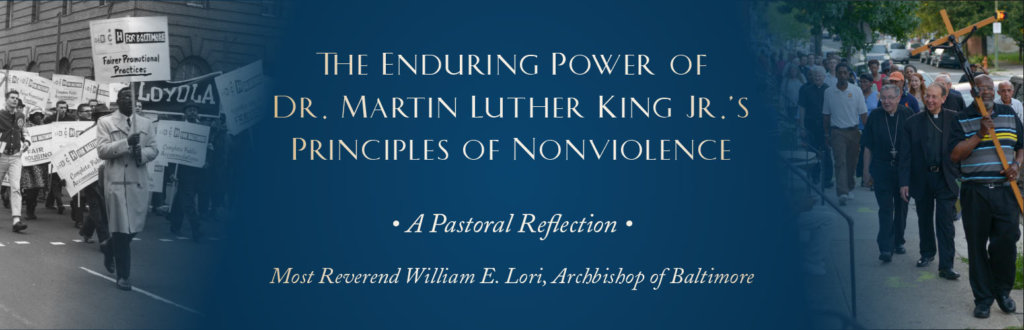
“The Enduring Power of Dr. Martin Luther King Jr.’s Principles of Nonviolence: A Pastoral Reflection” was formally issued on Ash Wednesday, Feb. 14. In it, the archbishop says, “Now is the time for all of us to reconnect with Dr. King and his teaching.”

A pastoral letter is an open letter about Catholic teaching or practice from a bishop to his people. The archbishop’s first pastoral, “A Light Brightly Visible,” laid out his goals for missionary discipleship and evangelization in the Archdiocese of Baltimore.

Archbishop Lori noted in this pastoral letter – his second –  that the archdiocese will mark the anniversary of King’s April 4, 1968, assassination with an interfaith prayer service at the Cathedral of Mary Our Queen in Homeland. The Rev. Raphael G. Warnock, Ph.D., senior pastor of Ebenezer Baptist Church in Atlanta, spiritual home of Rev. King, is scheduled to preach at the April 12 event, which begins at 7 p.m.

In the pastoral, Archbishop Lori said Rev. King’s principles do not apply “only to troubled urban neighborhoods or solely to our African-American brothers and sisters. Violence, racism, and a host of social problems exist in different forms and degrees throughout our suburban and rural areas as well,” he wrote, noting that every community experiences domestic violence, drug abuse and other social ills, and that immigrants face discrimination, hatred, denied opportunities and unjust deportation.

“Think of how vitriolic and coarse public rhetoric has become in politics and the media, a coarseness that often spills over into private conversation,” the archbishop said. “Instead of trying peacefully to reach the common ground of understanding, people far too often and far too quickly resort to abusive language. They may not kill their neighbors with bullets, but they do ‘kill’ them with words and gestures of disrespect.”

In an interview for a video produced by the archdiocese to accompany the pastoral, Archbishop Lori reflected that when he was a seminarian, he realized he did not have any experience in either the inner city or a rural area, experience that would allow him to serve wherever he was assigned.

He asked then-Archbishop William Baum of Washington to assign him, while he was a seminarian, to an inner-city parish. He was assigned to St. Vincent de Paul Parish in the District of Columbia’s Anacostia neighborhood. “I learned, and that was a great experience for me,” he said.

More times than he could count, the archbishop said, he has gone to visit parishioners where he has encountered people in a very poor situation. “I carry back so much more than I brought. … It’s humbling, it’s beautiful, it’s ennobling.

“And that’s why I say at the end (of the pastoral) I said that you get out to the peripheries and find (the people) are not peripheral,” he said. “We just thought they were a periphery. Once they become real people with a real story and God-given gifts, you know that’s not the case.”

Archbishop Lori noted that although the Catholic Church is already present in communities in Baltimore City and the nine counties that comprise the archdiocese, it must raise its profile in the larger community, speaking out more forcefully on issues that beset communities.

“We have to advocate for justice and we have to meet the social needs as best we can,” he said, noting that Catholic Charities of Baltimore is the largest private human services provider in Maryland.

“We have to intensify our efforts to provide a good education for kids. We have to be involved in housing issues and all kinds of things that get at the root causes of these things.”

In the letter, Archbishop Lori said, “If we truly allow Dr. King’s principles of nonviolence to guide us to conversion, we will not be content to camouflage our problems but rather be spurred into action; we will be moved to address and resist injustice in our community. Ultimately, however, it is only a change of mind and heart on the part of many that will lead to a new beginning for us and our beloved community.”

The pastoral letter includes discussion questions intended for all – families, parish groups and pastoral councils, as well as clergy and religious – to pray, reflect and discuss. “I wrote this so that it could find its way into the consciousness of the church – the whole church,” the archbishop said. The archdiocesan web page for the pastoral also will have a portal for people to submit comments about the letter and suggestions for how to address the concerns raised by the archbishop’s letter.

“This should also lead us as an archdiocese to an examination of conscience, and to ask if there aren’t things we ought to be doing differently,” Archbishop Lori said. “It’s not just a letter; it’s the beginning of a process.”

Pastoral Letter online

  • The pastoral letter, supporting videos and other information are available on the web at archbalt.org/kingpastoral. A PDF copy of the pastoral can be downloaded from the site.
  • To receive a printed copy of the pastoral letter, email communications@archbalt.org (with subject line “Request copy of MLK Pastoral”).
  • For information on the April 12 Ecumenical and Interfaith Prayer Service Commemorating the 50th Anniversary of the Assassination of the Rev. Dr. Martin Luther King Jr., visit archbalt.org/mlk-50.


SaveSave


Mother Lange Awards, for 21st time, honor’s God’s ‘best work’


WOODLAWN – “God does his best work with human hands.”

Opening the 21st annual Mother Mary Lange, O.S.P. awards banquet Feb. 9, master of ceremonies Kirk Gaddy succinctly described the 37 honorees in attendance at Martin’s West.

Sponsored by the Archdiocese of Baltimore’s Office of Black Catholic Ministries and held during Black History Month, the event honors those perpetuating the spirit and good works of Mother Lange, who in the late 1820s helped found both St. Frances Academy, the oldest continuously operating black Catholic school in the U.S., and the Oblate Sisters of Providence, the first religious order of women of African descent.

The honorees have contributed to the fabric of their parishes and Baltimore in the areas of leadership, service and youth.

The young and not-so-young in attendance included women, such as Michel Franklin and Frances Spears, whose ministries at St. Gregory the Great include more than two decades together in the choir; and, from St. Bernardine, Daniel Gonzalez, a senior at Mount St. Joseph High School in Irvington who serves as vice president of the parish pastoral council.

His peers include, New All Saints, the Underwood twins, Darren and Devin, who are in the seventh grade at Our Lady of Perpetual Help School in Ellicott City, and Jewel Murrill, who, through St. Cecilia Parish’s Disciples of God youth ministry, collects items for the residents of My Sister’s Place Women’s Center.

Gaddy is a parishioner of Historic St. Francis Xavier. Its service recipient was Mary Burton Watties, a manager for a local supermarket and grandmother of 13 who’s taught Sunday school for 20 years. The leadership award from St. Ambrose in Park Heights, meanwhile, went to Trudy Gordon, a native of Trinidad and Tobago who’s been instrumental in the parish’s International Ministry.

A performance was offered by the Liturgical Dance Ministry Group from St. Bernardine, under the direction of Lori Gonzalez.

Remarks were offered by Sister of Notre Dame de Namur Gwynette Proctor, director of the Office of Black Catholic Ministries, and one of her cousins, Sister Rita Michelle Proctor, the 20th superior general of the Oblate Sisters of Providence, a line that began with Mother Lange.

“This is a woman,” Sister Rita Michelle reminded the more than 450 in attendance, “who faced the challenges of her time.”

Bishop Denis J. Madden, in his welcoming remarks, spoke directly to the many Oblate Sisters of Providence in attendance.

“I can’t thank you enough for your fidelity and patience,” he said, “despite the hardships you endured.”


Mother Lange Award recipients

Thirty-seven men, women and children received awards for Leadership (L), Service (S) and Youth (Y). They are listed below, by parish.

St. Ambrose, Park Heights: Trudy Gordon, L; Gloria Jiggetts, S; Janet L. Butts, Y.

St. Ann: Cynthia Johnson, L; Janet Butts, S.

St. Bernardine: JoAnn Thomas, L; Jacqueline Powe-Joyce, S; Daniel Gonzalez, Y.

Blessed Sacrament: Janet L. Pettaway, L; Christopher Harris, Y; Crystal Harris, Y.

St. Cecilia; Raft Woodus, L; Sandra Morgan, S; Jewel Murrill, Y.

St. Edward: Dr. Calvin Woodland, L; Tamathea Dodson, S; Demteris Downing, Jr., Y.

Historic St. Francis Xavier: Avis Butler, L; Celestia Drake, S; Mary Burton Watties, S; Varia Alston, Y; Kai Massey, Y.

St. Gregory the Great: Michel Franklin, L; Frances Spears, S; Jonathan Kane, Jr., Y.

Immaculate Conception: Myoshi Smith, L; Toemore Knight, S.

St. Mary of the Assumption, Govans: Dr. Rosetta Gainey, L; Kenneth Church, S.

New All Saints, Liberty Heights: Joann Logan, L; Gwendolyn Shipley, S; Darren Underwood, Y; Devin Underwood, Y.

St. Peter Claver and St. Pius V: Helena Johnson, L; Gilbert McClendon, S;

St. Wenceslaus: Dwayne Coleman, L; Mary Westry Harrison-Harris, S; Steven Fung, Y.


Email Paul McMullen at pmcmullen@CatholicReview.org


Church must ‘speak and live in truth’ to combat racism, bishop says


CHARLOTTE, N.C. — The Catholic Church must confront the sin of racism, listen to people who have been oppressed, and seek reconciliation in part by promoting people of color into leadership roles, said Bishop George Murry of Youngstown, Ohio.

As chairman of the U.S. bishops’ Ad Hoc Committee Against Racism, he gave a talk Jan. 27 at St. Peter Catholic Church in Charlotte about racism in the church’s history and how the committee is addressing the issue.

About 300 people attended the lecture, including members of Our Lady of Consolation Church. The majority black parish in downtown Charlotte has fostered an ongoing dialogue on race with members of St. Peter Church, a majority white parish less than three miles away.

The dialogue came in the wake of a fatal police shooting that sparked violent protests in the city in 2016, leaving one Consolation parishioner dead.

Bishop Murry, a Jesuit whose background is in education, summarized Catholic teaching on racism and inequality, noting that the church’s teaching on the fundamental dignity of all people has not always been reflected in its actions — especially in the United States, where racism is “deeply rooted.”

Bishop Murry, who is one of the nation’s black Catholic bishops, criticized the church’s lethargic response to racism in America even after the U.S. bishops issued a 1979 pastoral letter on racism, “Brothers and Sisters to Us.”

“When considering the history of racism in the Catholic Church, one cannot help but wonder why, in the United States, there was so little social consciousness among Catholics regarding racism,” he said. “Why does it appear the church in America is incapable of taking decisive action and incapable of enunciating clear-cut principles regarding racism that have led to a change of attitude?”

“Racism is a sin that divides the human family and violates the fundamental human dignity of those called to be children of the same Father,” Bishop Murry said, and the church must become “a consistent voice” to eradicate it.

“In his letter to the Ephesians, St. Paul tells us Jesus is our peace. It is by means of his shed blood and broken body that the dividing walls of enmity have been demolished,” the bishop said, referring to Chapter 2, Verse 14, of the Letter to the Ephesians.

“Today the Catholic Church in America must recognize that Christ wishes to break down the walls created by the evils of racism, whether that evil is displayed publicly for all to see or buried deep in the recesses of our hearts,” Bishop Murry said. “If not, we are destined for history to continue to repeat itself, and once again the church will be perceived as a silent observer in the face of racism.”

The U.S. bishops’ Ad Hoc Committee Against Racism, formed last August, aims to address the problem of racism in the Catholic Church and the wider community, “and the urgent need for the nation to come together to find solutions,” he said.

He said the committee is working to bring together people of various races, faiths, cultures and backgrounds — and then listening to them.

A national summit of religious leaders and others will be convened this year to discuss the sin of racism and find ways to build bridges, he announced.

Not just Catholics, but all people of goodwill must work together to improve race relations, he said, because as a general rule Christian leaders “have not been consistent in getting across to our people that every human being is created in the image and likeness of God.”

“Through listening, prayer and meaningful collaboration, I am hopeful that we can find those lasting solutions that we so much need, and to find common ground, where racism will no longer find a place in our hearts or in our society.”

The Ad Hoc Committee Against Racism also is organizing a series of “listening sessions” across the country, Bishop Murry said.

Intended to be a “national conversation on race,” these sessions will take place in parishes, schools, seminaries, Catholic Charities organizations, Catholic health associations and social service agencies — “in every Catholic organization throughout the country,” he said.

“The goal will be to allow people to listen to each other, to exchange ideas, to become educated and change hearts,” he said, in part by listening closely to people who have experienced prejudice firsthand: African-Americans, Latinos, immigrants, Jews and others.

The committee will issue a study guide designed “to encourage people to come together and to overcome their hesitations and their fears, and to talk frankly with each other,” Bishop Murry said. Also, a pastoral letter on racism is expected to be issued by the bishops in 2018.

“There are some people in our country who are not going to want to have anything to do with any discussion about race because they think that they’re OK, it doesn’t affect them, ‘leave me alone,'” he said.

“There are other people who are curious and wondering,” he added. “They’re simply honest people who are saying, ‘I don’t want to oppress anybody. I don’t want to discriminate against anybody. How can I learn how best to be sensitive to other people?'”

The study guide is meant to help people have earnest conversations with each other, he said.

Besides listening and learning, Bishop Murry said, the church must “break her silence.”

“In imitation of Christ, we the church must be willing to give our total lives over to the liberation of women and men by defending the dignity and fundamental rights of every human person — and this includes a visible denouncement of racism,” he said.

But beyond statements, he continued, “the church must seek the forgiveness of those that she has victimized by her past injustices.”

Reconciliation can be fostered by finding ways to include people of color in decision-making and leadership roles within the church, he said, adding that the church also must confront racism wherever it occurs.

The Catholic Church must “speak and live in truth,” he said, “leaving behind the comfortable attitudes of superiority and fear. To get to that truth, we must break the silent complicity with the social evil of racism.”


Copyright ©2018 Catholic News Service/U.S. Conference of Catholic Bishops.


Coffee & Doughnuts with Erich March


The Catholic Review sits down with Erich March, president of King Memorial Park cemetery, vice president and COO of March Funeral Homes, and parishioner of St. Ann in Baltimore.

CR: What, and where, are your Catholic roots?

MARCH: My mother, Julia Roberta March, was a parishioner of St. Francis Xavier, the first African-American Catholic church in the U.S. My father, William C. March, was the son of a Lutheran minister who shunned him for marrying a Catholic.

In 1955, my father moved our family to East North Avenue, with the intention of opening a funeral home.  Because my mother did not drive, she took her children to the nearest Catholic church within walking distance, St. Ann’s. I was three years old, too young to know what segregation meant, but I remember, we always sat in the back of church. I attended grades one through eight at St. Ann School, under the guidance of the School Sisters of Notre Dame. I’m still a parishioner of St. Ann, now predominantly African-American.

CR: What led your parents to start offering free and reduced-cost bereavement services in 1982?

MARCH: “A Time of Sharing” was our recognition that there were unresolved issues or lack of support for families experiencing an especially painful death. Grief education and support was non-existent in African-American communities. My parents taught us that funeral service was not only a business, but a ministry. The same spirit that moved them to offer reduced-cost funerals moved us, as a family, to continue needed counseling and support beyond the day of the burial.

CR: Your family’s efforts include Roberta’s House. Explain, unfortunately, how its mission has expanded since its 2007 founding.

MARCH: Named for my mother, the  nation’s only minority-operated grief center helps children and families heal and recover after the loss of someone close, whether in death or connection.

Loss of life can be more traumatic if it is sudden or unexpected. Loss of connection could be the result of losing a loved one to drug addiction or incarceration. Both types of loss can be emotionally devastating, especially for children whose coping skills have yet to mature, which can lead to negative behaviors and continue the cycle of violence.

Its programs are overwhelmed by the homicide rate in Baltimore. Roberta’s House will serve more than 1,500 individuals this year, from helping police with notification of the victim’s family to helping expectant mothers through miscarriages and infant deaths to, more than ever, helping children learn to cope with the sudden loss of a parent, sibling, safety and security.

We’ve begun a capital campaign to raise money to build a state-of-the-art grief support center.

CR: How is your effort to solve food deserts in Baltimore City going?

MARCH: Unfortunately, Apples and Oranges Fresh Food Market failed. The reality of bringing fresh vegetables and healthful alternatives to underserved communities remains an economic and cultural challenge. The cost to eat healthy requires a certain income. Because we were a small store, we could not purchase at the same volume discount enjoyed by big stores.

The next time, it needs to be a non-profit store to qualify for more help for the mission.

CR: Favorite saint?

MARCH: St. Francis of Assisi. He seemed cool with animals and humanity, and I took his name at confirmation. I’m rooting for the canonization of Mother Mary Lange, the founder of both the Oblate Sisters of Providence, the first order of black nuns, and St. Frances Academy in Baltimore.

Read more Coffee & Doughnuts profiles here.

Email Paul McMullen at pmcmullen@CatholicReview.org


Catholic Church sometimes has been part of racism problem, says Bishop Murry

Though the Catholic Church has responded to racism for many years, some leaders and church institutions have at times been part of the problem, said a bishop who is heading a committee against racism.

Bishop George V. Murry, speaking to bishops gathered Nov. 13 for the U.S. Conference of Catholic Bishops fall gathering in Baltimore, said that while racism was not unique to the United States, it “lives in a particular and pernicious way in our country, in large part because of the experience of the historic evil of slavery.”

Bishop Murry, who became the head of the bishops’ Ad Hoc Committee Against Racism earlier this year, said the church must recognize “and frankly acknowledge” its failings.

The country has tried to address the problem before, he said, and yet, “even with that progress, one does not need to look very far to see that racism still exists and has found a troubling resurgence in modern years.”

Christ calls us to break down the walls created by the evils of racism, he said.

Though African-Americans have suffered intensely from “the sin of racism,” racism also has ravaged lives and livelihoods and many people of other races, he said. Its targets seem to be growing.

Weeks ago, in Charlottesville, Virginia, white supremacists and neo-Nazis marched with hate-inspired messages, leading to violence and death, he said.

“Racial hatred that is often in hiding, for some, was on full display for many,” Bishop Murry said of the events in Charlottesville.

The committee he heads, he said, is working to provide pastoral accompaniment and one way is to listen to the “voices of people suffering because of racism.”

Created by the U.S. bishops in August, the committee will have listening sessions and create and disseminate theological, liturgical, pastoral and community resources. The committee, he said, is also looking at ways to best commemorate the 50th anniversary to the assassination of civil rights icon the Rev. Martin Luther King Jr.

Bishops chimed in with comments and suggestions.

Bishop Gerald F. Kicanas, whose retirement as head of the Diocese of Tucson, Arizona, was recently accepted by Pope Francis, suggested that the bishops take “symbolic actions,” much in the way other church members have taken at events such as masses on both sides of the southern border.

“Racism isn’t going to be conquered by speech but by actions,” said Archbishop Wilton D. Gregory of Atlanta.

Bishop Murry said committee’s efforts also will focus on evangelization geared toward healing and reconciliation, toward conversion of those who harbor racist beliefs and who commit racist actions as well as caring for the victims of racism.

“All of this is aimed at one goal: to change hearts, which will lead to a change in behavior because every human being is created in the image and likeness of God,” he said.

While on the committee, he said, he has heard certain comments.

“Some people think that there’s no need to confront racism or that we should confront it only in private,” Bishop Murry said, but confronting racism “is necessary because the Gospel calls us to work for justice, and racism denies justice to people simply because of their race — and that is morally wrong.”

Much work has already been done, but there is much more to be done, he said.

“Racism has lived and thrived in various ways for far too long,” he said. “As a result, our efforts to root it out will not succeed overnight. Yet, the church’s contribution at this time is vital.”

Baltimore Archbishop William E. Lori, the chairman of the Maryland Catholic Conference, announced Sept. 27 the creation of a statewide task force on racism.

A news release from the Archdiocese of Baltimore described it as “an effort to better improve race relations and to address the sin of racism that continues to be a divisive force in our country.”

The group, which is co-chaired by Bishop Denis J. Madden, auxiliary bishop emeritus and urban vicar of the Baltimore Archdiocese, and Bishop Roy E. Campbell Jr., auxiliary bishop of the Archdiocese of Washington, has already begun meeting.

Also see:

At Baltimore Mass, Cardinal Parolin praises USCCB for century of working for a more just society

At home and abroad: Bishops’ conferences show collegiality, solidarity

Archbishop Lori announces statewide Maryland task force on racism

Copyright ©2017 Catholic News Service/U.S. Conference of Catholic Bishops.


Least of These: Despite gains, barriers remain in overcoming bigotry

Eleventh in a Series

Editor’s Note: Inspired by Matthew 25:40-45, which concludes “ … What you did not do for one of these least ones, you did not do for me,” each month in 2017 the Review will provide an in-depth look at the Catholic Church’s response to those in dire need.

“By the very terms of Christian teaching, we believe that all men are God’s special creatures, made to His image and likeness. … We have an essential duty in justice to recognize and to respect equally the rights of all men.”

– Cardinal Lawrence Shehan, March 1963

Fifty-four years after the 12th archbishop of Baltimore issued a pastoral letter titled “Racial Justice,” the 16th announced the creation of a Statewide Task Force on Racism.

Then-Archbishop Shehan wrote five months before he marched on Washington, D.C., with the Rev. Dr. Martin Luther King Jr., and two years before passage of the Voting Rights Act of 1965.

Archbishop William E. Lori cited the violence in Baltimore City that followed the April 2015 death of Freddie Gray from injuries sustained in police custody and a deadly riot in mid-August incited by a white supremacist rally in Charlottesville, Va.

Archbishop Lori, the son of a Navy veteran who helped fight fascism in the Pacific theater during World War II, wrote that Charlottesville “is a shocking reminder of how much still needs to be done to eradicate the sin of racism in our country, our state, and our local communities.”

He leads an Archdiocese of Baltimore that is a nexus in the discussion, as local history includes:

  • Chief Justice Roger B. Taney, a native of Calvert County and a Catholic, writing the Dred Scott decision in 1857 that said that slaves could not become U.S. citizens.
  • In 1838, Jesuits selling 272 of their slaves in order to keep Georgetown University open.
  • And in 1814, Francis Scott Key, observing the British bombardment of Fort McHenry, including lines in “The Star-Spangled Banner” that are objectionable to African-Americans.

Two centuries later, the nation is again divided.

One side includes those protesting police brutality. The other includes those defending Confederate monuments. Icons brandished include the American flag and the cross, both ones showing Christ crucified and others in flames, symbolizing the Ku Klux Klan, which historically has been anti-black, anti-Semitic – and anti-Catholic.

The Task Force on Racism includes members of the Hispanic community, as well as Valerie Twanmoh, director of the Esperanza Center, a signature program of Catholic Charities of Baltimore. She notes that newcomers face bias not only because of the color of their skin, but their language.

The Least of These series explored the church’s outreach to the immigrant in July. With November being Black Catholic History Month, this installment focuses on the experiences of African-Americans.

Matter of principle

According to Thomas W. Spalding’s history of the archdiocese, leadership ordered the integration of Catholic schools and hospitals in 1962.

That was four years after Mary and Rocky Byrd married and converted to Catholicism for the liturgy and the schools, despite resistance from the pastor of St. Bernardine in West Baltimore.

“Not In My Neighborhood: How Bigotry Shaped a Great American City,” Antero Pietila’s 2010 book on Baltimore’s racial history, wrote that Monsignor Louis Vaeth, who died in 1969, “fought from the pulpit to keep blacks out of Edmondson Village.”

Other priests, however, made them feel welcome.

“I believe in working for my church,” said Mary Byrd, the first black adult to prepare the St. Bernardine altar for Mass. “He (the pastor) didn’t want to mix, but Father (Paul) Witthauer told me about the Cooks (George and Marie). If not for them, I probably would have left St. Bernardine.

“She introduced me to the group, 10 to 15 women, who were not happy to see me, but Mrs. Cook and I got along. She was always talking about her son, the priest.”

That would be Monsignor Paul Cook, now a retired priest of the archdiocese.

In 1964, Mr. Byrd became one of the first two black ushers at St. Bernardine, where his family had been steered to the back of the church.

“Me being headstrong, I put my wife and kids toward the front,” Mr. Byrd said. “We were not invited to the ushers’ activities, until Monsignor (James) Cronin told the ushers, ‘If they can’t be a part of it, it cannot be held at the church.’ I don’t eat oysters, but I wanted access to the oyster roast.

“It was a matter of principle.”

Mr. Byrd became a eucharistic minister; Mrs. Byrd the Maryland State Regent for the Catholic Daughters of the Americas. An accountant, she worked for parish schools that educated their children, Lendora and Raymond, who went on to the Institute of Notre Dame and Cardinal Gibbons.

Of Monsignor Cronin, Mrs. Byrd said, “We loved him and he loved us back. He tried to get blacks and whites together; we’d go to each other’s homes. That still didn’t stop them (whites) from moving out.”

Of Monsignor Ed Miller, also deceased, who shared hate mail he received after the parish added a Gospel choir to 11:30 a.m. Sunday Mass, she said, “Excluding my husband, he was my best friend. … He was my gift from God.”


Conversion

The archbishop’s task force includes Father Donald Sterling, pastor of New All Saints Parish in Liberty Heights. What are his hopes for the group?

“That we won’t repeat the same things we’ve done,” Father Sterling said, “but make a true commitment, to bring about constructive change predicated on the principles of Jesus Christ and really face the hard questions.”

He was a minority student at both St. Ann’s parish school and Archbishop Curley High School in northeast Baltimore, but it wasn’t until he was a second-year seminarian at Resurrection College in Kitchener, Ontario, that he felt wounded because of his race.

“Dr. King’s assassination (in April 1968) was a wake-up call,” Father Sterling said. “We were huddled around the TV, trying to see what was going on in the United States. One of my good friends and classmates looked at me and said, ‘Donald, I’m glad they killed that troublemaker.’

“I looked at him and said, ‘You didn’t say that to me.’ It spoke volumes. … He cannot see that I am the same as Dr. King. That’s related to this issue of race relations; people might deal with an individual, but they can’t deal beyond.”

That exchange led Father Sterling to request a transfer to St. Mary’s Seminary in Baltimore, one which was approved by Cardinal Shehan. Ordained in 1974, he became pastor of St. Cecilia three years later. He has been at New All Saints since 1992.

He asks for more interaction between urban and suburban parishes, and for more Catholic schools in the city.

In early July, he was a featured speaker at the 12th National Black Catholic Congress in Orlando, his subject being racism, how “people of color were systematically put into as chattel, to enrich people, (including) the Founding Fathers.”

“We can’t start without acknowledging the past,” Father Sterling said. “We’ve got to go through a metanoia, a change of heart. It’s been woven into people’s consciousness, that this (racism) is alright, rather than us being responsive to each other as true brothers and sisters in Christ.”

He cites Scripture.

“God’s law is what?” Father Sterling asked rhetorically. “Everybody is equal, and we are to love one another as he loves us. That’s a major change for a lot of people, I know, but that’s where we’ve got to be.

“If we do that, we’re not dealing with political fall-out, we’re dealing with it in the context of bringing people to a real conversion.”


Coach them up

When Donald Davis entered Calvert Hall College High School as a freshman in 1992, he said, “I very much felt like a minority, because I never had a white teammate in the Northwood Rams (football) organization.”

When he returned to his alma mater to coach varsity football and teach an assortment of subjects that include African-American Literature, it was with a degree in sociology from The Johns Hopkins University and intimate knowledge of what minorities call “driving while black.”

“As a young adult, I got rid of an Acura Legend because it got me pulled over too many times,” Davis said. “I was starting a family. I didn’t want that.”

Mindful that young minds are more malleable, Davis tells his players, “We live in a diverse world, and you play on a diverse team.”

“We’ve got 108 ZIP codes here,” Davis said of Calvert Hall. “We have guys who are black, guys who are white, guys who are multi-racial. Some kids catch two city busses to get here; others drive a Mercedes Benz. We’ve got guys who have lost a parent.

“To have a locker room with all of that, it gives every one of those kids a different understanding and appreciation for that which is unlike them. Because you’ve experienced so many people different from you, you don’t then see just the differences.”

His players interact about everything from their favorite video game to the imbroglio over the national anthem in the NFL.

“I want them to have an open mind, and see everything,” Davis said. “If you only see one side, can you see everything? It’s the educational process, explore how and why the world and people work. Don’t get so caught up in which side of the fence you want to land on.”

In the classroom or calling plays in the Turkey Bowl against Loyola Blakefield Thanksgiving Day, Davis is aware that he serves as a role model, not  just  for black teens, but their teammates and classmates.

“I’m in a position to tear down stereotypes,” Davis said. “I believe that.”

Also see:

The Least of These: Pro-life activism goes beyond sidewalk’s end

The Least of These: Welcoming the stranger

The Least of These: Helping victims of modern slavery become survivors

The Least of These: Stella Maris volunteers bring companionship, Communion to the dying

The Least of These: Care for prisoners doesn’t stop after release

Fugett’s remarkable path includes being prep pioneer


As Baltimore City marks 300 murders, prayers for peace continue

On the same day Bishop Denis J. Madden led an evening prayer walk for peace through the streets surrounding St. Veronica in Cherry Hill Nov. 2, Baltimore City achieved the dubious distinction of reaching 300 murders so far this year.

It was the third straight year the city has logged 300 murders or more, arriving on the same day the Catholic Church commemorated the feast of All Souls.

The irony was not lost on the bishop, who during his prayer vigil had stopped at three sites where people had been killed.

“Every night on T.V., you’ll see reports of one or two shootings in and around Baltimore,” said Bishop Madden, urban vicar. “It dulls the mind so that there’s nothing new or shocking about it.”

All must guard against the notion that killings are somehow to be expected or tolerated in the city, he said.

“People should not have to live that way,” Bishop Madden insisted. “It’s not normal that people shoot each other.”

Among the nearly 70 people who participated in the peace walk was a 9-year-old girl who wore a large medical boot on her foot, the aftermath of a gunshot wound she sustained in September when a gunman inadvertently hit her instead of his intended target.

“Her attitude is wonderful,” Bishop Madden said. “She was smiling, and she came back to the church with us, even though it was a bit of a walk from her house. She was an innocent child who got caught in the crossfire.”

Bishop Madden gave a ringing endorsement of a 72-hour “cease fire” that has been declared in the city for Nov. 3-5. Calling the second-of-its-kind initiative “wonderful,” the bishop said it is intended to draw down violence.

Noting that there are many causes of violence, Bishop Madden highlighted the ready availability of guns as one of the most concerning. He suggested that society must explore ways of curbing the proliferation of guns.

“In the past, people could yell and scream and throw some punches at each other,” he said. “But these days, if they don’t have a gun, they go to their car or house to retrieve it and they come back and they settle scores that way.”

It’s important for the Catholic Church to be present in areas touched by violence to show love and solidarity, Bishop Madden said.

“Walking through the streets and being able to read Scripture, say prayers, sing hymns and carry a cross is important,” he said. “There’s something good about that. You are professing your faith and trying to support the people in the area and let them know they are not alone and they are not forgotten.”

Bishop Madden noted that the monthly prayer walks have seen an increase in participation. The previous prayer walk was Sept. 27, from St. Francis Xavier Church in the Oliver section of East Baltimore. Approximately 150 people joined the bishop and Josephite Father Xavier Edet, pastor of St. Francis Xavier. The historic church is the first black Catholic parish in the United States.

The group that evening included Capuchin Franciscan Father Paul Zaborowski, pastor of St. Ambrose in Park Heights; students from Cristo Rey Jesuit High School in East Baltimore; and several members of Nativity Missions, an outreach of the Church of the Nativity in Timonium. Stops included the Oliver Senior Housing Plaza, on what was part of the former St. Joseph Hospital; and the Dawson Safe Haven Center, on the corner of Eden and Preston Streets.

The Safe Haven Center commemorates the 2002 firebombing murder of five members of the Dawson family, in retaliation for their having reported drug dealing outside their home to police.

The next prayer walk for peace will be held outside St. Wenceslaus in East Baltimore Nov. 29, beginning with a light meal at 5:30 p.m.

 Email George Matysek at gmatysek@CatholicReview.org.

Paul McMullen contributed to this article.

Also see:

In his own words: A conversation with Bishop Denis J. Madden


Black Catholic History Month

November is National Black Catholic History Month, a time the church in the United States sets aside to recall the rich history of Black Catholicism and the many and important contributions that African-Americans have made to our church. Here in our Archdiocese of Baltimore, we need not look far to see the legacy of those Black Catholic pioneers whose works continue to bear fruit in our local church and beyond.

Elizabeth Lange fled her Haitian homeland in 1817 and arrived in Baltimore where she began a school to educate black children in her new Fells Point home. Eleven years later, Elizabeth Lange made history when she and three other women of African descent took formal vows of poverty, chastity and obedience in the lower chapel of St. Mary’s Seminary, founding the Oblate Sisters of Providence. St. Frances Academy in East Baltimore, operated by the Oblate Sisters, opened in 1828. It continues to this day to be a beacon of hope for predominantly African-American children and traces its roots to Mother Lange’s school.

Charles Uncles became the first African-American ordained to the priesthood in the U.S. when he took his vows at the Basilica in Baltimore in 1891. He was one of five priests who founded the Josephite Fathers, who had been given the ministry of “Negro Missions” in the U.S. by Pope Pius IX.

It’s impossible to tell the history of the Baltimore Archdiocese or the church in the United States without noting the invaluable contributions of the Josephites, who lovingly minister to God’s people at St. Francis Xavier, St. Peter Claver/St. Pius V, and St. Veronica parishes.

Among the many holy priests to profess vows for the Josephites is our own beloved Bishop John H. Ricard, who was ordained an auxiliary bishop for the Baltimore Archdiocese in 1984 before becoming Bishop of Pensacola-Tallahassee in 1997.

And service to the church and to Black Catholics extends beyond the clergy, as laymen such as Charles Tildon and Samuel Cooper contributed their time and talents to many Catholic parishes and ministries. Tildon was named by Cardinal Lawrence Shehan – archbishop during the Civil Rights Era – as the first chairman of the Archdiocesan Urban Commission, formed in 1966. He was the first layman appointed to head a major archdiocesan post.

The commission was formed to identify problems in Baltimore City such as race relations, community development, mass incarcerations, homelessness and the treatment of blacks in Catholic hospitals. Then it worked to identify how the church could play an integral role in addressing these problems.

Cooper, who died just last month at the age of 93, served on many boards and committees, including the Archdiocesan Pastoral Council, and raised money to support the ministries of the Oblate Sisters. In 1983, in recognition of his many contributions, Pope John Paul II conferred upon him the highest honor awarded to a member of the laity, the Pro Ecclesia et Pontifice medal.

There are countless examples like these of women and men throughout the history of our archdiocese who have contributed greatly to the church’s mission of living out the Gospels and sharing the Good News of Christ’s love through acts of prayer, service, and generosity to others. May the examples of Mother Lange, Father Uncles and others inspire us to follow in their footsteps on the journey for peace, justice and unity. And may we take time this month to give thanks for the many ways in which the Black Catholic community has enriched our church and continues to bless us with their faithful witness.


Bishop Madden to lead Baltimore prayer walk for peace Nov. 2

Bishop Denis J. Madden, urban vicar and auxiliary bishop emeritus of Baltimore, will lead a prayer walk for peace Nov. 2 at St. Veronica, 806 Cherry Hill Road in Cherry Hill.

The evening will begin with a light meal at 5:30 p.m. in the parish hall. The event will end before 7:30 p.m.

During the walk, participants will pray at locations that have been affected by violence. They will also pray for all those individuals who have been affected by violence and for a change of heart for those given to violence.

There is ample on-street parking near the church.

For more information, call the parish at 410-355-7466.