Bishops consider, comment on proposed pastoral against racism

BALTIMORE — The U.S. bishops took the first steps toward approving a pastoral letter against racism with the document’s introduction Nov. 13 during their annual fall general meeting.

The proposed pastoral letter, “The Enduring Call to Love: A Pastoral Letter Against Racism,” has been in the works for four years, although its issuance was put on the front burner following the September 2017 “Unite the Right” rally in Charlottesville, Virginia.

Archbishop Gustavo Garcia-Siller of San Antonio, chair of the U.S. bishops’ Committee on Cultural Diversity in the Church, said all standing committees of the U.S. Conference of Catholic Bishops collaborated on the document.

“Open Wide our Hearts’ conveys the bishops’ grave concern about the rise of racist attitudes in society,” said Bishop Sheldon T. Fabre of Houma-Thibodaux, Louisiana, chairman of the USCCB Subcommittee on African American Affairs. He also chairs the Ad Hoc Committee Against Racism.

It also “offers practical suggestions for individuals, families and communities,” Bishop Fabre said.

“Despite many promising strides made in our country, the ugly cancer of racism still infects our nation,” the proposed pastoral says. “Racist acts are sinful because they violate justice. They reveal a failure to acknowledge the human dignity of the persons offended, to recognize them as the neighbors Christ calls us to love,” it adds.

“Every racist act — every such comment, every joke, every disparaging look as a reaction to the color of skin, ethnicity or place of origin — is a failure to acknowledge another person as a brother or sister, created in the image of God,” it adds.

“Racial profiling frequently targets Hispanics for selective immigration enforcement practices and African-Americans for suspected criminal activity. There is also the growing fear and harassment of persons from majority-Muslim countries. Extreme nationalist ideologies are feeding the American public discourse with xenophobic rhetoric that instigates fear against foreigners, immigrants and refugees.”

“Personal sin is freely chosen,” a notion that would seem to include racism, said retired Bishop Ricardo Ramirez of Las Cruces, New Mexico, but “social sin is collective blindness. There is sin as deed and sin as illness. It’s a pervasive illness that runs through a culture.” Bishop Fabre responded that the proposed letter refers to institutional and structural racism.

Bishop Curtis J. Guillory of Beaumont, Texas, said the proposed pastoral “gives us a wonderful opportunity to educate, to convert,” adding that, given recent incidents, the document should give “consideration to our Jewish brothers and sisters.” Bishop Fabre said that while anti-Semitism is mentioned in the document, future materials will focus on anti-Semitism.

The rollout of the proposed pastoral was the chief concern of Bishop Christopher J. Coyne of Burlington, Vermont. “We do this great work,” he said, and it should be shaped to fit “multiple formats,” including short videos, digital media, religious education and adult education. Although “we’re getting better at it,” he added, all too often “we do these documents, and they sit on a shelf.”

Bishop Fabre allayed his concerns. “We do have lesson plans ready to go, from kindergarten to high school,” he said, “ready, just waiting for the pastoral letter to be approved.”

A vote to approve the document was scheduled for Nov. 14, the last day of the public sessions of the bishops’ meeting.


Copyright ©2018 Catholic News Service/U.S. Conference of Catholic Bishops.


New Baltimore Catholic school to be named in honor of Mother Lange

The proposed new Catholic elementary school in Baltimore City will honor the name of Mother Mary Elizabeth Lange, the foundress of both the Oblate Sisters of Providence, the first religious community of women of African descent, and the first Catholic school in the United States for black children.

The announcement of the selection of “Mother Mary Lange Catholic School” was made by Archbishop William E. Lori Sept. 4, the first day of the 2018-19 school year in the Archdiocese of Baltimore.

In April, he announced plans for the first new K-8 school in the city in nearly six decades. With plans to open in downtown Baltimore in 2020, its students will include those currently attending Holy Angels Catholic School, on the campus of the former Seton Keough High School in Southwest Baltimore, and Ss. James and John Catholic School, in the Johnston Square neighborhood.

The new school will honor a woman being considered for canonization, one who was born in 1784 in the Caribbean, emigrated to Baltimore and opened, in her home in East Baltimore, a school for black children, what would become St. Frances Academy.

“The Oblate Sisters of Providence considers it a great honor and tribute to have this new city Catholic School named in honor of Mother Mary Lange,” said Sister Rita Michelle Proctor, superior general of the order founded by Mother Lange, in a news release from the archdiocese. “She herself valued Catholic education as she established the first Catholic school for ‘children of color’ in 1828, St. Frances Academy, which still exists today.”

The new school will be built on a tract of city-owned land along Martin Luther King Jr. Boulevard, between Lexington and Saratoga Streets. According to the news release, the final $2 million of a goal of $18.6 million must be raised before construction begins.

It will not be the first school in the archdiocese to bear her name, as the consolidation of the parish schools at St. Dominic, Shrine of the Little Flower and St. Anthony of Padua, on the campus of the latter, opened in 2005 as Mother Mary Lange Catholic School. It closed in 2010.

Dr. Camille Brown, associate superintendent of schools, and Monsignor Richard J. Bozzelli, pastor of St. Bernardine, led a consultation on the matter of naming the new school, which included a petition with 359 signatures promoting the name of Mother Lange that was forwarded to Archbishop Lori.

“One can’t tell the history of the Catholic school system in this country without mentioning Mother Mary Lange,” Archbishop Lori said. “She was a visionary woman of deep faith and recognized the life-changing role of education in the lives of children, most especially those living on society’s margins.

“Please God, Mother Lange’s name on our new school will be a beacon that shines brightly for the children of Baltimore and a reminder to all that every child of God deserves a good education and the hope and opportunity that comes with it.”

The Vatican is reviewing Mother Lange’s cause for canonization, which requires confirmation of two miracles attributed to her intercession.


St. Bernardine parishioner offers comfort with meals

As a child, Jo Ann Thomas watched her grandmother cook for the retired Josephite priests and brothers in residence at St. Joseph’s Manor in Roland Park.

Those memories of growing up around the Josephites (her mother served them as a nurse) surround Thomas when she cooks with commercial-sized pots and pans in the kitchen of her parish, St. Bernardine in West Baltimore.

Thomas is the leader of the Comfort Food Ministry, which provides meals for repasts after parish funerals. For up to 100 attendees, the parish provides a home-cooked meal at no cost. The faith community also tries to send families home with meals for the seven days following funerals.

“We ask for a love donation, or a donation if you are able,” Thomas said. “And if you are not able, it’s no different if you’re a millionaire or a person who doesn’t have two nickels to rub together. You’re treated the same – with dignity and respect.”

Thomas has been a member of the Comfort Food Ministry since 2000, identifying closely with those she serves. She draws on the experience of losing her mother and father just four months apart.

“When I started doing it, I remembered how I felt,” Thomas said. “It is such a good feeling to be able to relate to these people, go to them and say, ‘Do you need anything?’”

When she asks if families need anything, she said, they inevitably say no. She brings them something, anyway.

“We make people feel comfortable,” she said. “Not just with food, but with whatever we need to do on that day.”

Even a compliment on a grieving person’s dress or family can be just enough to make a difference.

Though she leads the Comfort Food Ministry, she did not begin with that intention.

“You come to serve,” said Thomas, who recently took over leadership of the ministry after the former leader retired following many years of dedicated service. “If you come in with a mentality that you’re in it for some type of self-gratification, or to run things or give people unsolicited advice, it won’t work.”

St. Bernardine’s pastor, Monsignor Richard Bozzelli, said Thomas is not only maintaining the ministry, but is honing its excellence.

That includes a standardized menu that Thomas created – rotisserie chickens (bought cooked from Sam’s Club), mashed potatoes, macaroni and cheese, string beans, corn and gravy. During the winter, she makes well-loved additions – dressing and sweet potatoes.

“Butter is so comforting,” Thomas said. “Butter, cream, mashed potatoes with some nice flavorful gravy – that’s so comforting.”

The Comfort Food team focuses on details such as cutting the rotisserie chicken, separating the light meat from dark and de-boning everything but the drumsticks and wings.

“Some people would think ‘Why do you even bother with all of that?’” Thomas said. “Because we’re trying to make people feel good.”

Those actions might seem small, she said, but they are helpful to those grieving.

Monsignor Bozzelli called Thomas an “ideal parishioner.”

“If there’s a need, she just says, ‘How can I help?’” he said, adding that she is also responsible and thorough in her work. “You only need five people like that and you can run a parish.”

Monsignor Bozzelli meets with the family to determine if there are any special requests and relays the information to Thomas, who usually has about a week to prepare. The parish of approximately 950 registered households has about 40 funerals a year, according to Monsignor Bozzelli.

Since April, Monsignor Bozzelli said there has been a funeral approximately every 10 days.

As the owner of her own business, American Dream Real Estate Services, Thomas able to be flexible in her ministries at St. Bernardine.

“I like to house people with difficult situations,” Thomas said, speaking of homelessness and poor credit situations. “People have poor credit for reasons, but big organizations don’t care about those reasons. … I do.”

Thomas said she works with people to determine the cause of their problems, which may include the loss of a job, or a medical issue in the family.

“People have real issues, so we’re a second-chance company,” she said. “We will find you a place to live.”

Thomas is also a member of St. Bernardine’s women’s ministry, and is regent for the parish’s court of Catholic Daughters of the Americas. Her 17-year-old son, David Anoma, is active in the parish and is employed there for the summer.

Thomas is a recipient of a Mother Lange Award, presented in February by the archdiocesan Office of Black Catholic Ministries in recognition of her service.

Her lifestyle allows St. Bernardine to be the center of her life. She said she is grateful for the community and her volunteer corps of approximately 40 people, who come when they can. They work with the Hospitality Ministry, which helps to set up and serve the food that the Comfort Food Ministry prepares.

“I want them to feel good when they come because I want them to come back,” she said of the volunteers. “I want them to share the feeling that I get from it – and they do.”

Email Emily Rosenthal at erosenthal@CatholicReview.org

Read more Faces of Faith profiles here.


University, institute to be hub for sainthood causes of African-American Catholics

NEW ORLEANS — Reynold Verret, president of Xavier University of Louisiana, announced July 31 that the university and its Institute for Black Catholic Studies will become the new hub for the advancement of sainthood causes of African-American Catholics.

Verret made the announcement in the university’s St. Katharine Drexel chapel.

Privy to this historic announcement were attendees of the Joint Conference 2018 of the National Black Catholic Clergy Caucus, the National Black Sisters Conference, the National Black Catholic Seminarians Association and the National Association of Black Catholic Deacons held in New Orleans July 28-Aug. 2.

Verret said Xavier and its Institute for Black Catholic Studies will serve as hosts and administrators, and Chicago Auxiliary Bishop Joseph N. Perry will be moderator and chair of the center, whose goal is to unite all guilds advancing the causes of black sainthood.

Bishop Perry is postulator of the cause of Father Augustus Tolton, the first recognized African-American priest. Father Tolton has the title “servant of God” at this stage in his cause.

The center’s initial focus will be on the canonization of Father Tolton and Pierre Toussaint, Mother Henriette Delille, Mother Mary Elizabeth Lange and Julia Greeley, Verret said, with the hopes, this fall, of adding another ground-breaking black Catholic, Sister Thea Bowman, who taught at Xavier’s Institute for Black Catholic Studies.

The eventual goal, Verret said, is to establish “a resource center at Xavier with scholarly work on the lives and work of the … soon-to-be six candidates for sainthood and St. Katharine Drexel and St. Kateri Tekakwitha.”

A brief update was given during the announcement by promoters of the causes of each of the five sainthood candidates:

— Father A. Gerard Jordan, representing Bishop Perry, described Pierre Toussaint as a former slave and hairdresser who purchased freedom for his family. Toussaint has been declared “venerable.”

— Father Jordan also talked about Father Tolton, a former slave from Missouri whose family used the Underground Railroad to find freedom in Illinois. He trained for the priesthood in Rome because he was refused entrance into American seminaries and was ordained in 1886. He suffered threats while pastoring in his Illinois hometown and moved to Chicago to found St. Monica’s, the city’s first black parish.

“His life was a life of courage,” Father Jordan said. The cause for his canonization was proclaimed in 2011. He was named a “servant of God” in 2012. The Vatican Congregation for Saints’ Causes declared affirmatively to the validity of the inquiry into his life in 2015. His remains were exhumed in 2016, and his “positio” was approved so his cause can move forward to the pope.

Father Jordan also said the five candidates were universal saints for everybody, and their causes are “not in competition but in communion” to recognize black Americans who are people of virtue.

— Sister Magdala Gilbert, an Oblate Sister of Providence, discussed Mother Mary Elizabeth Lange, her Baltimore-based order’s founder and a “servant of God.” Sister Gilbert described her “as a no-nonsense woman who did what she had to do.” She worked to educate African-American children when it wasn’t popular: “When you have God at your side, you fear nothing.” Mother Lange’s cause began in 1991 but was recently assigned a new postulator in hopes that the “positio,” or position paper, on her life will be completed this October.

— Sister Greta Jupiter, a member of the Sisters of the Holy Family, talked about the cause of Mother Henriette Delille, who founded the order in 1842. She was declared “venerable” in 2010 by Pope Benedict XVI. Two miracles attributed to her intercession are being examined. In general, one authenticated miracle is required for beatification and a second such miracle for canonization.

— Mary Leising described the Denver Archdiocese’s progress made on the cause of “Angel of Charity” Julia Greeley of Colorado. Born in Hannibal, Missouri, she worked and walked the streets of Denver collecting food, coal, clothing in a little red wagon and delivered the goods at night to the needy. She joined the Secular Franciscan Order in 1901. A guild to research her sainthood was established in 2011. Her cause was opened by Denver Archbishop Samuel J. Aquilla in 2016. On Aug. 10, the archdiocese will close its investigative phase and send its findings to Rome.

Xavier University was the last stop on the conference’s Black Catholic Enrichment Tour that treated attendees to significant sites in the life of African-Americans in New Orleans. The conference celebrated the 50th anniversary of the National Black Catholic Clergy Caucus and the National Black Sisters Conference and their formation of strong black Catholic men and women of service.

The enrichment tour illustrated the joint conference theme of “We’ve Come a Mighty Long Way!”

“Welcome. You are standing on holy ground” were the first words tour participants heard when entering St. Augustine Church, founded in 1841, in New Orleans’ historic Treme’ neighborhood.

Local conference committee member Jari Honora and New Orleans Auxiliary Bishop Fernand J. Cheri explained that St. Augustine Church saw whites, free people of color and slaves worshipping together.

It also was where Mother Henriette Delille began her ministry to the poor and elderly; and where civil rights activists Homer Plessy, attorney A.P. Tureaud and many musicians prayed. It also is home to the “Tomb of the Unknown Slave.”

Along the route, Bishop Cheri referenced Congo Square as a place where free people of color congregated, the Mahalia Jackson Performing Arts Center (named after the New Orleans-born gospel singer) and how native Louis Armstrong was baptized Catholic at Sacred Heart of Jesus Church on Canal Street.

When passing Corpus Christi-Epiphany Church, which merged after Hurricane Katrina, Corpus Christi Parish, founded in 1916, was noted as once being the largest African-American parish in the world and was considered “Queen of the Josephite missions.” Bishop Cheri recalled there being about 53 majority-black parishes in New Orleans; now, the number is close to 24 parishes and three predominantly black schools.

At the Sisters of the Holy Family Motherhouse in Gentilly, Sister Laura Mercier said when her order’s founder is canonized, she would be the first native-born African-American saint. “Her life will be a reminder that everyone can be a saint, no matter what color they are,” Sister Laura said.

Blessed Sacrament Sister Eva Marie Lumas, interim director of the Institute for Black Catholic Studies, said Xavier University is a special place that understands the woes and giftedness of the African American community and a perfect place to honor black Catholic ancestors who walked before and contributed much to society and the church.

She said elevating these African-Americans to sainthood is “a witness to advancing some who are ordinary people who did extraordinary things, and extraordinary people that understood the frame of reference of ordinary things …” While they might not have seen the fruits of their labors in their lifetime, these candidates for sainthood did what was right anyway by standing tall, walking, talking and showing how to do it right.

“It is both appropriate and significant that this joint effort to promote the cause for sainthood for these six extraordinary individuals should originate at Xavier,” Verret said.

Copyright ©2018 Catholic News Service/U.S. Conference of Catholic Bishops.


Bringing it all back home to Baltimore, Father Whitt still teaching

As staff canonist in the Metropolitan Tribunal of the Archdiocese of Baltimore, Dominican Father Reginald Whitt untangles the twists and turns that bring men and women to the Catholic Center seeking the annulment of a marriage.

He had his own circuitous route to full communion with the Catholic Church.

Now in the fifth decade of his priesthood, Father Whitt finally has an assignment in his hometown. He was raised Baptist, in a blue-collar household where the passion for learning was palpable. That drive was honed as one of a handful of black students at what was then Loyola College.

“God put me in the hands of the Society of Jesus,” Father Whitt said, “so I could become a Catholic.”

He made that observation before heading to New Orleans, host city of the Joint Conference of the National Black Catholic Clergy Caucus, the National Black Sisters’ Conference, the National Black Catholic Seminarians Association and the National Association of Black Deacons.

Father Whitt will be among 50 past and present leaders honored Aug. 1 as “exemplars.” Also among them is Father Donald Sterling, pastor of New All Saints in Liberty Heights, who that same day will offer a keynote address, titled “An Acknowledgement of Ongoing Ministry Challenges, Issues and Tensions.”

The Joint Conference comes 50 years after its beginnings, in 1968, when the United States was experiencing political and racial turmoil and Father Whitt was a brand-new Catholic.

While he studied at Yale Divinity School and earned advanced degrees from Duke Law School and The Catholic University of America, Father Whitt traces his love of learning to his parents, Esley and Cora. His father may have been a steelworker at Sparrows Point, but, Father Whitt said, “We were a bookish family.”

A first cousin began dating a Catholic. “She dropped him,” Father Whit said, “and kept his religion. … I was intrigued.” He “pulled down the encyclopedia and looked up Roman Catholic Church,” and read “about the authority to teach that Jesus gave the Apostles.”

He told his mother that he wanted to become a Catholic.

She told him to wait.

He was 12.

Father Whitt went from the Baltimore City College to Loyola College, on a state scholarship, in 1966. He entered the Catholic Church Aug. 27, 1967, just before the start of his sophomore year.

Working at the college library, re-shelving books – on religious orders – no less, he was “struck by this eerie, delightful and sickening feeling, that what I had done was the first step of a long journey rather than the final step of a journey into the church.”

Father Whitt’s reading led him to the Dominicans, and their charism for preaching. He has spent most of his ministry in academia, with stops as a lecturer in canon law at St. Augustine College of South Africa; associate professor at the Notre Dame Law School in South Bend, Ind.; and, for the previous 17 years, as a professor at the University of St. Thomas School of Law in Minneapolis.

He was “delighted” in May 2017, when he was assigned to the Baltimore Archdiocese, his hometown and that of the late Cardinal Lawrence Shehan, one of his “heroes.”

Father Whitt recalls a Baltimore “where the culture of Catholicism was thick around you.”

“We no longer have a critical mass of Catholics to support the various parishes,” he said, “even though the need for Catholic services – evangelization, health care, social services, charity – the need for the work of the church in the city is greater than ever.

“The people who want everything that the Catholic Church has to offer don’t get it.”

The Tribunal, in many ways, fits in perfectly with the Dominican charism.

“This provides us,” he said of the Tribunal, “with the opportunity to help people come to a new appreciation of the vocation of marriage.

“It’s a healing ministry.”

 Also see:

Least of These: Despite gains, barriers remain in overcoming bigotry

Catholic News Service contributed to this article.


Email Paul McMullen at pmcmullen@CatholicReview.org


Bank CEO, archbishop discuss needs, successes of urban education

The head of one of the largest retail banking companies in the world sat down with Baltimore’s archbishop for a wide-ranging discussion on urban education April 26 at the Center Club in downtown Baltimore.

About 150 business and civic leaders attended the event, hosted by the Archdiocese of Baltimore, which brought together Archbishop William E. Lori and Brian T. Moynihan, chairman, president and chief executive officer of Bank of America, to talk about the challenges in public and private education today, especially in urban areas.

Moynihan recalled that he grew up the sixth of eight children in a Catholic family. As a teen, he worked at his parish as a receptionist and cleaning classrooms.

He noted that now, as a member of several CEO councils, and the leader of a company with more than 200,000 employees, he is concerned about the quality of education in this country – Catholic or not.

He said many of the groups he works with “dissect education” – talking about pre-K education, programs that help children read by the third grade, STEM (science, technology, engineering and math), vocational programs and more.

He told Archbishop Lori that when he talks to business and community leaders such Cardinal Seán O’Malley, archbishop of Boston, and others, he recognizes that primary schools are often able to solve some of the problems in education generally, and that schools that have their foundation in faith or values serve students well.

He noted that such an approach is unique and helps students at Catholic schools whether they are Catholic or not. The archbishop said that the majority of students in the city’s Catholic schools are not Catholic.

“It’s just a good values-based education that can link them to a much better outcome,” Moynihan said.

Archbishop Lori said that on his visits to schools in the archdiocese, he finds an atmosphere of love, respect and relationships. “There’s a lot of social capital there,” he said.

Moynihan agreed the additional element of religious aspects and values that can be discussed at such schools is important. “You can actually talk about it, too, and it’s become so secularized” in public schools.

“The ability to have a courageous conversation around difference is tough when you can’t talk about certain aspects of differences. I think the Catholic schools have a unique opportunity to drive that,” the CEO said.

Principals and teachers at Catholic schools choose to do work there because “they think it’s something different and special. If they just wanted to teach, they could teach anywhere,” Moynihan said.

He said Bank of America helps train school principals through its own management program, noting that with 23,000 managers in the company, adding 25 principals to the program is incremental.

Corporations have to invest in the quality of the teacher as well as the physical plant of the schools, he said.

It’s also important to track traditional outcomes and metrics – graduation rates, test scores, etc. – but the extra measure is being able to find out 10 years later how the person looks back and appreciates what he or she learned as a student and behaves in a way that is helpful.

That’s true in any school, Moynihan said, but “Catholic schools have a chance to add an element to this.”

Archbishop Lori noted the archdiocese is looking at establishing on the city’s West Side the first new archdiocesan Catholic school in the city in 57 years.

“Unfortunately, there is currently no Catholic school in West Baltimore,” he said. “And West Baltimore is a great part of our city but it has a lot of needs to it.”

He said the process is in the fundraising stage to build a pre-K to grade eight school for about 500 students. He is proposing to name the school after Cardinal William H. Keeler, a former archbishop of Baltimore who was a great champion of education.

The “21st-century school” would be located near the University of Maryland Biotech Park with connections to other organizations in the community to help underserved students and families. He said he want to put it in “a neighborhood that has a great chance of flourishing.”

The project has about $13 million in pledges toward a goal of $18.6 million.

In a question-and-answer session, an audience member asked how technology affects education and whether everything would eventually be virtual.

Moynihan noted people predicted 20 years ago that digital banking systems would eliminate the need for branches, but his company still has 875,000 people a day going into more than 14,000 physical branches.

For schools, he said, the need to physically convene is high, adding that the concept of diversity needs people of different backgrounds to be in the same room to be able to learn from and with each other. “People actually relate to each other,” he said.

Transportation to and from schools can affect outcomes as well, if students have to take public transportation long distances to get to their school, Moynihan said in response to another question. Archbishop Lori said the archdiocese hopes to address that by having schools close to where the student population lives.

Another question highlighted the importance of apprenticeship and other programs for students who have desire or aptitude for careers that do not require college.

Moynihan said that education tracks for students who want to work in traditional trades, call centers or skilled nursing can be vital elements.

Sabina L. Kelly, Greater Maryland president for Bank of America, said after the session that the company places a great emphasis on economic mobility so that people in the community can be more successful. The company encourages employees to volunteer and donate personally, which is matched by the company, and the corporation provides support to nonprofits as well.

She said her company tries to develop “a partnership with the community, to raise up everybody.”

Kelly, a Baltimorean who attended St. Anthony of Padua School, said she values the strong fundamental education she received at a Catholic school. “It gave me the foundation to be successful, to be curious, to work hard and learn – a foundation for life.”


To view more photos or purchase prints, visit our Smugmug gallery here.


Transcript of remarks of Rev. Dr. Raphael D. Warnock at the Cathedral of Mary Our Queen

This is a transcript of the recorded remarks of the Rev. Dr. Raphael D. Warnock at an interfaith/ecumenical prayer service to commemorate the 50th anniversary of the death April 4, 1968, of the Rev. Dr. Martin Luther King Jr. The prayer service was held April 12, 2018, at the Cathedral of Mary Our Queen in Baltimore.

Rev. Warnock has served since 2005 as the senior pastor of Atlanta’s historic Ebenezer Baptist Church, Rev. King’s spiritual home.

The son of two Pentecostal pastors, Rev. Warnock responded to the call of ministry at a very early age, and at age 35, became the fifth and the youngest person ever called to the senior pastorate of Ebenezer Baptist Church, founded in 1886.


Well, good evening. [Congregation responds tepidly.]

Listen, I’m a Baptist preacher. You have to talk back to me. [Laughter]

Good evening, everyone. [Congregation responds “Good evening” loudly.] That’s better. Praise the Lord. Give yourselves a round of applause for being here. [Applause]

I am delighted and deeply grateful to be back in Baltimore, Maryland, where I served for about five years as senior pastor of the Douglas Memorial Community Church. [Applause] I am grateful to the members of the congregation for putting up with me for five years. And I’m grateful to this august body for inviting me to be here on this very special occasion. To your archbishop and mine, the Most Reverend William Lori; to your mayor and mine, Catherine Pugh, whose political career I remember during my time here and I’ve watched with great interest; to all of the clergy across many faith traditions and the leaders. I’m sitting next to the Chief of Police. I was trying to be on my best behavior. [Laughter]

And to this wonderful choir. Isn’t the future in great hands? Come on. [Applause] To all of you, my sisters and my brothers, how good and how pleasant it is for brothers and sisters to dwell together in unity. It is as the precious ointment upon the beard – even Aaron’s beard that went down to the skirts of his garment. It is as the dew of Hermon – there God commanded the blessing, even life forever more.

Thank you so very much. I’m humbled and grateful to be here now. We are an ecumenical gathering. God is known by many names and worshipped in many houses, but of one blood, God has called all nations to dwell upon the face of the earth that we might seek after God and yet God is not far from any one of us. In him we live and move and have our being. What a wonderful gathering of the children of God.

Now for those of you who are Catholic and Episcopalian, every now and then, if you hear somebody talk back to me, don’t get afraid. Those are just Baptists. That’s what we do. Amen. [“amens” and Applause] Now if you don’t do that in your tradition that’s fine. Just sit quietly. Don’t be afraid. We love those who are quiet and reflective as well. We call the Episcopalians the frozen chosen. [laughter]

I grew up in the Pentecostal church. So I bring a little learning and burning. I’m Penta-baptist, Bapti-costal. But I’m grateful to be in this wonderful cathedral.

Will you bow with me and will you reach out and join hands with your neighbor?

I saw a great multitude of men and women, boys and girls, gathered together on a hill. There they were, diverse and variegated, hailing from the four corners of the earth, yet they looked into each other’s eyes and they were not afraid.

So I asked the one standing there, “What is this?” He said, “It is the kingdom of God, imbued with love and justice.”

And so I asked, “Where is this?” And he answered, “It exists already in the hearts of those who have the courage to believe and struggle.”

And so I asked, “When is this?” And he answered, “When we learned the simple art of loving each other as sisters and brothers.”

And so, O God, give us wisdom give us courage for the living of these days, for the facing of this hour, as we bear witness to your kingdom. O God who loves us into freedom and frees us into loving, to you we offer this prayer. Amen.

And I saw a new heaven and a new earth. Behold, I make all things new.

I just want to talk for a little while about a new heaven and a new earth – the spirit of Martin Luther King Jr. draws us to this place. And as we remember him we would do well to remember why he went to Memphis, where he would meet his destiny, in the first place.

He went to Memphis fighting for those on the margins of the margins. It was 1968. Garbage collectors, fighting for their basic human dignity, were trying to get a movement started, and if we are honest tonight the church was slow to get on board.

I don’t know if it was the politics of respectability. I don’t know if it was a lack of courage or uncertainty.

It’s difficult sometimes to discern in the moment what to do. The movement had a lot of fits and starts and then on February 1st – can I tell the story? Two garbage collectors by the name of Echol Cole and Robert Walker were literally crushed, their bodies were crushed in the compactor area of their garbage trucks. And their shed blood provided fuel for a movement that finally got started.

Poor and marginalized, crushed by the machinery of systemic oppression. They were there in the back of that garbage truck in the first place because the curious logic of Jim Crow segregation said that they could not ride in the front of the truck, and so they were in the compactor trying to find some shelter from the storm.

But from the storm of racism and classism, there was no hiding place. So they were crushed and Dr. King made his way to Memphis and then he made his way to Memphis again and then on April 4th, he met his destiny on the balcony of the Lorraine Motel.

But what I want you to know tonight is that he was scheduled to preach at our church. He was scheduled to preach at Ebenezer on April 7th, 1968, and there among the effects in his briefcase were the early thoughts of a sermon he never lived to preach. We don’t know the text, but the title was “Why America May Go to Hell.”

I know that’s shocking but don’t get mad at me. That’s Dr. King’s sermon. You’re here to celebrate him, right?

Perhaps it’s hard for us to imagine Dr. King preaching a sermon titled “Why America May Go to Hell” because Dr. King, although he lived and died long before our current era, years ago he was already the victim of identity theft. In other words, when Dr. King died we resurrected a new Martin Luther King Jr., one who does not make us too uncomfortable.

And so it’s hard for us to imagine the prophet of peace preaching with such harsh words. But you ought to remember that it was not the first time that Dr. King spoke to the country that he loved so much with some challenging words. He said to America a year before he died, in that famous Vietnam war speech, at the Riverside Church. He called America the greatest purveyor of violence on the globe. He said that the nations of our world are caught up in a colossal contest for supremacy. And I’m sad to admit that my nation is the supreme culprit. In other words, he was the best kind of patriot because he loved the country enough to tell the country the truth.

Now is a time for truth-telling. Now is a time to call the nation to be the best, to stand tall with moral excellence. To push past the predictable partisan arguments of the public square and catch a glimpse of the vision of a new heaven and a new earth.

It’s bigger than Republican politics; it’s bigger than Democratic politics.

It is God’s vision of a new heaven and new earth. And whenever people of faith catch a vision of what God intends, it makes folks on the right and the left uncomfortable.

So that’s why in recent days I’ve been drawn to the book of Revelation. We don’t deal much with this book in our churches. And I submit to you that we need revelation in a time like this.

Don’t be afraid of the book. It just reminds us that our God reigns. Our God reigns in the heavens above and the earth below.

It reminds us that although it may not seem like it in the moment, our God really is up to something in this world. And I want to be wherever God he is. Reminds us that evil and injustice will never have the last word. Revelation encourages us to fight, to fight on, knowing in the words of George Frederick Handel, who was simply lifting words from Revelation, that the kingdoms of this world had become the kingdoms of our God and he shall reign forever and ever. [applause]

And if you know that, if you know that, you don’t mind making your way to Memphis, even with death threats all around. Because you remember that you serve one who was born in a barrio called Bethlehem, raised in a ghetto called Nazareth. One day he made his way into Jerusalem where prophets die.

We Christians celebrated, not long ago, Palm Sunday. I hope your preachers up here didn’t tell them it was a parade or a processional. It was really a protest march. Jesus was making his way on the east side of the city at the same time Pilate the governor would have been coming in on the west side. You understand east side/west side. I’m in Baltimore. [laughter]

See the governor, followed by all of his military might, surrounded by cavalry. Jesus comes in on a donkey. What is he up to? It is a parody of imperial power. It is a mocking of a power that is too impressed with itself.

He makes his way into Jerusalem, and then he sits down for a meal by Thursday – a Passover meal with friends because contrary to what we Christians think, Jesus was not a Christian. He lived and died a Jew.

He sat down for Jewish Passover meal, which reminds the people of God that God is the God who delivered us out of Egypt, out of the hand of Pharaoh into the promised land, into the good and spacious land. It is a land of human flourishing where everybody can live, where everybody has enough to eat.

It is the vision of a new heaven and a new earth and it is that vision that brings him into conflict with the powers that be.

So Jesus died, executed by the Empire, lynched on a tree.

Martin made his way into Memphis. If you believe that the kingdoms of this world belong to God, if you remember that he rose with all power in his hand and that he said, “Be faithful unto death and I will give you a crown of life,” then that causes you to stand up in the midst of injustice, it won’t allow you to be silent. So by the time we get to Revelation, the church movement is under attack.

Nowadays the church is seldom under attack, at least not for the right reasons. Perhaps we’re not under attack by the powers because too often we’re in cahoots with the powers.

You know, the simple folk that I grew up with down in Savannah, Georgia, used to say that if you never have a head-on collision with the devil that means you’re riding in the same car. [laughter and applause]

And so John, the writer of this letter, is not some other-worldly thinker thinking about some life that is trans-historical. It is eschatological in character, to be sure, but it is a critique of this world.

He is an inmate in Rome’s prison industrial complex. And this is his letter from a Roman jail, kind of like Dr. King’s “Letter from a Birmingham Jail.”

This is no pie-in-the-sky religion. He is writing in memory of a brother who was lynched on a tree. It is the language of the oppressed because oppressed folk have to find a way to talk to one another so that they know what they’re talking about when they’re talking about it and other folk don’t know what they’re saying. [applause] The arts of resistance. Roman emperor – self-important – declared himself kairos kai dios – Lord and God. This movement offered no ultimate allegiance to him. They dared to say that the one executed by Rome’s method of capital punishment was Lord and God.

Oppressed people have to speak to each other in coded language.

Martin Luther King Jr. did not emerge out of nowhere – ex nihilo – out of nothing. He was a part of a great faith tradition and of a people who trusted God when they couldn’t hear nobody pray. Long before he became the leader of the movement, he was a part of a faith tradition of religion and resistance of faith and struggle for freedom.

He hailed from a people who form their churches, and their churches were born fighting for freedom and they used to sing about that freedom in the coded language that oppressed people use to speak and so they say, “Steal away to Jesus. Ain’t got long. Stay here.” And the master thought they were talking about some pie-in-the-sky religion. What he didn’t know is that later on that night, they were going to steal away. [laughter and applause]

They sang, “I got shoes.” Stripped of basic material necessities they dared to sing, “I got shoes, you got shoes. All of God’s children got shoes.”

When I get to heaven, it’s a critique of this world and I’m going to put on my shoes. I’m circumscribed right now but guess what I’m going to show all over God’s heaven.

And then they give the master what we call side-eye and say “heaven, heaven, everybody talking about heaven, ain’t going there.” They were talking about a new world order.

And I saw a new heaven and a new earth. For the old-world order – the first heaven and the first earth –had passed away and I came all the way from Atlanta to suggest that voices of faith and moral courage ought to lead the way. We ought to be raising our voices fighting for God’s kingdom imbued with love and justice where everybody can eat, where everybody has medicine, where everybody has education, where every child has a chance.

Do you believe in a new heaven and a new earth? A new heaven and a new earth. The longing for a new order, not some uninformed reminiscences of an old order. No desire to make Rome great again. I’m just preaching the text. [laughter]

Whatever your politics you ought to be suspicious of this idea, not of greatness but of again-ness. Because as a person of African descent I have to ask when was this again? Was it when I was three-fifths of a human being? Was it when women could not vote?

No, a new heaven and a new earth. Dr. King went to Memphis and died in Memphis fighting for that and you ought to keep fighting. Don’t give up. [applause]

Don’t give up on America. Don’t give up on our children. Don’t you dare give up on God.

Triplet evils, he said of racism, poverty and war. Racism, we’re still dealing with it. It is that old sin.

We don’t like to talk about it in America. But you can’t heal a disease without a diagnosis. Without a diagnosis, there’s no prescription.

We can talk about racism in so many ways, but let me just say that in America today, we live with this tragic irony. All of the racialized barriers that Dr. King lived to pull down, and to be sure he accomplished much. Those who say nothing has changed, don’t get it; a whole lot has changed.

We ought to pay homage to those who died too young and gave so much. Red, yellow, brown, black and white. Not just black folk. But a white woman named Viola Liuzzo, who gave her life. Two Jews and an African-American – (Michael) Schwerner, (James) Chaney and (Andrew) Goodman – who gave their lives. So many others who gave their lives.

Yet, many of the racialized barriers have reinvented themselves within the context of what that brilliant legal mind Michelle Alexander calls the New Jim Crow. Mass incarceration in the age of colorblindness and so today, three years ago today, Freddie Gray lost his life [editor’s note: Gray was arrested April 12, 2015, and died April 19 of injuries suffered in police custody], but I submit to you, Baltimore, that as tragic as those incidents are, they are tragic and predictable. Because while we abhor police brutality and Dr. King was talking about police brutality – did you know that? – in 1963.

He said, “Some are asking, when will we will we be satisfied? We will not be satisfied as long as the Negro is the victim. As long as the Negro is the victim of the unspeakable horrors of police brutality.” He said that in the “I Have a Dream” speech.

We don’t even like to hear the whole “I Have a Dream” speech. We’ve cherry picked Dr. King.

He said, “as long as the Negro is the victim of police brutality.” In other words, he recognized that there was racial bias and he was honest about it.

Translation: It was the 1963 version of “Black Lives Matter.” [applause] Don’t get mad at me and don’t get mad when folks say black lives matter. That’s part of what it means to be an oppressed people.

So all lives matter, of course. And that’s the point. [applause]

Can I help you? Part of what it means to be an oppressed people is that you have to have a campaign and a movement to declare about yourself that which ought to be obvious. Fifty years ago – have you thought about it? No. It’s kind of like Sunday school. You’ve seen it so often you haven’t thought about it. Fifty years ago: “I am a man.” Why would anybody have to say that?

What it means to be an oppressed person is you have to have a movement to declare yourself that which ought to be obvious. “I am a man. I AM A MAN.” Sojourner Truth, 19th century, asking rhetorically, challenging racism and sexism, “Ain’t I a woman?” Black lives matter.

In Dr. King’s lifetime, there were less than 200,000 people in America’s prisons.

In 1980, there were about 300,000 or so Americans in prison. Today there are 2.3 million Americans in prison. Most of them are there for non-violent, drug-related offenses in America’s so-called war on drugs.  We warehouse in America 25 percent of the world’s prisoners.

Nobody else comes close. Not even China with a billion people. We’ve got them beat. We warehouse 25 percent of the world’s prisoners in the so-called war on drugs.

And here’s the irony: when they come out or even if they don’t serve much time or no time at all, when our children take a plea sometimes for a marijuana charge – and we deplore drug use, to be sure. But some children are taken down to central booking, and others are taken home.

The issue is not simply drugs. Raise your hand if you ever tried some weed. You’re in church now. [laughter]

For 35 years, we’ve had a war on drugs.

And so when they get out, 1964 civil rights law, completely undermined. 1965 voting rights law, for them undermined, why? Because job discrimination, legal; you have to check the box. Housing discrimination, legal. Voting discrimination, legal. Matter of fact, my church had an expungement event last year.

We did in one day in church what takes 120 days to do. We convinced all of our government entities, Mayor Pugh, to come together. And in one day we did expungements for people’s criminal arrest records because there are folks who been arrested, never convicted. Some of them acquitted.

And yet they can’t move forward in life because they have an arrest record. And so that day in church everybody in church had a record. Now that I think about it, that’s true every Sunday and every Saturday night, Friday night, everybody in all of our houses of faith has a record. We expunged those records.

I was in the barbershop not long ago. Believe it or not. True story. I was in the barbershop. [laughter]

This man came up to me and said, “Rev., thanks for doing that expungement event.”

I said, “God bless you.” I thought he had seen it on the news.

He said, “No, you expunged my record.” He looked respectable. had on a jacket and a nice button-down shirt.

He said, “Twenty years ago I had a check, an issue of a bad check. Twenty years I haven’t been able to get a good job. You expunged my record and I have a much better job than any job I’ve ever been able to get because I didn’t have to check the box. Quality of life improved.” [applause]

I said, “God bless you.”

He said, “No, it’s better than that.”

He said, “There’s a young couple in my family. They have a young baby, they had a baby. They weren’t able to take care of the baby. The baby needed to be adopted. Two years ago, I would not have been able to do anything for them. DFACS (Georgia Department of Family and Children Services) would not have allowed me to adopt the baby. But because you cleared my record I was able to save this child from foster care. Two generations saved because of some grace and mercy.” [applause]

So we’re now trying to expand that program across the state, across the country.

For 35 years – Freddie Gray, the tip of the spear, that’s physical death. Those who can’t get jobs, can’t get an apartment, they suffer social death.

For 35 years we’ve had a war on drugs. Now, back then we were dealing with heroin, crack. Now we’re dealing with meth and opioids. It’s interesting to me that now we have a public health emergency. I’m glad we’ve become so enlightened now that the bodies are suburban, rural and white. [applause] Public health emergency.

In a war, you have enemy combatants. Public health crisis you have patients.

I’m glad we’re taking this approach. I just want to know – as I think about the war on drugs that did as much devastation to places like Baltimore as the drugs themselves – I just want to know where is the restorative justice package for the inner cities like Baltimore that have been devastated by 35 years of this so-called war. [applause]

We’ve got to deal with racism. We’ve got to deal with poverty.

It’s expensive to be poor. Poor people have to work two, three jobs. In 1968, when Dr. King went to Memphis to fight for those workers, do you know that the minimum wage in 1968 had more purchasing power than it does today?

We’re still crushing the poor in the compactor of systemic oppression. And if the church, if people of faith, if the mosque and the synagogue will not speak up, who will?

The Kaiser Family Foundation did a study and it showed that Christians are more likely than the rest of the population to blame the poor for their poverty. There’s something wrong with the theology that’s coming from too many of the pulpits of the American church.

I preach in memory of that one who said, “I came to preach good news to the poor.” You cannot say you love God whom you have not seen and not love the poor whom you see every day. [applause]

Don’t talk about poor people like they’re not human. It makes me so mad. And I believe that it disturbs God.

Most poor people are children. I was one of those children. You invited me because I’m in King’s pulpit, but long before I was in King’s pulpit, I was a little boy growing up on the west side of Savannah in Caton Homes housing projects. Didn’t have much money. My parents though gave me faith and a sense of humor.

My parents had so much faith. You know they used to just live in the world of the Bible. They were Pentecostal preachers and so they spoke to us in King James English. “Thou shalt wash the dishes [laughter], lest I smite thee with my rod and my staff.”

They instilled in us, archbishop, a deep sense of faith. And so I decided because I believed in myself and I believed in God – don’t give up on yourself believe in yourself, young people – I decided when I was just a young boy that I was going to Morehouse College because Dr. King went to Morehouse College. I had no idea I’d end up in his church. [laughter] I went to Morehouse on a full-faith scholarship. When I got there, there were those who already driving fancy cars, dressed like they were already working on Wall Street. They were students.

And I didn’t have enough money, really, for the first semester.

When I went to Morehouse on a full-faith scholarship. I turned to my parents as they were getting ready to drop me off as a young freshman and I just wanted a few dollars, you know, to make it. And my dad – a veteran of World War II, a strong man, loving father – looked at me. True story, spoke to me in King James English. He said, “Silver and gold hath I none [laughter]. But such as I have, I give unto thee. The grace of the Lord Jesus Christ go with you.”

Put his arms around me and they drove off into the horizon. [laughter]

Four years later some of those guys who were driving BMWs were driving by the stage. I was standing on the stage getting my degree. [applause] I was 18 years old. I returned 18 years later as the pastor of Ebenezer Baptist Church. [applause]

Now – I’m almost done – but I had a sense of responsibility. Personal responsibility, yes. And a drive, yes. Discipline, hard work, yes. We believe in all of that, but somebody gave me a Pell Grant.

Somebody gave me a low-interest, guaranteed student loan. I’m trying to tell you don’t buy into this lie about personal responsibility and public responsibility. You’ve got to be responsible for yourself and we are responsible for one another. America, invest in your children. It’s the greatest resource that we have. All children ought to have a chance. Give all of our children a chance. All sides of town.

I saw a new heaven and a new earth.

Racism was gone. Poverty was gone. Racism, poverty and then finally Dr. King talked about war and some are beating the drums of war even tonight. Pray for our nation, but as you think about the geopolitical situation, let us resist the demons of militarism that disturb our domestic situation.

We’ve got more guns in America than there are people. Don’t ever forget that Dr. King was himself the victim of gun violence. And know that his own beloved mother, just a few short years later, was shot and killed in our sanctuary by a deranged young man who had a gun and no mental health care, while she was praying the Lord’s Prayer. Playing it on the organ. Killed her and one of our deacons, Deacon (Edward) Boykin. It would have been a bloodbath in 1974 if he had had an AR 15.

So I’m proud of these young people who are standing up in the Black Lives Matter movement and in the March for Our Lives and in the Me Too movement. [applause]

Because I still believe in the vision of a new heaven and a new earth. Do I get tired and weary sometimes? Of course I do. When I get tired and weary I just look up, and because I’m a preacher I’d love to tell you that when I look up I see some grand and lofty vision, he very thing of God riding across the milky deep in Aramaic Hebrew and Greek.

Truth be told all I usually see is birds flying by. [laughter] But I love to see birds fly by. I especially like to see geese because geese fly in a V formation. Pelicans flap their wings faster but they don’t go as far. If you want to go fast, fly alone; if you want to go far, fly together.

Geese fly in a V formation and the one out front is getting all the glory and the sunshine – the one that you want to hate on because he’s out front getting all of the media attention. The one out front, if he’s a real leader, is actually working the hardest. [applause] Leading by example. What I like about geese is that when the one out front grows tired, he just moves further back into the formation and another one moves up and takes her place. [applause]

And geese do that without a church schism.

They do that without a war.

They do that without one side of the geese formation deciding to shut the whole geese government down.

Why? Because geese understand that my individual location is not as important as our collective destination. [applause]

And so, if you want to celebrate Dr. King, you don’t have to be Dr. King. You just have as much sense as a goose. [laughter]

Pray together. Struggle together. Plan together. Work together. Fight together. STAND TOGETHER. WE SHALL OVERCOME. [applause]


Watch a video of the prayer service here.



Successor to Martin Luther King Jr. urges unity in cathedral sermon

The Rev. Dr. Raphael G. Warnock invited those attending an interfaith/ecumenical prayer service April 12 at the Cathedral of Mary Our Queen in Homeland to join hands with those near them.

As all in the nearly full cathedral did so, Archbishop William E. Lori joined hands with Baltimore Mayor Catherine Pugh and Baltimore Police Commissioner Darryl DeSouza  while seated in the sanctuary.

Rev. Warnock, senior pastor of Atlanta’s historic Ebenezer Baptist Church, invited the congregation to imagine a great multitude of men and women, boys and girls from the four corners of the earth. “They looked into each other’s eyes and they were not afraid.”

The preacher said he asked one of those in this vision what was happening.

“He said, ‘It is the kingdom of God imbued with love and justice,’ and so I asked, ‘Where is this?’” Rev. Warnock said.

“And he answered, ‘It exists already in the hearts of those who have the courage to believe and struggle.’ And so I asked, ‘When is this?’ And he answered, ‘When we learned the simple art of loving each other as sisters and brothers.’

“And so, O God, give us wisdom, give us courage for the living of these days, for the facing of this hour as we bear witness to your kingdom,” he prayed. “O God, who loves us into freedom and frees us into loving, to you we offer this prayer.”

Rev. Warnock, spiritual successor to the Rev. Dr. Martin Luther King Jr. – and his father, the Rev. Dr. Martin Luther King Sr., known as “Daddy King” – was invited by Archbishop Lori to be the guest preacher for a prayer service to commemorate the April 4, 1968, assassination of Rev. King Jr. Rev. Warnock is only the fifth senior pastor of Ebenezer Baptist Church, which was founded in 1886. He has been senior pastor since 2005.

He spent five years in Baltimore at Douglas Memorial Community Church, his first senior pastorate.

In his introduction for the prayer service, Archbishop Lori said the goal for the evening was to “remember that tragic day 50 years ago when we lost one of the greatest leaders our nation has ever produced: Dr. Martin Luther King. Jr.”

“And though we come together on this anniversary of his death, it is his life and his legacy that we come together to recall and to reflect on and to embrace,” he said.

“Fifty years after the death of his earthly body, his spirit and his words and his example continue to be present among us. And what a true tragedy it would be if we ever stop opening our hearts and our minds to the teachings he shared with us, not only in words but in actions,” the archbishop added.

He also noted that April 12 was the third anniversary of the arrest of Freddie Gray Jr., whose death from injuries suffered in police custody touched off days of unrest in the city.

“We do more than pray for our beloved city and for each other,” Archbishop Lori said. “As we saw three years ago in communities all over the city, people helped each other, neighbors of every race and creed helped their fellow neighbor.


“And that is the story of Baltimore that you won’t see on the news. And it’s a story that I and my colleagues here tonight are determined to tell, along with our mayor and our city councilmen and women and our police commissioner – and we’ll keep telling it until hope conquers fear and until people begin to think of Baltimore as a city of neighborhoods and not a city of violence,” he said to applause.

Rev. Warnock also reflected on the Freddie Gray anniversary, noting that Gray lost his life in 2015, “but I submit to you, Baltimore, that as tragic as those incidents are they are tragic and predictable. Because while we abhor police brutality, and Dr. King was talking about police brutality – did you know that? – in 1963. He said, ‘Some are asking, “When will we be satisfied?” We will not be satisfied as long as the Negro is the victim. As long as the Negro is the victim of the unspeakable horrors of police brutality.’ He said that in the ‘I Have a Dream’ speech,” the preacher said.

Rev. King “recognized that there was racial bias and he was honest about it. Translation: It was the 1963 version of ‘Black Lives Matter.’ Don’t get mad at me and don’t get mad when folks say, ‘black lives matter.’

“That’s part of what it means to be an oppressed people,” Rev. Warnock said. “All lives matter, of course. And that’s the point.”

He called Rev. King a truth-teller. “He was the best kind of patriot because he loved the country enough to tell the country the truth.”

And the country needs more of that today, he said in his sermon. “Now is the time for truth-telling. Now is it time to call the nation to be the best. To stand tall with moral excellence. To push past the predictable partisan arguments of the public square and catch a glimpse of the vision of a new heaven and a new earth.

“It’s bigger than Republican politics, bigger than Democratic politics,” he added. “It is God’s vision of a new heaven and new earth. And whenever people of faith catch a vision of what God intends, it makes folks on the right and the left uncomfortable,” the preacher said.

In an interview before the prayer service, he said the country needs more of the nonviolent civil disobedience espoused by Rev. King, and which Archbishop Lori promoted in a pastoral letter released in February, “The Enduring Power of Dr. Martin Luther King Jr.’s Principles of Nonviolence.”

Rev. Warnock said, “We are living in an evil time. The country is deeply divided, and the church is strangely silent at a time when we need – sorely need – a voice of faith and moral courage.”

He also touched on themes of criminal justice and prisons, poverty, and healing America in the 45-minute sermon, which was punctuated by applause and “Amens” from the congregation.

Faith traditions represented at the prayer service included Muslim, Jewish, Mormon, Baptist, Lutheran and Catholic. Civic leaders, including Pugh, DeSousa and others from government, participated.

A combined gospel choir, led by Kenyatta Hardison, music director at Cardinal Shehan School, led the congregation in song. Her school’s choir, now famous for its viral video and appearances on local and national TV, sang its rendition of Andra Day’s “Rise Up.”


To see more photos or purchase prints, visit our Smugmug gallery here.


SaveSaveSaveSaveSaveSave

SaveSave

SaveSaveSaveSave


Watch an archived livestream of the Rev. Dr. Martin Luther King Jr. prayer service

The Archdiocese of Baltimore’s Facebook page livestreamed the ecumenical and interfaith prayer service at the Cathedral of Mary Our Queen in Baltimore April 12. To watch, click here.

The prayer service, which commemorated the 50th anniversary of the Rev. Dr. Martin Luther King Jr.’s assassination, featured a talk by the Rev. Dr. Raphael Gamaliel Warnock. Rev. Warnock is the senior pastor of Atlanta’s historic Ebenezer Baptist Church, spiritual home of the Rev. Dr. Martin Luther King Jr.

A special gospel choir including people from around the area was led by Kenyatta Hardison, director of the Cardinal Shehan Choir of students who have been seen on television and recently performed at the anti-gun violence rally in Washington, D.C.

Full coverage of the prayer service will be posted soon.


Interfaith prayer service for MLK features Atlanta pastor

The Rev. Dr. Raphael Gamaliel Warnock, senior pastor of Atlanta’s historic Ebenezer Baptist Church, spiritual home of the Rev. Dr. Martin Luther King Jr., will be the featured speaker at an ecumenical and interfaith prayer service April 12, 7 p.m., at the Cathedral of Mary Our Queen in Homeland.

The prayer service was organized by Archbishop William E. Lori and the Archdiocese of Baltimore to commemorate the 50th anniversary of Rev. King.

A special gospel choir including people from around the area will be led by Kenyatta Hardison, director of the Cardinal Shehan Choir of students who have been seen on television and recently performed at the anti-gun violence rally in Washington, D.C.

Rev. Warnock has served since 2005 as the senior pastor of Ebenezer Baptist Church. The son of two Pentecostal pastors, Rev. Warnock responded to the call of ministry at a very early age, and at age 35, became the fifth and the youngest person ever called to the senior pastorate of Ebenezer Baptist Church, founded in 1886.

Rev. Warnock is a graduate of the Leadership Program sponsored by the Greater Baltimore Committee, a graduate of the Summer Leadership Institute of Harvard University and a graduate of Leadership Atlanta. He receiving a bachelor’s degree in psychology from Morehouse College in Atlanta in 1991 and a master’s of divinity from Union Theological Seminary in New York City.

Seeing his pastoral work as tied to the ministry of scholarship and the life of the mind, Rev. Warnock continued his graduate studies at Union, receiving master’s and doctor of philosophy degrees in the field of systematic theology.

He is the author of “The Divided Mind of the Black Church: Theology, Piety and Public Witness” (NYU Press, 2014).

Archbishop Lori announced the prayer service to commemorate Rev. King’s death in his pastoral reflection “The Enduring Power of Dr. Martin Luther King Jr’s Principles of Nonviolence,” which was released Feb. 14.

In the pastoral letter, the archbishop said, “The wisdom of Dr. King’s teaching is both timely and important for our family of faith, the Archdiocese of Baltimore, and indeed for our whole society,” noting that the interfaith and ecumenical gathering would be held just after the anniversary of the civil rights leader’s assassination April 4, 1968.

“In preparation for that celebration and long afterward, however, we urgently need to retrieve, understand, embrace and put into practice his teaching and legacy,” Archbishop Lori said. “For, if in God’s grace we are to create the just, peaceful and compassionate society that Dr. King envisioned, we must undergo a lasting conversion of heart and mind and make a firm commitment to teach, learn and practice nonviolent direct action for social change.”

All are welcome to attend the prayer service. The cathedral is located at 5200 N. Charles St.

The prayer service will also be livestreamed on the archdiocesan Facebook page.  Watch here.


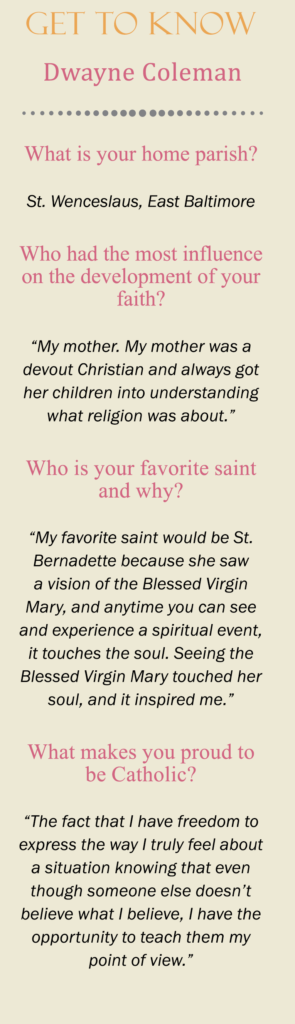
East Baltimore man dedicated to parish, food bank

Dwayne Coleman rarely sits still.

Despite some serious health issues, he can be found watering flowers, painting walls, staining floors, changing lightbulbs – anything to help keep St. Wenceslaus in Baltimore in good shape.

“I’m a jack-of-all-trades. There’s hardly anything here that I don’t dabble in,” said Coleman, who also serves as sacristan. “You see a need, you fill the need.”

Coleman spends his Tuesdays and Thursdays helping out at the parish, which regularly sees a steady crowd of 100 at its 9 a.m. Sunday Mass.

“One of the things that amazes me about St. Wenceslaus is how dedicated the parishioners are,” said Conventual Franciscan Father Timothy Dore, pastor. “(Coleman) epitomizes that attitude of a lot of our parishioners – that tremendous dedication.”

A native east Baltimorean, Coleman attended the parish and elementary school at St. Katharine of Siena, which was less than a mile from St. Wenceslaus. He remained a faithful parishioner until St. Katharine closed in 1986 and the parishes merged.

“I’ve been in church all my life,” said Coleman, who then continued as a dedicated member of St. Wenceslaus.

A former crane operator at the old Armco Steel plant, Coleman likes to put his spare time to good use volunteering in various ministries. One is the parish’s food bank, where Coleman saw a need and again was ready to lend his aid.

“The need was great, but the workers were few,” said Coleman, who describes himself as the “muscle” and “ladder” of the mostly female food pantry volunteers.

In the immediate area surrounding St. Wenceslaus, there are few grocery stores, and even fewer opportunities to get fresh foods. Coleman, a recent recipient of the Mother Lange Leadership Award, himself relies on public transportation, and noted that getting groceries to and from a store is difficult.

“If you look around the city, you see so many people that are not necessarily homeless, but food deprived,” Coleman said. “In the heart of the city, we live in a food desert.”

Volunteering at the food pantry, he said, allows him to aid in alleviating that burden.

At Thanksgiving and Christmas, the pantry usually looks like it is bursting at the seams, Coleman said, but a few weeks later, the supplies will dwindle.

Alicia Champlin, a parishioner of St. Wenceslaus and the volunteer director of the food bank, said she never turns away donations – whether they are of food, money or time.

When she took over the position nearly two years ago, the food pantry was open every weekday. Due to a lack of volunteers, the hours were reduced to the Wednesday and Thursday of the second and fourth weeks of the month. During the summer, when school is out and children no longer are receiving meals through school programs, Champlin opens every day of the week.

The food bank partners with the Maryland Food Bank and receives supplies via The Emergency Food Assistance Program (TEFAP). Champlin has been researching other food banks in the area, and uses the information to help clients.

Since January, Champlin estimated that the food bank has aided more than 100 people, and is seeing an increase as people learn that it has moved down the street.

“We’re letting the area know we’re here,” Champlin said. “We turn away no one.”

Until January, the food pantry, which has been operating for more than 40 years, was located in the basement of the parish center. After the center was sold to a group of Asian physicians, it was moved to a renovated garage.

When the location was announced, Father Dore said that Coleman was in the garage right away, clearing the items that were in storage.

“He was the first one to put his hands on that space,” Father Dore said.

The parish will host a re-dedication of the food pantry, named the Lucielle Fitzgerald Outreach Center, April 21 at 10 a.m.

Email Emily Rosenthal at erosenthal@CatholicReview.org.

Read more Faces of Faith profiles here.


Footage of Cardinal Shehan’s open housing testimony uncovered

Not long after he was loudly booed and heckled while speaking in favor of an open housing bill before the Baltimore City Council in January 1966, Cardinal Lawrence Shehan calmly and confidently read his testimony for a local television audience.

“The dignity of the individual requires that no prohibition be placed against any person with respect to his place of habitation simply because of his race, religion or ancestry,” the white-haired prelate insisted. “The overwhelming persuasive moral argument which calls for statutory relief is one which cannot be postponed or crippled.”

For the first time in more than a half century, digitized footage of the cardinal’s television appearance is now available for viewing on YouTube.

While researching archival material to support Archbishop William E. Lori’s recent pastoral letter on Rev. Dr. Martin Luther King Jr.’s principles of nonviolence, the archdiocesan communications office uncovered the newsreel at archives held at the University of Baltimore.

Originally broadcast by WMAR-TV in Baltimore, the news coverage includes reaction to the cardinal’s testimony from prominent Baltimoreans including then-Baltimore City Council President Thomas D’Alesandro III and then-Baltimore Mayor Theodore R. McKeldin.

The bill, introduced by D’Alesandro, would have banned discrimination in the sale and rental of all city housing. The cardinal was the first speaker at the city council meeting, which was moved from City Hall to the War Memorial Building to accommodate more than 2,000 people who attended.

According to 1966 coverage by what is today known as Catholic News Service, approximately half the audience stood and applauded as the cardinal walked to the microphone. Others booed and jeered him. Police escorted the cardinal from the hall following his testimony, Catholic News Service reported, “as the audience once again divided between jeers and cheers.”

Before the hearing, the cardinal’s brother had received an anonymous call from someone threatening to shoot the cardinal if he testified in support of the bill.

The recently uncovered footage shows D’Alesandro expressing shock at Cardinal Shehan’s treatment.

“It was an act of disrespect to probably the number one Catholic spokesman in this country,” the Democratic City Council president said. “It just exemplified the pent-up emotions that exist in this consideration.  I thought that regardless of the cardinal’s position, which was obviously known, that there would be respect for the office that he held as a prince of the church, the archbishop of Baltimore and cardinal.”

D’Alesandro, the bill’s sponsor, added that “people are so blinded sometimes by their emotion on this subject that they just throw caution to the wind, and, as a result, we saw what took place last night.”

Mayor McKeldin, a Republican, was similarly shocked.

“We Baltimoreans, of course, are not proud of the hearing held in the War Memorial Building when the beloved Cardinal Shehan of this city was booed by some of the spectators,” he said. “It seems to me that if I were against that bill and had been present and heard the cardinal booed, for no other reason, possibly, I would have voted for it.”

Despite D’Alesandro’s prediction that the cardinal’s testimony would sway the vote in favor of the bill, the council voted down the measure. Fair housing laws would not come to Baltimore until the U. S. Congress banned housing discrimination with passage of the Civil Rights Act of 1968.

For more on the cardinal’s testimony, click here.

Email George Matysek at gmatysek@CatholicReview.org.